




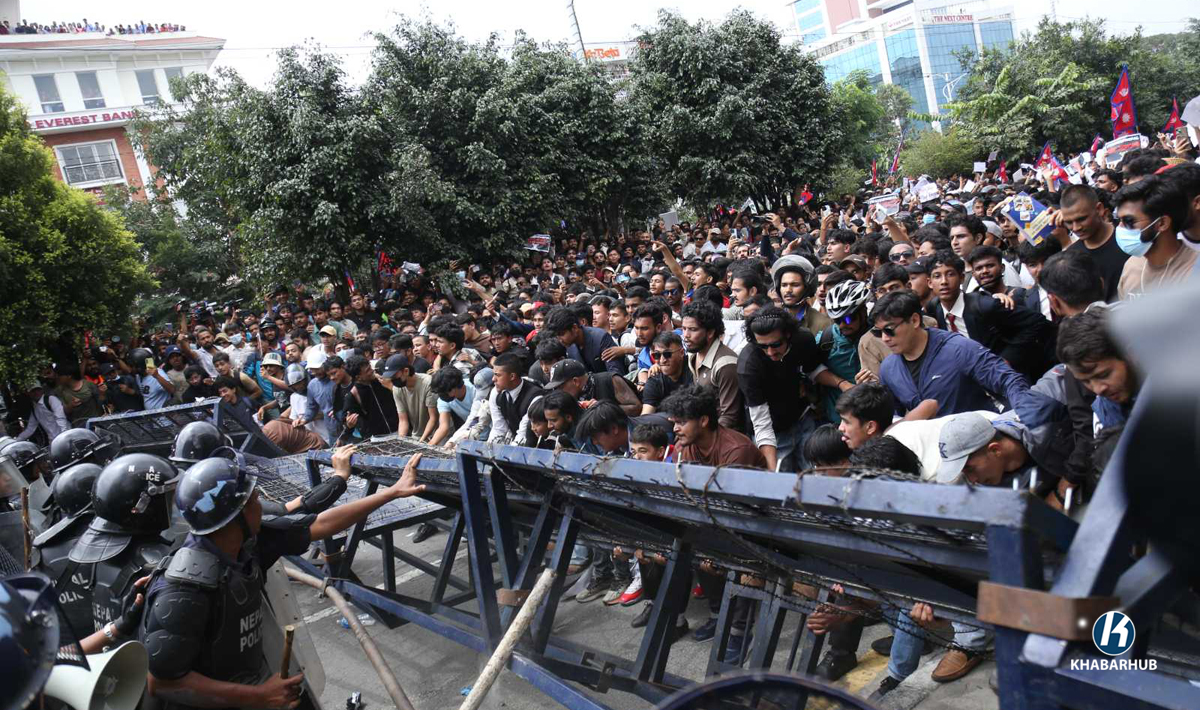
KATHMANDU: Human Rights Watch (HRW), the international human rights watchdog, has concluded that Nepali security forces used “unlawful, unnecessary, and disproportionate” force during the Gen-Z protests held on September 8.
In its newly released study, HRW states that protesters were fired upon repeatedly for nearly three hours on September 8, describing the shooting as indiscriminate. The organization also noted that extensive arson and looting occurred the following day, although many of those involved were not directly linked to the Gen-Z protest movement.
HRW emphasized that the judicial commission formed to investigate the violence must operate transparently and be empowered to investigate and prosecute anyone responsible for violations. It stressed that the commission’s credibility depends on its ability to impartially examine all actions taken on both days of the unrest.
According to HRW, 17 people were killed in the indiscriminate firing that targeted protesters demonstrating against political corruption and social-media restrictions—raising the death toll that day to 22.
The report concludes that police used direct lethal force to disperse demonstrators near the parliament building around 12:30 pm, even though security personnel were not in life-threatening danger. Many victims were shot in the head, chest, and abdomen.
The report cites a retired police officer who confirmed that standard procedures for crowd control and the use of lethal force were not followed. Under UN norms—and Nepali law—lethal weapons may only be used in response to an imminent threat to life, and only after issuing a clear warning. HRW found no evidence that such warnings were given.
Despite knowing that large numbers of young people were mobilizing through social media platforms such as Discord, only one roadblock was placed on the route to the parliament. Protesters who gathered at Maitighar around 9 am grew into a large crowd by 11 am, after which police deployed tear gas, water cannons, and batons when the barricade was breached.
A curfew was announced around 12:30 pm, but HRW reports that neither protesters nor journalists were informed. By 1 pm, the situation had deteriorated sharply. Eyewitnesses said shots were fired at close range without warning. At around 1:45 pm, a teenage girl was shot in the shoulder despite the area being calm at that moment.
According to HRW, 33 protesters detained near Singha Durbar were beaten and threatened by Special Task Force personnel and were released only the following day. Security forces also used force inside hospitals.
Examinations of 47 bodies showed that 35 had gunshot wounds—mostly to the head, neck, chest, and abdomen. Hundreds were treated for injuries.
September 9: Retaliation and escalation
HRW found that the violence that erupted the next day was largely a reaction to the killings on the first day. Many individuals with no connection to the protests joined in arson, beatings, and attacks. The report concludes that security forces “failed to intervene effectively,” allowing government buildings, political leaders’ homes, media offices, schools, and private businesses to be attacked.
Protesters attacked police stations and looted weapons; three police personnel were killed. Civilians were involved in arson in many locations. Top leaders had to be airlifted by military helicopters, and major state institutions—including the Parliament building, the President’s Office, the Supreme Court, and Singha Durbar—were set on fire. Thousands of prisoners escaped amid the chaos.
Eyewitnesses described targeted arson and assaults across multiple sites, questioning why security forces were largely absent on the second day.
HRW notes that this absence prevented protection of both people and property. Several analysts and eyewitnesses told HRW that political groups and infiltrators may also have played a role.
HRW concluded that the violence involved “serious human rights violations.” Deputy Asia Director Meenakshi Ganguly said, “Those responsible—whether security personnel or political actors—must be held accountable. The government must ensure that no one who broke the law is shielded.”
Meanwhile, HRW has urged the commission of inquiry to investigate the actions of security forces, possible infiltration, and all other criminal acts. As of two weeks ago, police had arrested 423 people for involvement in the two-day Gen-Z protests, but HRW questioned why no action had been taken against officers who fired on crowds the previous day.
The report also highlights Nepal’s long-standing failure to prosecute past human rights violations—from peaceful protests to the civil conflict—warning that such impunity paved the way for the recent violence. “Ending the culture of hidden investigations and delayed prosecutions is essential,” Ganguly said.
HRW linked the protests to broader civil-rights concerns, including corruption and the lack of dignified living conditions, and said the government led by Prime Minister Sushila Karki must address these systemic issues.
According to HRW, it interviewed 52 eyewitnesses, victims, journalists, medical workers, security personnel, and political leaders. It reviewed social-media posts, photographs, and videos shared with researchers, and conducted field visits to hospitals and sites of protests and arson. The research primarily focused on Kathmandu.
Human Rights Watch, founded in 1978, is an international non-governmental organization that monitors human rights abuses, violence, war crimes, and related issues. Its Kathmandu-based investigation followed the Gen-Z movement protests.



Comment