




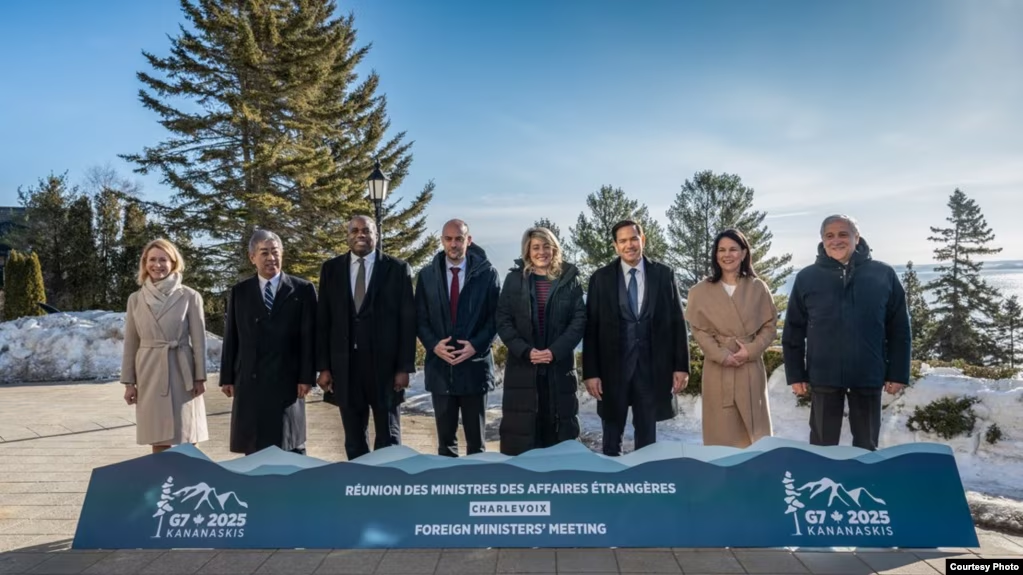
TORONTO: Curbing China’s dominance over critical minerals will be the main focus of a G7 energy ministers meeting in Canada on Thursday, as industrialized democracies seek more reliable access to the resources that power advanced technologies.
The Group of Seven, including the United States under President Donald Trump, has raised concerns over China’s control of minerals essential for products ranging from solar panels to precision missiles. Earlier, Trump signed a rare earths deal with China, which is valid for one year and will be renegotiated annually.
At a June summit in western Canada, G7 leaders launched a “Critical Minerals Action Plan,” aiming to diversify supply chains to protect shared national and economic security interests. The upcoming two-day Toronto meeting provides “a major opportunity” to advance this plan, according to Tae-Yoon Kim, head of the International Energy Agency’s critical minerals division.
“The high concentration of critical minerals refining in a single country creates economic and national security risks,” Kim said, urging the G7 to start shifting market power and avoid a supply shock similar to the oil crisis of the 1970s.
A key concern is that China does not fully adhere to market principles. While several countries have mineral reserves, China dominates processing and refining, particularly for rare earths used in specialized magnets for high-tech products. Beijing’s control over the supply chain allows it to build stockpiles and manipulate global markets.
Canada’s Energy Ministry said the Toronto meeting will include announcements aimed at countering such market manipulation. “For decades, we’ve been facing a competitor who consistently distorted free markets, used industrial subsidies, created overcapacity, and undermined fair trade,” said Abigail Hunter, executive director of the Washington-based Center for Critical Minerals Strategy.
Canada’s Energy Minister Tim Hodgson called the meeting a “hinge moment.” According to his spokesman, Gregory Frame, Canada will announce the first outcomes of a new alliance to ensure minerals for future industries can be mined, refined, and produced by countries sharing democratic values.
Within the G7 – Britain, Canada, France, Germany, Italy, Japan, and the United States – energy policy priorities vary, and Trump’s protectionist trade policies may challenge unified action. However, G7 ministers are aligned on ensuring “security of supply” as China tightens rare earth export controls.
Hunter highlighted the need for traceability, tracking raw materials from mine to refinement, and ensuring suppliers comply with global rules. She noted that “opaque” Chinese-controlled companies dominate much of the supply chain, which the G7 should aim to “box out of the market” through transparency and policy reforms.
“The window to fix this is very small, but still open,” Hunter said. “I’m an optimist because this sector is very painful at times.”






Comment