




When revolutions erupt, they promise renewal. When blood is spilled and the streets roar, hope swells. But too often, those flames cool only to reveal the same hands once again gripping the levers of power. The Gen Z Uprising was meant to break that cycle. Instead, it now seems to have opened another chapter of betrayal — and Sushila Karki’s interim government stands at the heart of that betrayal.
On September 8 and 9, Nepal witnessed something rare and raw: thousands of young Nepalis flooding the streets, demanding not just a change of government but a transformation of a system that had failed them for decades. This was not a spontaneous outburst; it was a political rebirth — the culmination of long-brewing anger against corruption, institutional collapse, and the betrayal of public trust.
Seventy-six young people were martyred. Countless others were injured. Government buildings and historic monuments were reduced to ashes. Their sacrifice demanded systemic change — not another round of political theatre.
But instead of embracing that change, the chaos was seized upon. Old political actors came together to form what they called an “interim government,” and Sushila Karki emerged at its head. In her national address, she declared that “the demands of the uprising must be addressed through elections.” On the surface, that sounded democratic. In reality, it betrayed a profound misunderstanding — or perhaps a deliberate distortion — of what the uprising represented.
The Gen Z Movement was not about elections. It was about structural transformation: freedom of expression, a directly elected executive, and transparency through institutional reform.
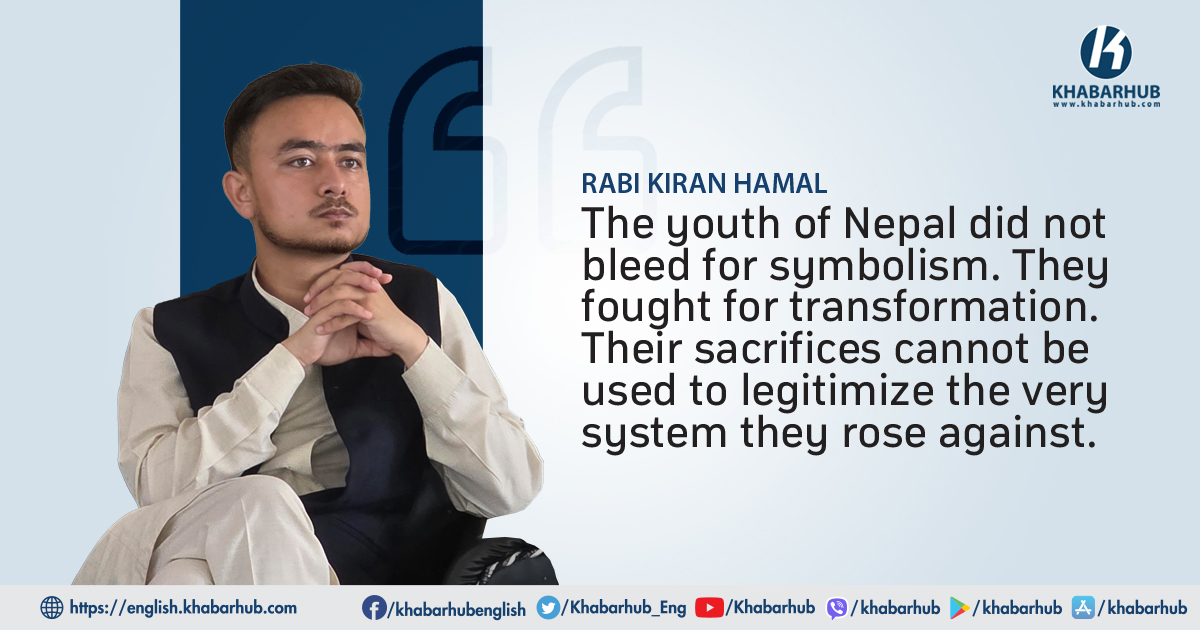
The youth of Nepal did not bleed for symbolism. They fought for transformation. Their sacrifices cannot be used to legitimize the very system they rose against. The truth is clear now: Sushila Karki’s government is not reform — it is betrayal. And betrayal must never be rewarded with silence.
On paper, one of those demands — lifting restrictions on social media — was partially met. But the other two have disappeared into the fog of political self-interest. Instead of turning pain into policy, the interim government has turned the movement’s moral authority into performance. The push for midterm elections has become a diversion — a carefully staged spectacle meant to distract from real change.
To question the legitimacy of this government is not rhetoric; it is an obligation. The timing and manner of Sushila Karki’s ascent to power did not reflect democratic renewal, nor did it carry the consent of those who fought and bled in the streets. It bears all the marks of a power grab — a coup in disguise.
When power is seized amid blood and chaos, governance becomes indistinguishable from opportunism. Elections held under the same broken structure will not deliver transformation; they will only recycle dysfunction. Nepal has seen more than thirty governments in three decades, and yet the same institutions that enabled corruption and instability remain untouched. Pushing for midterm elections without addressing these structural flaws is not a step forward — it is a deliberate attempt to keep the nation trapped in the same loop of crisis.
The moral dimension of this betrayal is impossible to ignore. Those who ordered the bullets that killed young protesters now walk freely through the halls of power. They are being invited for tea at Baluwatar, casually reintegrated into the state’s political stage. This is not reconciliation — it is mockery. It insults the dead, wounds the living, and undermines the very idea of justice.
Sushila Karki’s government presents itself as reformist, but reform that does not challenge the architecture of power is not reform — it is deception. When a government neutralizes the demands of a revolution and repackages them as electoral slogans, it strips the movement of meaning. It turns justice into performance and hope into propaganda.
The stakes are existential for Nepal’s young generation. If their sacrifice is allowed to be trivialized, if their demands are diluted into campaign slogans, then their courage will have been wasted. Worse still, it will breed another generation of cynicism — one that no longer believes change is possible. And when that happens, revolutions don’t just die; nations do.
Nepal must not let that happen. It must demand accountability for the violence inflicted upon its youth. It must insist on deep institutional reform — especially a directly elected executive and a transparent, functional system of governance — before any election is held. And it must reject any façade of legitimacy built upon the ruins of a people’s movement.
The youth of Nepal did not bleed for symbolism. They fought for transformation. Their sacrifices cannot be used to legitimize the very system they rose against. The truth is clear now: Sushila Karki’s government is not reform — it is betrayal. And betrayal must never be rewarded with silence.





Comment