




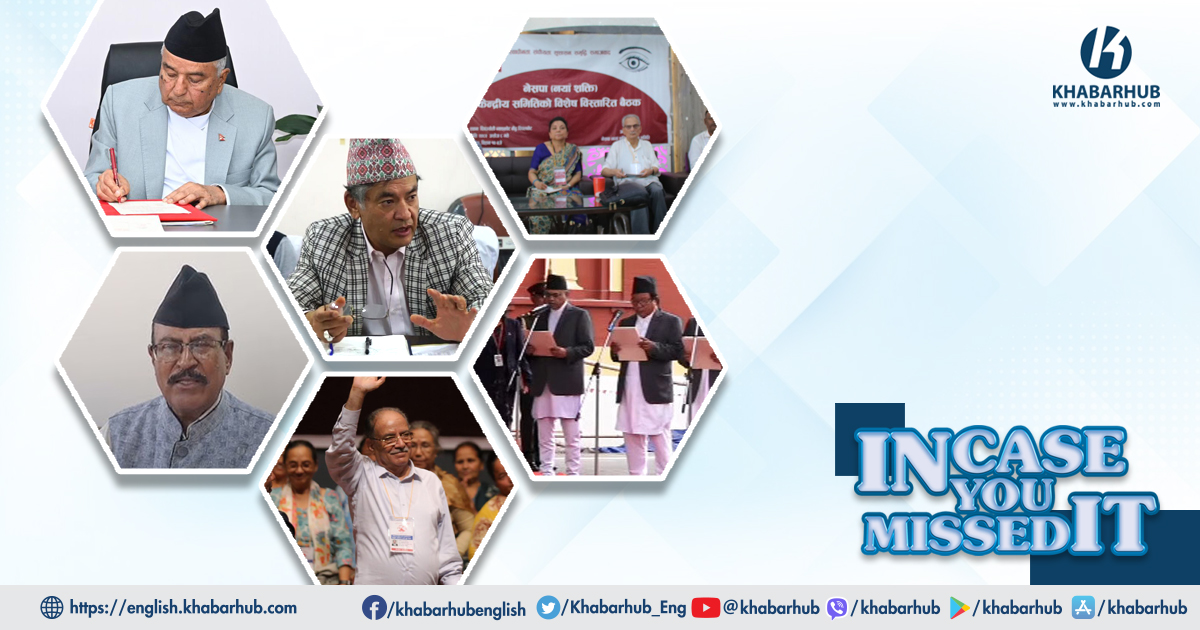
KATHMANDU: Last week marked a defining period in Nepal’s evolving political and administrative environment, reflecting a deep undercurrent of institutional reckoning, recalibration of leadership, and growing public accountability.
The confluence of strategic cabinet reshuffles, accountability measures following the Gen-Z movement, internal restructuring within political parties, and financial austerity signals a government simultaneously navigating legacy burdens and future ambitions. This multifaceted shift—spanning governance, policy, and political maneuvering—may well set the tone for how Nepal will approach its upcoming elections, public-sector transparency, and long-term stability.
Cabinet reshuffle: Merit over politics?
The swearing-in of four new ministers to the interim cabinet led by Prime Minister Sushila Karki is perhaps the most visible sign of a pivot toward issue-oriented governance. Rather than conventional party-line appointments, the inclusion of technocrats, innovators, and non-career politicians sends a calculated message: this interim government is attempting to restore faith in the state’s ability to respond to public expectations, especially post-Gen-Z upheaval.
The appointment of former Supreme Court Justice Anil Kumar Sinha as Minister for Industry and Law points to a renewed focus on judicial integrity and legal reform. Similarly, Mahabir Pun, a celebrated innovator and a fierce advocate of rural technological empowerment, taking over the Ministry of Education, Science, and Technology is symbolically significant. It reflects the administration’s intention to shift focus from bureaucracy to innovation—something desperately needed in Nepal’s education sector plagued by policy stagnation and brain drain.
Madan Pariyar and Jagdish Kharel, appointed to head Agriculture and Communication respectively, bring domain expertise and field-level insight. However, the most politically nuanced move was the exclusion of Dr. Sangita Mishra from the Health Ministry appointment. While her nomination was withdrawn due to controversies linked to her bureaucratic past, it’s important to note that the government’s sensitivity to Gen-Z pressure played a key role in this reversal. This demonstrates how civil society, particularly the youth, is increasingly influencing executive decisions—forcing the government to factor public optics and accountability into appointments.
Accountability and the Gen-Z reckoning
Perhaps the most structurally important decision of the week was the formation of a three-member judicial inquiry commission to investigate alleged suppression during the Gen-Z protests. Headed by retired judge Gauri Bahadur Karki, and including a former police AIG and a practicing advocate, the composition appears balanced on paper. However, critics might argue that commissions in Nepal have historically struggled with implementation of their findings. What distinguishes this commission is the context: it comes amidst widespread youth mobilization, increasing international scrutiny, and heightened public demand for justice. Its success or failure will be a litmus test for Nepal’s institutional maturity in the face of popular dissent.
The removal of Home Secretary Gokarnamani Duwadi, who was perceived to be directly involved in the state’s heavy-handed response to the protests, reinforces the administration’s attempt to show that impunity will not be tolerated. Yet, his transfer to the National Planning Commission rather than outright dismissal reflects the government’s balancing act between accountability and political preservation. Such reassignments often serve to quiet criticism without fully dismantling entrenched administrative networks.
Structural shakeups: Electricity, party politics, and policy reform
Another major reshuffle came with the removal of Hitendra Dev Shakya from the top post at the Nepal Electricity Authority. The utility had been under scrutiny for alleged inefficiencies and policy bottlenecks, particularly related to energy trading and project delays. Manoj Silwal’s elevation as Managing Director might offer a reset moment for the NEA, though it remains to be seen whether personnel changes translate into meaningful reform.
On the political front, the dissolution of the Maoist Center’s central committee marks a significant moment in Nepal’s party politics. Party chair Pushpa Kamal Dahal’s proposal to hold a special convention in December signals a strategic recalibration ahead of the elections. It reflects internal acknowledgment that the party’s traditional rhetoric no longer resonates with younger voters. By promising organizational restructuring and pledging support to the interim government for the upcoming elections, the Maoists are attempting to rebrand themselves in an increasingly fragmented political space.
Equally symbolic is former Prime Minister Baburam Bhattarai’s resignation from the Nepal Samajbadi Party (Naya Shakti). As one of the architects of Nepal’s republican shift, Bhattarai’s exit signals the generational fatigue within old-guard leadership circles. His departure creates space for new leaders like Durga Sob and Sonam Singh Syangtang, indicating that the political center-left is in the midst of ideological and structural reinvention.
Economic austerity and governance discipline
In a marked departure from populist trends, the government announced a ban on the purchase of luxury goods and distribution of non-essential subsidies like gas, health insurance fees, and sarees. The announcement by Finance Minister Rameshwor Khanal is tied directly to efforts to curtail fiscal waste, manage election-related expenses, and reallocate resources toward public infrastructure and essential services. This decision reflects a growing recognition of Nepal’s tight fiscal space and the need for discipline in public expenditure.
Yet, enforcing these restrictions will be the real challenge. Without a robust monitoring mechanism, past attempts at cost-cutting have often remained cosmetic. Still, the move is notable for its policy signaling value—especially when public trust in government spending is fragile, and demands for transparency are escalating.
Rural connectivity and service delivery
In a more service-oriented highlight, Nepal Airlines’ resumption of flights to Rara Airport after four months is a welcome development for remote districts like Mugu. With tourism revival and emergency transport tied closely to air connectivity in Nepal’s mountainous regions, this move goes beyond convenience. It highlights the role of state-owned enterprises in public service delivery, especially where the private sector lacks commercial incentives to operate.
While the return of flights may appear routine, it carries deeper political implications. It shows that even in interim phases, governments can act on the margins to restore credibility through localized, practical interventions.
Conclusion: A nation at a crossroads
Altogether, last week’s developments paint the picture of a country at a crossroads between political inertia and institutional rejuvenation. The Karki administration, though temporary, is operating with surprising clarity of purpose—bringing in reformists, responding to public pressure, and initiating course corrections across governance, party politics, and fiscal policy. At the same time, these moves also expose the fragility of Nepal’s bureaucratic culture, where transfers substitute for accountability and long-standing political figures dominate decision-making.
With elections approaching and a restless, politically literate youth increasingly dictating the terms of engagement, Nepal stands poised for a generational and systemic shift. Whether this week’s actions are part of a broader reform trajectory or merely reactive remains to be seen. But for now, the signs of change—tentative as they may be—are unmistakable.





Comment