




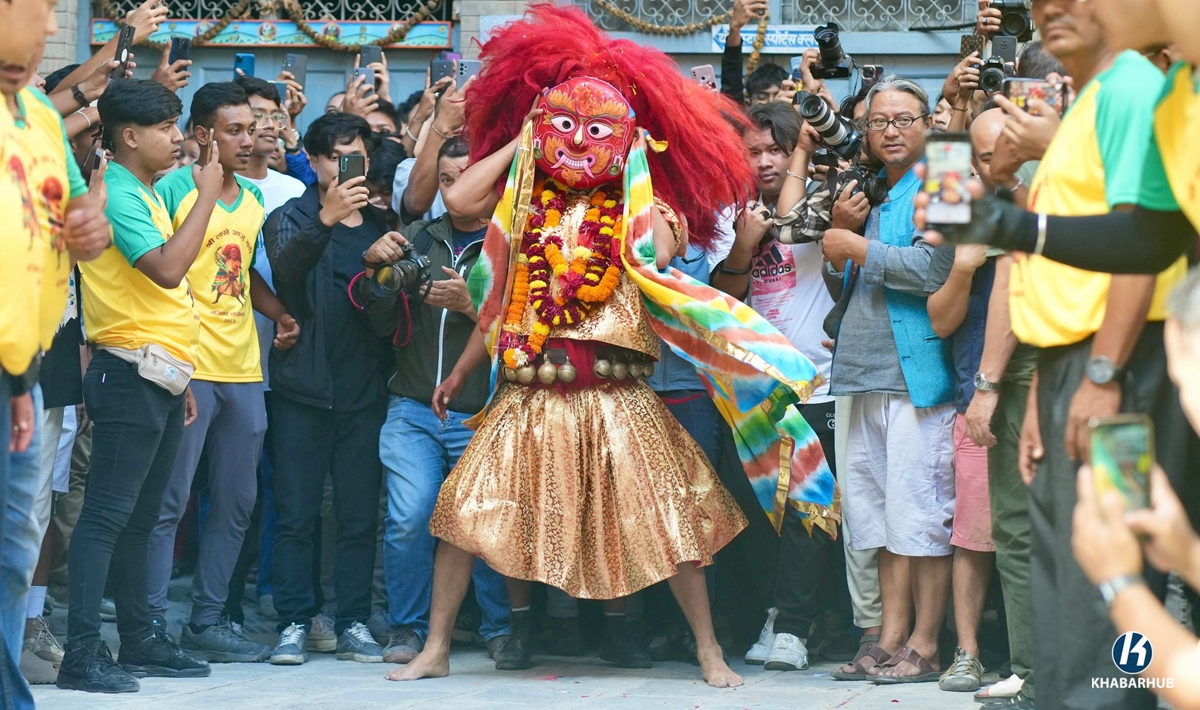
KATHMANDU: On Thursday evening in Kathmandu, as drums thundered and cymbals clashed, a towering red-faced figure with wild hair bursts into a narrow alley. Children squeal in delight, elders fold their hands in reverence, and tourists scramble for their cameras. This is the Majipa Lakhe, the fearsome yet beloved demon of Indra Jatra, whose presence is as old as the Valley’s collective memory.
To outsiders, he may look like a dancer in a frightening mask. But to Kathmandu’s residents, the Lakhe is far more: a protector of children, a keeper of history, and a cultural symbol that continues to breathe life into the city’s traditions.
Legends say the Lakhe was once a flesh-eating demon who fell in love with a young woman from Majipa, a neighborhood of Kathmandu. His love drove him to take human form and enter the city. When his true identity was discovered, he was brought before the king.
The king could have punished him, but instead offered a pact: if the Lakhe promised to defend the city’s children from other demons and to appear every year in Indra Jatra, he would be allowed to stay. The Lakhe agreed.
When asked what he would eat if not children, he answered with a grin, “Meat, fish, and eggs.” In Newar, la means meat and khe means egg—hence, the name Lakhe.
That day, the demon was reborn as a guardian, bound to the city through love, compromise, and duty.
The demon-slayer of Indra Jatra
Another tale ties the Lakhe to King Sawan Bhaku’s cannibal children, who once terrorized Kathmandu. It was the Lakhe, urged by gods Akash Bhairav and Hanuman, who chased them out. Yet the legend says they return each year during Indra Jatra to reclaim their power, and each year, the Lakhe rises again to drive them away. His dance is not just a performance but a ritual reenactment of victory and protection.
“The Lakhe reminds us that even demons can become guardians when they choose to protect the vulnerable,” says cultural historian Ramesh Shrestha. “He is a mirror of Kathmandu’s own story—chaotic, resilient, and deeply communal.”
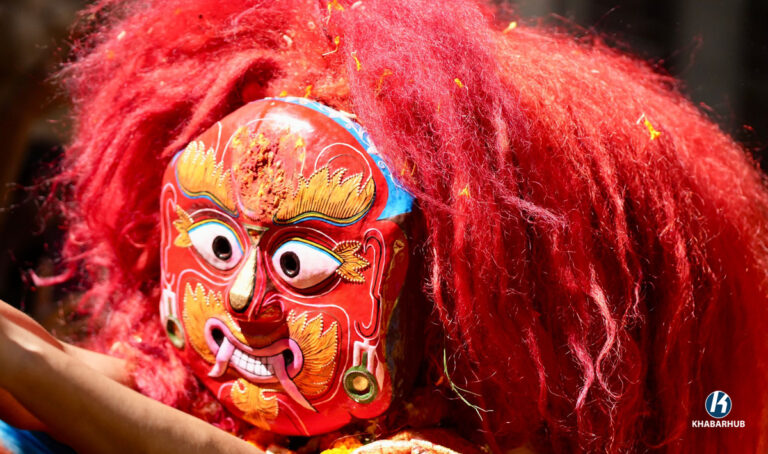
The Lakhe is also remembered as a family man in folklore, with a wife named Lasi and a daughter named Lakhpati. These tales soften his terrifying image, connecting him to family life and anchoring him within society. For many, this makes him less of a monster and more of a complex figure—one who embodies both danger and protection.
Dance that brings the past alive
At the heart of the Lakhe’s identity is his dance. During Indra Jatra, he storms through Kathmandu’s courtyards and alleys, stomping to the heavy beat of dhime drums. His movements are wild yet controlled, terrifying yet mesmerizing. To watch him is to witness a thousand-year-old memory spring to life: the protection of children, the expulsion of evil, and the celebration of community.
“The moment the Lakhe dances past you, you feel connected to the Valley’s soul,” says Sunita Maharjan, a local resident. “It’s not just entertainment—it’s history moving in front of your eyes.”
Despite Kathmandu’s rapid urbanization and the pressures of globalization, the Majipa Lakhe tradition endures. Today, he is as much a tourist attraction as a local guardian, drawing visitors from across the world during Indra Jatra. Yet for residents, his role remains sacred: he is the living reminder of a pact that protects the city’s children and binds the community together.
A living legacy
When the Lakhe dances through the alleys, he is not just performing. He is keeping a promise made centuries ago, to guard the weak, to unite the community, and to carry forward Kathmandu’s cultural memory.
For the people of the Valley, the Majipa Lakhe is not a myth locked in the past. He is here, alive, and still keeping watch.






Comment