




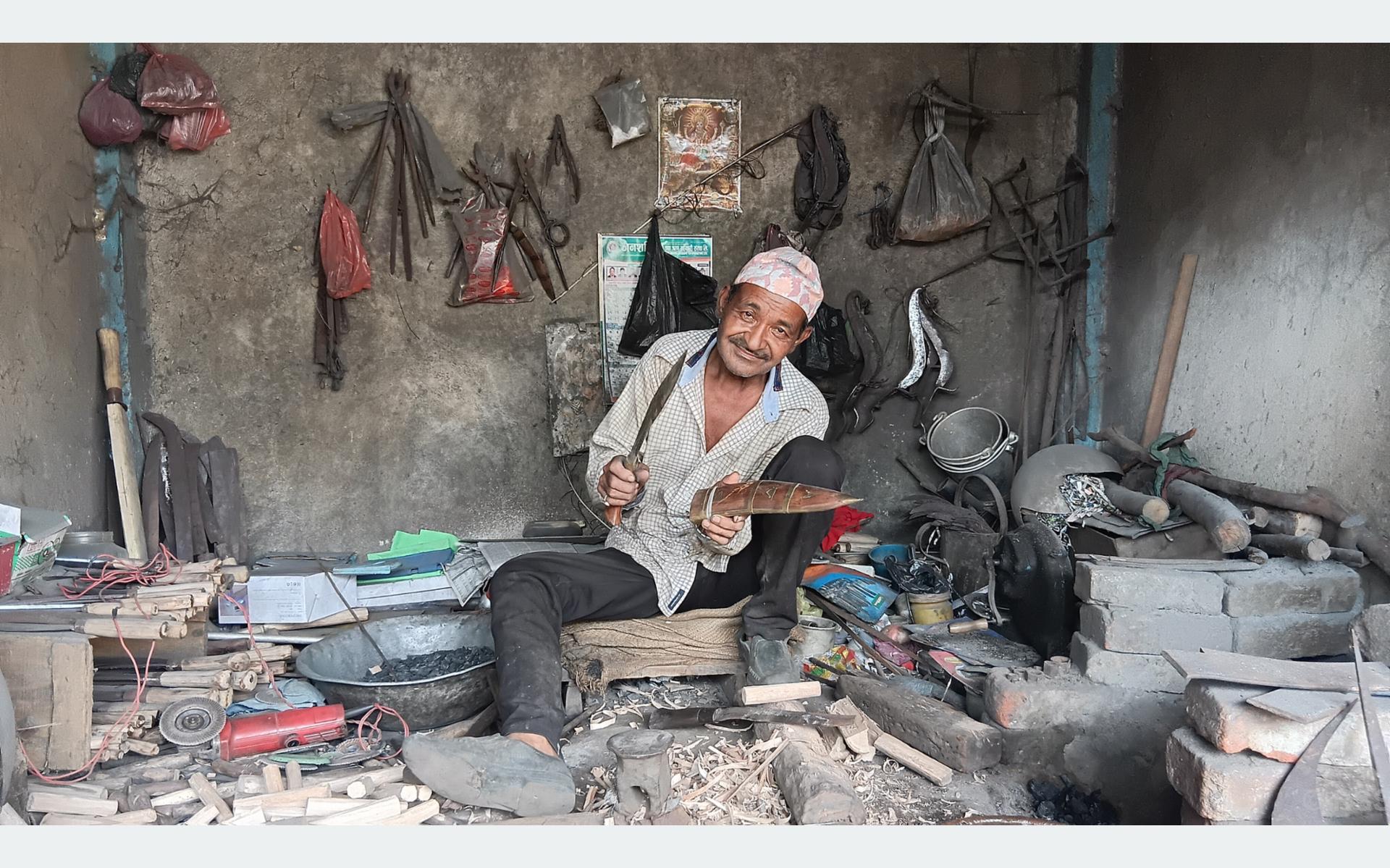
JHAPA: In the early hours of the morning at Goldhap Bazaar, Haldibari Rural Municipality in Jhapa, the marketplace slowly stirs to life.
Amid the opening shutters and rising sun, the rhythmic clang of metal on metal echoes from a small corner shop. Inside, 70-year-old Ram Kumar Baraili is hard at work, hammering iron in his modest blacksmith workshop.
Despite his aging frame, Baraili’s face still carries a youthful glow, and his eyes sparkle with purpose. That spark comes from a lifetime bonded to the aran (anvil), hammer, and iron—tools that have become more than instruments of labor; they are companions of his soul.
Born in Pakhribas, Dhankuta, Baraili was raised surrounded by the sights and sounds of the traditional iron craft. He moved to the then-Goldhap Bazaar in Jhapa around 2034 B.S. (circa 1977 A.D.), where he established a workshop named Durga Iron Repairing Center. There, he began crafting essential household tools like hammers, axes, sickles, and other iron items.
“During rice planting season, farmers would come asking for sickles. During corn harvest, they’d want stoves made. If someone broke a knife, they came here for repairs,” Baraili recalls.
Back then, work was abundant. Now, at 70, most of his peers have either retired or can no longer work due to age. Still, Baraili opens his shop every morning, cleans the workspace, heats iron, and shapes it by hand as he always has. He lives in Goldhap with his wife.
His two daughters are married and settled. One son serves in the Indian Army, the other works abroad in Dubai. Though his children reside in Birtamod, Baraili remains devoted to his humble workshop.
But alongside his dedication grows a deep concern—that this age-old skill will disappear with him. “No one wants to pass this on to their children. Everyone dreams of the city or going abroad. This craft will end with me,” he laments.
Baraili’s story is not unique. Across Nepal, traditional artisans—blacksmiths, carpenters, craftsmen—are being displaced by modern tools, mass production, and changing economic aspirations. Yet, people like Baraili remain powerful reminders of the cultural heritage we risk losing.
Having spent a lifetime preserving his ancestral craft, he supported his family and served his community. But now, the familiar clang of metal in his aran is fading, slowly but surely. “I lived with this small worshop, and I will die here too. But I wish this skill could survive,” Baraili says.
His hope is not just personal—it poses a challenge to society and the state: Will we preserve this original heritage or let it vanish with artisans like Ram Kumar Baraili?





Comment