




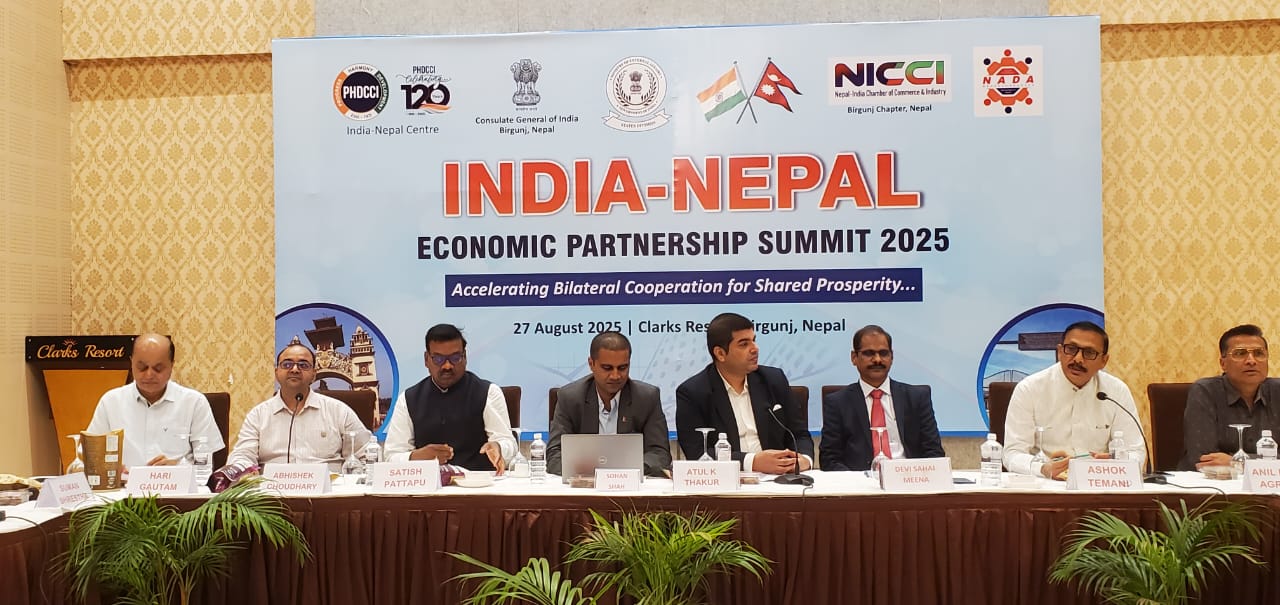
BIRGUNJ: To accelerate bilateral economic cooperation for shared prosperity, the PHDCCI India-Nepal Centre, in association with the Consulate General of India, Birgunj (Nepal), the Nepal-India Chamber of Commerce & Industry (NICCI) Birgunj Chapter, and the NADA Automobile Association of Nepal, Madhesh Pradesh, organised the “India-Nepal Economic Partnership Summit 2025” on 27 August in Birgunj, Nepal.
The Summit witnessed the significant presence of industry leaders from both India and Nepal, along with office bearers of NICCI, BiCCI, FNCCI, NADA, and chambers from the neighbouring Indian state of Bihar.
The Consul General of India, Birgunj (Nepal), and the Vice Chairman of the Madhesh Province Policy and Planning Commission, Government of Madhesh Province, Nepal, were among the key speakers.
Chief Guest and Keynote Speaker, Devi Sahai Meena, Consul General of India, Birgunj (Nepal), presented a brief overview of India-Nepal bilateral economic and trade relations.
He emphasized that India has made remarkable progress in various sectors of the economy and that Nepali businesses could greatly benefit by partnering with Indian enterprises. He noted that the “India-Nepal Economic Partnership Summit 2025” is a significant initiative aimed at enhancing bilateral economic cooperation and strengthening the base of Nepali businesses in India, particularly in the bordering Indian states.
This effort, he added, would help improve the overall Ease of Doing Business between the two friendly nations. He reaffirmed that India and Nepal share strong economic ties and that the two countries would continue to enhance this foundation through improved connectivity and trade transit facilities.
Dr. Sohan Prasad Sah, Vice Chairman of the Madhesh Province Policy and Planning Commission, Government of Madhesh Province, Nepal, remarked that India’s serious consideration of Nepal’s investment aspirations is essential for a real economic turnaround in the Nepalese economy.
He underlined that the Madhesh Pradesh government is committed to improving economic outcomes in key sectors such as tourism, food processing, and renewable energy.
The Commission, he added, is adopting a data-centric, policy-making approach to support informed decision-making for Madhesh Pradesh’s economic development, including efforts to boost cross-border trade with India.
Abhishek Choudhary, President of the NICCI Birgunj Chapter, highlighted the deeper historical, cultural, and economic connections between India and Nepal.
He emphasized that their economies are interlinked in such a way that when one grows, the other benefits. Choudhary called for a broader focus beyond trade balances, encouraging both countries to pursue win-win opportunities in diverse sectors including manufacturing, agriculture, tourism, energy, and digital trade.
Atul K. Thakur, Secretary of the India-Nepal Centre at PHDCCI, opened the Summit by emphasizing the substantial progress achieved in recent years across key areas of bilateral cooperation, particularly in connectivity—physical, digital, energy, and people-to-people linkages.
He highlighted the ongoing implementation of important infrastructure projects such as roads, bridges, cross-border railways, Integrated Check Posts (ICPs), and petroleum pipelines. Thakur noted that recent high-level visits have resulted in key milestones, including the completion of the Integrated Check Post at the Raxaul–Birgunj border, and ongoing progress at ICPs in Nepalgunj, Bhairahawa, and Dodhara-Chandani.
Additionally, he spoke about the inauguration of a freight train service between India and Nepal, as well as the development of railway lines such as Kurtha–Bijalpura and the proposed Raxaul–Kathmandu route.
Further developments include the expansion of the Motihari–Amlekhgunj pipeline (Phase-II), and the construction of new petroleum pipelines from Siliguri to Jhapa and Amlekhgunj to Chitwan, demonstrating deepening energy infrastructure cooperation.
In the power sector, Thakur cited the finalisation of the Long-Term Power Trade Agreement, along with the trilateral power trade arrangement between India, Nepal, and Bangladesh. He also pointed out new Indian-led hydropower projects in Nepal, including the 480 MW Phukot Karnali and the 669 MW Lower Arun.
In the domain of digital financial connectivity, Thakur noted that since March 2024, Nepal has started accepting UPI payments via interoperability with FonePay QR, marking a significant development in digital commerce between the two countries.
Further, he emphasized the ongoing coordination between the National Payments Corporation of India (NPCI) and Nepal Clearing House Limited (NCHL), which is expected to significantly ease cross-border digital transactions, thereby opening a new chapter in the financial technology space between India and Nepal.




Comment