




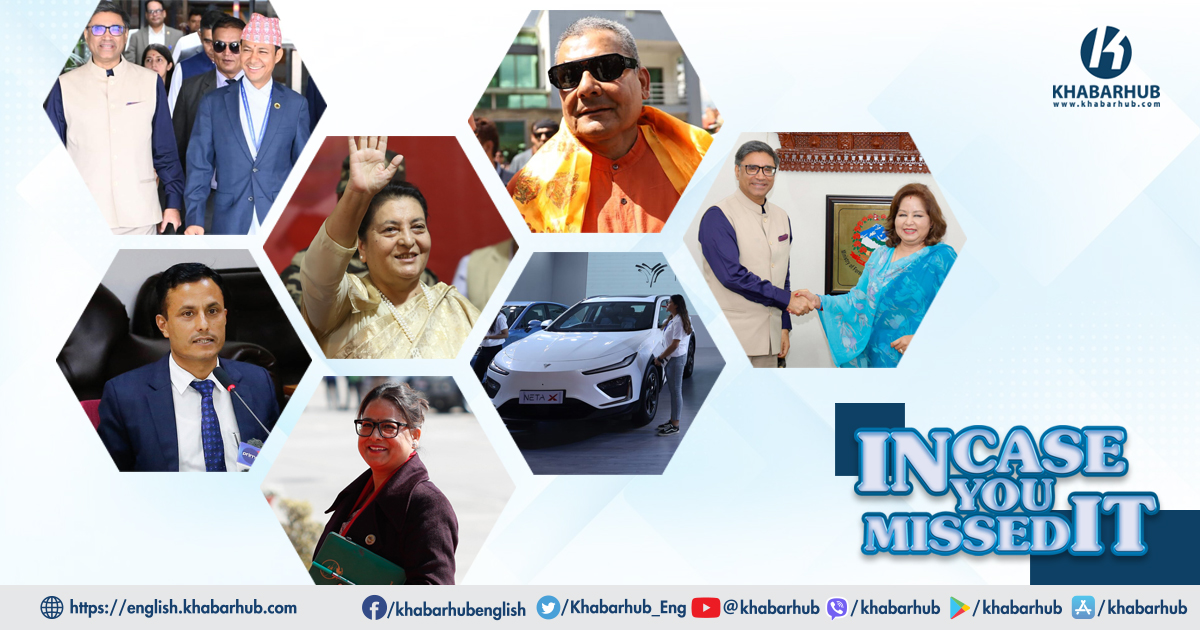
KATHMANDU: The past week in Nepal was marked by a flurry of high-profile diplomatic engagements, evolving internal party dynamics, judicial developments with historical implications, and new policy enforcement measures. Together, these events underscore the country’s fragile balancing act — both internationally, between competing regional powers, and domestically, among fractious political forces and underperforming institutions.
RSP suspends leader over fake certificate charges
The Rastriya Swatantra Party (RSP) suspended Hari Prasad Kandel after his arrest for allegedly using fake academic certificates from Nepal and India. Kandel, who held a key training role in Bagmati Province, was suspended to allow an unhindered investigation. Once a respected educator and principal, Kandel was arrested by Rupandehi police for involvement in document forgery. The party stated that further action will follow if he is found guilty.
PM Oli’s India Invitation: A Calculated Diplomatic Gesture in a Delicate Time
The formal invitation extended to Prime Minister KP Sharma Oli by Indian Foreign Secretary Vikram Misri — on behalf of PM Narendra Modi — marks an important diplomatic overture as Nepal and India seek to reset ties amid several contentious issues. That this invitation comes ahead of an anticipated meeting in Bodh Gaya, a culturally symbolic location, is no coincidence. The Modi government is deploying soft power rooted in shared heritage (Buddhism, pilgrimage) to ease geopolitical tensions.
However, the absence of a confirmed date for the visit reflects careful maneuvering by both governments. Nepal remains cautious following recent events such as the India–China agreement to conduct trade through Lipulekh — a territory Nepal claims as its own. India, for its part, is balancing Nepal’s sensitivities while seeking to prevent Chinese influence from growing unchecked in its traditional sphere of influence.
Misri’s meetings with PM Oli, Foreign Minister Arzu Rana, and other officials emphasized areas of cooperation like trade, infrastructure, and water resources. Yet behind the friendly language, it is evident that bilateral irritants persist. Nepal’s expectations for additional air routes, fewer trade barriers, and progress on stalled projects such as the Pancheshwar Multipurpose Project remain unmet. The tone of the discussions suggests both countries are interested in stabilizing the relationship, but substantial breakthroughs are yet to come.
Foreign Minister Arzu Rana’s Assertiveness Signals a More Demanding Nepal
Foreign Minister Arzu Rana’s direct requests to the Indian side during Misri’s visit were significant. By raising concerns over non-tariff trade barriers, inadequate air connectivity, and delays in infrastructure projects, Rana articulated what many in Nepal’s private sector and civil society have long felt — that India’s promises do not always translate into timely execution. Her call to address difficulties around exporting plywood and steel, and the push for direct flights from cities like Nepalgunj to Delhi, highlight Nepal’s desire to diversify its economic gateways and reduce over-dependence on singular points of connectivity. This indicates a shift in tone from Nepal’s foreign policy — from passive reception of aid and goodwill to assertive diplomacy driven by practical national interests.
Immigration Crackdown: Reflective of a Reactive Bureaucracy
The Department of Immigration’s aggressive directives to curb irregularities in foreign travel highlight a reactive and overstretched bureaucracy grappling with rising abuses in the labor migration and tourism sectors. The focus on overbooking, fraudulent brokers, and illegal currency transactions is timely but also overdue. The directives acknowledge serious issues like travelers being confined in hotels or forced to buy tickets under duress. However, the implementation of these guidelines — including local-level monitoring and international embassy reporting — will test the administrative machinery’s capacity to coordinate and act swiftly across multiple levels of government. This episode illustrates a deeper concern: Nepal’s migration policies and oversight mechanisms are still largely reactive, often moving only after public pressure or media coverage, rather than functioning as preventive systems.
Internal Turmoil Within the UML: Bidya Bhandari’s Political Comeback?
Former President Bidya Devi Bhandari’s re-entry into active politics — and her open challenge to UML leadership — is reshaping internal dynamics within the party. Her speech in Biratnagar reaffirming her commitment to the UML, despite being excluded from the central committee, is more than symbolic. It hints at a brewing power struggle with KP Oli, especially ahead of potential general elections. While UML tries to downplay her influence, Bhandari’s consistent messaging and long-standing ties to party grassroots make her a potential rallying figure for those disillusioned with Oli’s top-down leadership style. Her assertion that the presidency is a term-bound republican post, not a lifelong detachment from politics, also counters critiques that former presidents should remain apolitical. This could mark the beginning of a more ideological and structural realignment within UML, especially if Oli’s grip weakens.
Royalist Movement in Disarray: Durga Prasai’s Explosive Return
Durga Prasai’s post-release statements following the Tinkune violence not only reignited debates over the royalist movement but also fractured its public image. His direct attacks on RPP Chair Rajendra Lingden, claims of betrayal, and alleged assassination attempts add layers of drama and danger to the royalist discourse. Prasai’s positioning — mixing victimhood with populist threats — reflects a dangerous trend of hyper-personalized politics, where institutional discipline is eroded, and political narratives are driven by charisma and confrontation. His threats to lead a national uprising and hold all leaders accountable further blur the line between activism and extremism.
Judicial Revival of the Gaur Massacre Case: Transitional Justice Takes Center Stage
The Supreme Court’s order to proceed with the Gaur massacre case, implicating JSP leader Upendra Yadav, reopens a violent chapter from Nepal’s transitional period. The killings of 28 Maoist cadres in 2007 were among the most brutal post-conflict incidents, and the judicial revival indicates growing legal appetite to confront unresolved atrocities. This case could become a litmus test for Nepal’s stalled transitional justice mechanisms. While politically sensitive, its resolution will set precedent for how Nepal handles justice, memory, and accountability for past war-era crimes — especially when powerful political actors are involved.
Rabi Lamichhane’s Jail Conditions and Political Optics
The account by Rabi Lamichhane of being kept in solitary-like confinement in Bhairahawa Prison, and his meeting with Prachanda, gives the ongoing cooperative fraud case a political edge. Whether accurate or exaggerated, such claims tap into public discontent around selective justice and prison conditions — issues that could galvanize support for RSP as an anti-establishment force. Lamichhane’s narrative of health deterioration due to lack of sunlight, and his portrayal as a political victim, signal an attempt to shift the public narrative from criminal accountability to persecution.
Lipulekh Deal: A Wake-Up Call for Nepal’s Foreign Policy Establishment
The recent India–China agreement to trade through Lipulekh — an area Nepal claims — has triggered alarm across political lines. The Nepali Congress’s strong objection, voiced by Gagan Thapa in Parliament, shows that foreign policy is once again becoming a space for cross-party consensus and nationalist assertion. The statement was balanced: firm on sovereignty but cautioning against using the issue for short-term political gain. The incident reminds Nepal of the need for proactive diplomacy with both neighbors, rather than reactive statements after deals are signed in its absence.
Political Fragmentation: 26 Parties in Rupandehi By-election
The registration of 26 political parties for the Rupandehi by-election shows either democratic pluralism or disorganized fragmentation. With limited electoral reform and low thresholds for party registration, such overcrowding risks diluting meaningful policy discourse and creating unstable coalition dynamics. This pattern reflects a crisis of representation, where disillusionment with mainstream parties fuels a mushrooming of new entities, many lacking ideological clarity or organizational depth.
Grassroots Innovation: Zaap EV and the Rise of Inclusive Mobility
Amid the political storm, the launch of Zaap EV, a sustainability-driven, women-focused electric vehicle rental service, is a rare piece of positive news. The initiative targets underserved groups — gig workers, students, and women — and aligns with global trends in green urban transport. Zaap EV also signals that innovation in Nepal is not just possible but scalable — provided policy environments remain supportive. Its success will depend on how it navigates urban infrastructure challenges, regulatory hurdles, and public adoption.
Conclusion: A Country at Multiple Crossroads
The developments of the past week show that Nepal is navigating multiple transitions at once — diplomatic recalibration, internal political realignments, judicial reckoning with past violence, and regulatory struggles in governance. While there are promising signs of institutional assertion and entrepreneurial innovation, these are often undermined by structural instability and reactive policymaking. As Nepal approaches critical junctures — including high-level diplomatic visits, pending legal cases, and key by-elections — the country’s leadership will need to balance short-term political survival with long-term statecraft, lest these overlapping crises converge into deeper dysfunction.




Comment