



No political system can be considered great if the economy collapses. A nation must first build a clean, healthy, and sustainable economic foundation. I do not subscribe to the idea of balloon-like, short-term economic growth.
Instead, I believe the economy should be guided toward long-term, sustainable development—even if that requires patience and the ability to endure temporary challenges. At its core, the economy must be productive.
For any political system to be deemed acceptable or effective, it must rest on a stable economic base. Without coordination between politics and the economy, neither a just society nor a secure one is possible.
We have often spoken about development and investment, but my emphasis is on good governance. Despite significant investments over the years, the outcomes have fallen short of expectations.
If we look, for example, at the area surrounding the Nepal Rastra Bank, the key questions remain: How can we make economic activity more dynamic? How can we stabilize the economy? These should be our guiding principles.
This is a system that demands a thorough review. Economic justice, borrower protection, and long-term sustainability must be prioritized over rigid procedures and short-term profitability.
What does dynamic economic activity mean in practice? Particularly within the banking sector, while investment volumes have increased, recent trends suggest a decline in demand.
The more pressing issue is: where have these investments delivered tangible outcomes? Shouldn’t agricultural investments lead to increased rice production?
Shouldn’t industrial investment result in higher industrial output? Shouldn’t exports grow? We see expansion in figures, but little in terms of real results. Something is clearly amiss.
It is not easy for borrowers to approach banks for loans. The real issue isn’t just the reluctance to borrow—those who try also face numerous bureaucratic hurdles, starting with KYC and compliance requirements, which often drive people toward traditional lenders.
There is also the question of external influence. Are we responding to international pressure without evaluating our own economic potential and sustainability? Are we aligning these factors properly?
Getting a loan is difficult, and repaying it is equally burdensome. Often, borrowers seek more financial support only when they’re already in distress—what we call “asking for an umbrella when it rains.”
But that is not the role banks should play. A bank should not merely act as a lender; it must be an advisor, a monitor, a partner, a marketer—and above all, a facilitator.
Investment without capacity is ineffective. Banks should assess and support a borrower’s ability to utilize funds. What is their knowledge, experience, scope, and understanding of the market? These factors must be part of the assessment package. Capacity building must be embedded within the lending framework.
When banks recover assets through auctions after loan defaults, it might serve their control structure, but it doesn’t foster true banking facilitation. If bankers profit while borrowers are auctioned off and ruined, that represents a serious anomaly.
A banking system that thrives while its clients fail is flawed at its core. A banker’s success should depend on the borrower’s success. Therefore, banks must invest not just money but also in building borrowers’ capacity, environment, and opportunity.
Small borrowers, in particular, deserve protection. They should not be pushed out or intimidated. We must increase their access to credit and integrate them into the formal banking system to reduce their dependency on informal lenders.
While supporting large borrowers is important, failing small borrowers—who exist in much greater numbers—undermines inclusive economic growth.
Many individuals on blacklists today are likely small borrowers who defaulted on small loans or had cheques bounce. This raises a critical issue: Should a bounced cheque result in criminal charges?
Should we continue to blacklist people over such matters? From a crime-control perspective, such measures may seem justified, but they could suppress economic activity.
Loan recovery through legal proceedings such as tamsuk (loan deeds) takes years. If someone misses a cheque payment, they risk imprisonment—this may protect the banks but creates a hostile credit environment in a society where access to credit is already limited and repayment is often challenging.
We often ask why foreign investment isn’t coming. The answer may lie in our own economic indicators—they lack attractiveness and credibility. Foreign investors won’t come to fix what’s broken; it’s up to us.
This is a system that demands a thorough review. Economic justice, borrower protection, and long-term sustainability must be prioritized over rigid procedures and short-term profitability.
It’s easy to talk about making banks effective, but has that translated into real economic gains? What exactly has been achieved by strictly enforcing check bounce laws? These questions deserve careful study.
Bankers must prioritize investments in the productive sector—especially agriculture. Farming should never be discouraged, even if it costs Rs. 5 to produce Rs. 4 worth of paddy. Agriculture is not just an economic activity; it is tied to our sovereignty. Without food security, sovereignty is at risk.
We also need to shift focus toward small industries and digital startups. Investment should follow productivity, not just profitability. Too much attention has been given to real estate and the stock market.
But how productive are those sectors? Do stock prices reflect real value or inflated speculation? If prices crash, banks investing in them may also be at risk.
We must adopt the principle that healthy, clean, and sustainable companies protect not just their own sectors but contribute to the overall economy. If financial sectors act in silos or as rivals, we miss the bigger picture.
The Nepal Rastra Bank could form a committee to review and improve banking governance. Similarly, a stock market inquiry commission could ensure transparency and strengthen trust in our financial system.
We often ask why foreign investment isn’t coming. The answer may lie in our own economic indicators—they lack attractiveness and credibility. Foreign investors won’t come to fix what’s broken; it’s up to us.
Our problems are serious, but not unsolvable. With alertness, transparency, hard work, and a positive mindset, we can still set this economy on a path to recovery and growth.
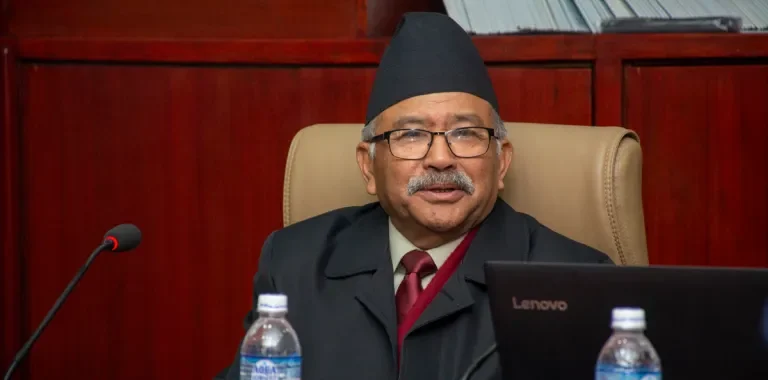
(Opinion based on views expressed by former Chief Justice Kalyan Shrestha at a program organized by the Institute for Strategic and Socio-Economic Research (ISSR) in Kathmandu last week)






Comment