




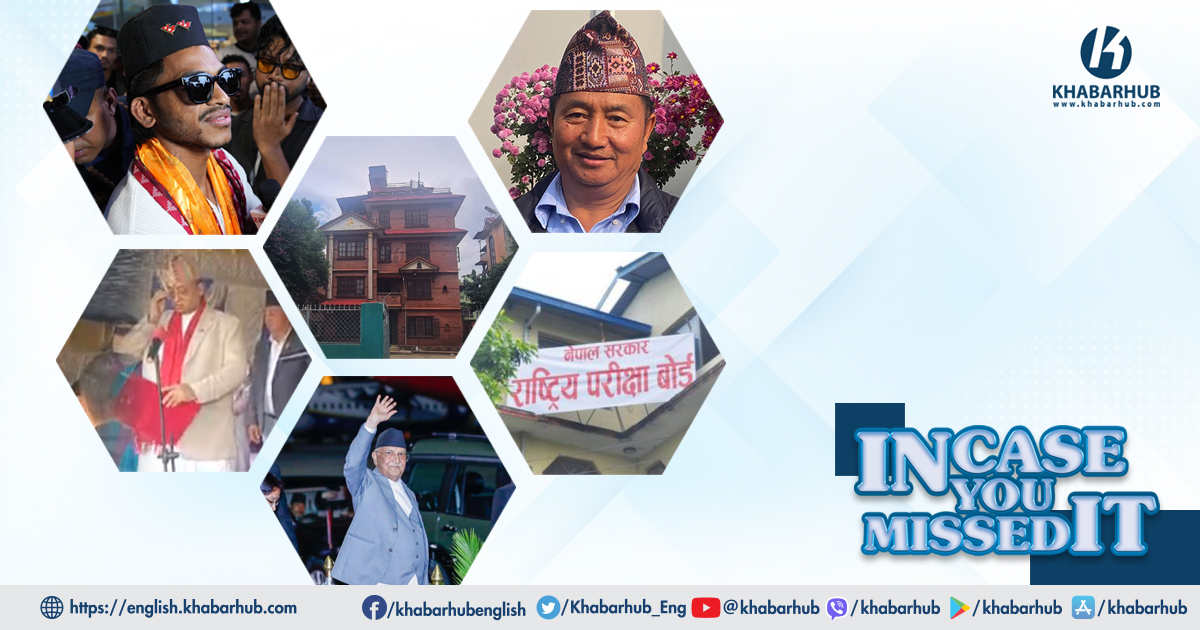
KATHMANDU: The political developments in Nepal over the past week reflect both the volatility of its evolving democratic structures and the persistent undercurrents of power consolidation, intra-party factionalism, and public discontent with governance.
The most consequential event was the resignation of Bahadur Singh Lama and the subsequent appointment of Indra Bahadur Baniya as the sixth Chief Minister of Bagmati Province. Although this transition was executed through constitutional procedures, the manner in which it unfolded exposed deep rifts within the Nepali Congress.
Lama’s resignation was not simply an administrative reshuffle but the outcome of internal political pressure, especially after he lost the party’s provincial parliamentary leadership to Baniya.
The fact that his resignation was conditional—particularly regarding the retention of ministers he had recently appointed—illustrates the transactional nature of provincial politics, where policy priorities are often sidelined in favor of political bargaining.
The coalition dynamics between the Nepali Congress and CPN-UML added further complexity, with the UML initially blocking the swearing-in of Lama’s chosen ministers.
Nepal’s democratic experiment continues to unfold in layered and often contradictory ways, with questions of legitimacy, accountability, and representation remaining at the core of its political discourse.
A last-minute agreement brokered outside formal institutions once again underscored how political negotiations in Nepal often rely more on informal understandings than transparent, institutional mechanisms.
While provincial politics simmered with internal tension, Prime Minister KP Sharma Oli’s international engagement at the United Nations Conference on Landlocked Developing Countries in Turkmenistan stood in sharp contrast.
His presence at the global forum presented Nepal as an active player among developing nations struggling with trade and connectivity challenges. However, Oli’s international image-building efforts may also serve a domestic function—shifting focus away from increasing criticisms at home and reinforcing his leadership credentials.
His absence from Nepal during a time of political reshuffling at home might also indicate the degree of insulation national leadership often maintains from subnational political developments, a pattern that weakens the federal spirit envisioned in Nepal’s constitution.
Parallel to these political shifts, Maoist Centre leader Pushpa Kamal Dahal “Prachanda” delivered a fiery speech declaring the need for a new rebellion. His language evoked the revolutionary past of the Maoists, suggesting that the socio-political transformations envisioned after the ‘People’s War’ remain incomplete.
This rhetoric may be interpreted less as a literal call to arms and more as a strategic appeal to rally disillusioned cadres and reassert ideological relevance in an increasingly fragmented and competitive political environment.
It also serves as a response to declining influence, with the Maoist Centre often caught between supporting the government and playing the role of opposition. Prachanda’s emotional invocation of class unity and resistance against “reactionary forces” reflects the party’s struggle to redefine its identity in a post-conflict political order where pragmatic coalitions have replaced ideological alliances.
Amid these developments, the former president Bidya Devi Bhandari’s re-entry into partisan politics marked a symbolic yet controversial move. Her establishment of a contact office in the historic Thapagaun residence, linked to her and her late husband Madan Bhandari’s political legacies, is both a personal and political statement.
Despite the CPN-UML Central Committee’s decision to invalidate her party membership and discourage her active participation, Bhandari’s actions signal a refusal to retreat quietly into ceremonial retirement. Her re-engagement challenges the authority of KP Sharma Oli, especially as the party prepares for its Second Statute Convention. The internal contradictions within UML—such as the removal of term limits by Oli alongside moves to marginalize rivals—suggest a centralization of power that could destabilize internal unity.
In the case of Rabi Lamichhane and the Rastriya Swatantra Party, a different form of political resistance is playing out. Lamichhane’s bail petition, framed as a response to politically motivated prosecution, reflects a broader strategy of portraying the RSP as a victim of establishment politics.
The party’s campaign for the voting rights of Nepalis abroad further reinforces its image as a reformist, citizen-focused alternative. However, the credibility of this posture hinges on the legal outcomes of the cooperative fraud case.
If Lamichhane is vindicated, the RSP could gain significant momentum; if not, the party risks being discredited as another populist venture marred by internal contradictions and ethical lapses.
Outside the political arena, the publication of Grade 12 results after significant delays caused by a teachers’ strike brought attention to the fragility of Nepal’s education system.
The 61.17% pass rate, though an improvement over the previous year, is overshadowed by systemic challenges such as delayed reforms and legislative inaction—particularly the stalled School Education Bill.
These issues were among the many highlighted in the Maoist Centre’s 26-point resolution, which offered a sweeping critique of the ruling coalition’s governance.
From drought relief and price control to corruption and interference in education, the Maoists attempted to articulate a broad-based agenda, though it remains unclear whether these resolutions will translate into effective political action or remain rhetorical devices.
The week also witnessed a rare moment of national pride in the sporting arena, with Rabindra Dhant’s MMA victory in India. His achievement resonated with a public that often finds in sports the kind of unity and affirmation absent in politics.
Similarly, the observance of Janai Purnima provided a cultural anchor amid political flux. The festival’s diverse manifestations across ethnic and regional communities exemplify Nepal’s pluralistic identity, offering a moment of collective continuity in a period marked by political discontinuity.
In sum, the week’s events reveal a country at multiple crossroads: provincial power struggles reflecting a deeper party centralism, national leadership engaging globally while facing domestic discontent, ideological leaders attempting to reclaim lost relevance, and citizens navigating between systemic inefficiencies and symbolic victories.
Nepal’s democratic experiment continues to unfold in layered and often contradictory ways, with questions of legitimacy, accountability, and representation remaining at the core of its political discourse.


Comment