




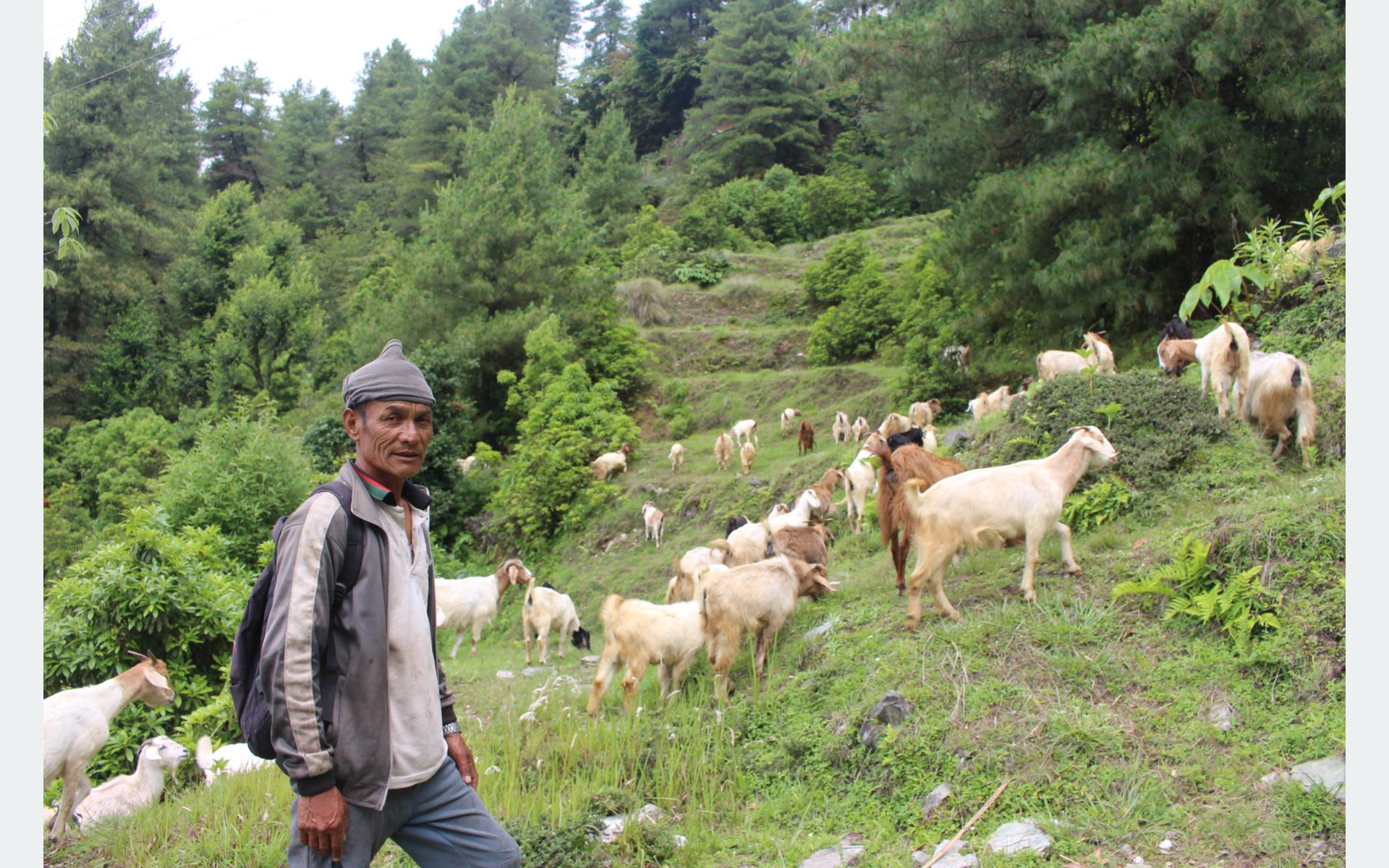
MYAGDI: Jag Bahadur Fagami of Ramche Kafal Danda, Annapurna Rural Municipality-8, Myagdi, has become self-reliant through goat farming after returning from foreign employment.
Fagami had worked in Malaysia for three years, but returned home empty-handed after being cheated out of his wages by the company he worked for.
“After returning to the village, I bought a goat and started farming. When the goats gave birth to twin kids, their number gradually increased. Later, I turned goat farming into a business by purchasing 53 goats from the Ramche Baba group for Rs. 200,000,” said Fagami.
Today, Fagami is an example of how one can become self-reliant by using locally available resources, labor, and skills. For the past six years, he has been running a structured and business-oriented farm, the Sutare Integrated Agriculture and Livestock Farm, which currently has 150 goats.
Of these, 40 female goats are breeding stock. Goats and kids are sold during festivals and religious ceremonies directly from the shed, Fagami shared. According to him, the farm earns Rs. 40,000 to 50,000 per month.
Fagami, along with his wife, son, and daughter-in-law, manages the farm, with an additional employee hired to take the goats to graze. In winter, the goats are fed in the village fields, where they also fertilize the land.
After the start of Jestha, they are taken to the highland forests of Dharwa, Dhaulapara, and Sandhikharka for grazing. Fagami, now self-employed and self-sufficient, also plans to add sheep farming to diversify his livestock.
To commercialize goat farming further, the family has expanded their pen capacity. In the fiscal year 2081/82, a shed capable of housing 300 goats was constructed with support from the Gothkhor Construction Scheme of Annapurna Rural Municipality.
The municipality provided a grant of Rs. 166,000, while the family invested around Rs. 350,000 more through cash and labor contributions. Raju Fagami, Jag Bahadur’s son, shared that the new pen has helped improve conditions for commercial goat farming.
The Fagami family has fully committed to goat farming because of its quick return and higher income potential compared to other livestock. Despite facing setbacks in the past—particularly in managing goat diseases—they continued with determination and have now found success.
Although the family also grows cereal crops and potatoes, their primary source of household income is goat farming. They plan to expand operations further, provided a reliable market for their goats and lambs can be secured.





Comment