




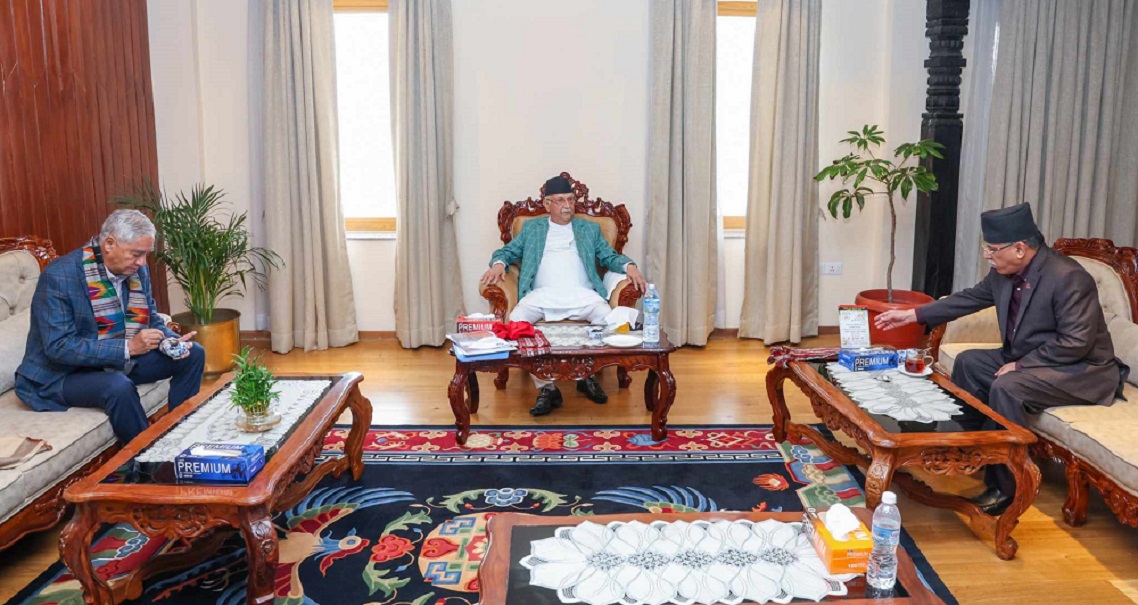
KATHMANDU: Exactly one year after the Nepali Congress and the CPN-UML began their power-sharing arrangement with a focus on amending the constitution, the third-largest party, CPN (Maoist Centre), has now expressed willingness to take responsibility for securing the required two-thirds majority in Parliament to push the amendment forward.
As the ruling coalition of Congress and UML has failed to muster the numbers necessary to proceed with constitutional amendments, Maoist Centre Chairperson Pushpa Kamal Dahal ‘Prachanda’ has stepped in, announcing in Parliament on Monday that his party is ready to deliver the numbers if the government commits to a progressive amendment of the constitution.
Dahal laid out several conditions for his support, stating that the amendment must address the long-standing dissatisfaction that emerged during the promulgation of the constitution in 2015.
His party demands that the proposed changes address Nepal’s system of governance, the electoral system, and issues of federal demarcation, naming of provinces, identity, and power devolution.
“If the government is ready to amend the constitution to ensure greater inclusion and social justice, then I, as the leader of the main opposition, am ready to take responsibility for securing the two-thirds majority,” Dahal said, challenging the ruling coalition: “Does the government have the courage to do this?”
Dahal said any amendment must further institutionalize the rights of the Nepali people and protect the identity and rights of historically marginalized castes, classes, geographies, and communities.
While both Nepali Congress and UML have committed to constitutional amendment in writing, they have yet to table it formally in Parliament due to a lack of adequate support and concerns about unmanageable debate.
UML chief whip Mahesh Bartaula recently admitted that without a two-thirds majority, the proposal risks both rejection and an uncontrollable political discourse.
Last year, on July 2, Nepali Congress President Sher Bahadur Deuba and UML Chair KP Sharma Oli reached a midnight agreement to topple the then Maoist-led government and form a new one. The second point of their agreement was to prioritize constitutional amendment.
According to the agreement, the national consensus government was to review the strengths and weaknesses observed during the implementation of the constitution and make necessary amendments along with corresponding laws to ensure political stability.
However, Nepali Congress has recently come under internal criticism for failing to move ahead with the amendment process. In response, the party decided during its Central Working Committee meeting to form a task force to take the amendment initiative forward.
The task force will hold consultations with parties that played a role in constitution drafting, as well as with experts, civil society members, and other stakeholders.
In his address to Parliament, Dahal reiterated that his party has always held a clear position on the need for amendment.
“Even though we had said that the constitution should be implemented for ten years before reviewing it, the present circumstances demand a serious review,” he said. “Essential laws have yet to be enacted, and governance has not met public expectations. We need to examine whether these shortcomings stem from our electoral system, our governance model, or our political culture.”
He further argued that the constitution must evolve to meet the aspirations of the people, particularly by ensuring stronger protections for marginalized groups.
Dahal pushed back against criticism that the Maoist party has become like other traditional parties, asserting that had it not been for the Maoists, Nepal would not have held Constituent Assembly elections or transitioned into a federal democratic republic.
“If we were like others, would women, Dalits, indigenous nationalities, Muslims, and working-class people have gained proportional and inclusive rights?” he asked.
He concluded by stating that superficial and ritualistic reforms will not transform Nepali society and that his party remains committed to meaningful structural change.






Comment