




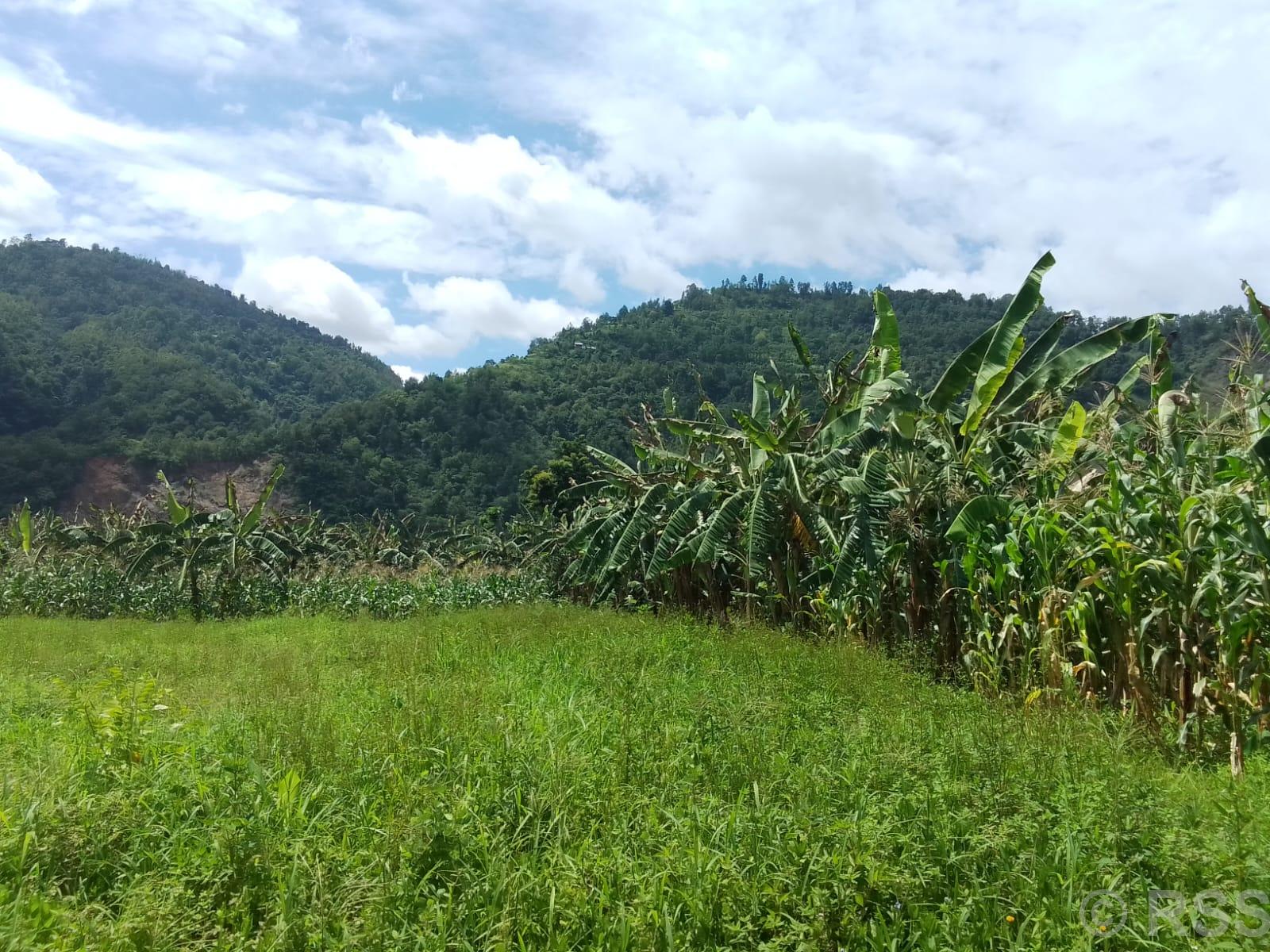
SYANGJA: Most households in Banstari, Kaligandaki Rural Municipality-5, Syangja, are engaged in banana farming, either commercially or for household use. Of the 35 households in the village, the majority have shifted to cultivating bananas.
The trend began around 2036 BS when local resident Prem Narayan Gaudel planted two banana trees. Over time, he expanded his efforts and began commercial farming.
His son, Ravilal Gaudel, has since taken the initiative forward, cultivating bananas commercially on three ropanis of land. He currently grows Harisal and Jhapali Malbhog varieties.
According to Ravilal, the support provided by Kaligandaki Rural Municipality last year—including banana saplings and technical assistance—encouraged more farmers to adopt banana cultivation.
“We are earning more from bananas than from traditional crops. It takes about 15 months to harvest, and we currently earn around Rs 100,000 annually. I’m working to increase that to Rs 500,000,” he said.
Chandrakanta Neupane, another farmer from Banstari, has been involved in commercial banana farming for the past 13 years. He cultivates bananas on nine ropanis—three ropanis of his own and six rented—and earns about Rs 200,000 annually. “There’s no market problem. Traders come directly to the farm. I sell at Rs 70 to 80 per dozen,” he said.
Previously used for crops like maize, millet, and siltum, the land in Banstari has proven ideal for banana farming due to its flat terrain and favorable climate near the Kaligandaki River.
However, farmers report occasional challenges such as black spots on stalks and fruit, as well as hailstorms, which can reduce yields.
At present, commercial banana cultivation in Banstari spans approximately 150 ropanis of land.




Comment