




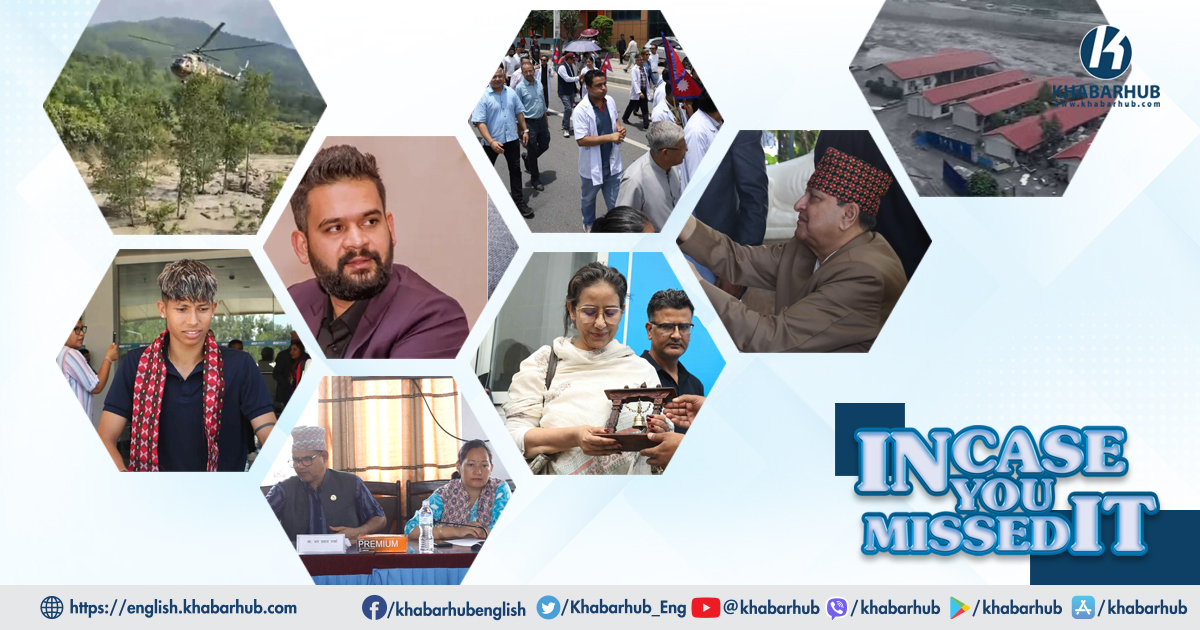
KATHMANDU: Last week in Nepal was marked by a flurry of developments across the economic, political, and social spectrum—each exposing underlying tensions, institutional shifts, and simmering realignments.
The most awaited announcement came on the economic front. Nepal Rastra Bank Governor Biswo Nath Poudel unveiled the monetary policy for fiscal year 2025/26, marking his first major move since assuming office. The policy signaled a shift toward monetary easing.
Interest rates across the corridor were lowered, and the long-debated cap on margin lending was increased from Rs 150 million to Rs 250 million per borrower. These moves were designed to revive capital market sentiment, especially after months of subdued trading activity due to tight credit conditions.
The increase in the loan ceiling was particularly welcomed by institutional and high-net-worth investors, who had long lobbied for more breathing room.
Yet the policy’s underlying bias towards market liquidity without clear structural reform raised eyebrows among some economists. While encouraging investment in equities, it does little to address the persistent credit gap in the productive sectors of the economy.
As the country heads deeper into the fiscal year and its monsoon cycle, these events hint at more turbulence ahead—whether in the corridors of power, the riverbeds of the high Himalayas, or the ballot boxes of the future.
The question now is whether these measures will provide a temporary lift or simply fuel another speculative cycle in the stock market.
On the political front, old wounds within the Nepali Congress resurfaced with disciplinary action against central member Devendra Raj Kandel—expelled for five years for supporting rebel candidates during the 2022 local elections.
The timing of the announcement, years after the actual decision was taken, revealed deep-seated factional rifts. It also coincided with action against 18 other leaders who had allegedly acted against party interests in the 2079 elections.
This set off a sharp reaction from the Shekhar Koirala faction, which denounced the expulsions as vindictive and vowed political resistance.
As internal friction played out in Nepal’s oldest party, its president Sher Bahadur Deuba sent a defiant message to critics pushing for leadership change. Dismissing calls to announce the party’s next general convention, Deuba reminded everyone of his constitutional right to stay on, adding, “I’m not someone who steps down just because I’m told to.” The remark, though wrapped in humor, signaled his unwillingness to cede control, at least for now.
Meanwhile, alternative forces found new ground to criticize the mainstream. Baburam Bhattarai launched a direct attack on all three major parties, singling out his former comrade Pushpa Kamal Dahal Prachanda.
In a scathing statement, he declared that successive governments—regardless of who leads them—have failed to address Nepal’s deep structural problems like corruption, unemployment, and dependency.
He argued that the failure of traditional parties paves the way for new political forces, raising once again the demand for systemic change from outside the old guard.
This undercurrent of disillusionment also echoed through a symbolic gathering at Nirmal Niwas, where former king Gyanendra Shah celebrated his 79th birthday by opening his residence to the public.
A steady stream of monarchist well-wishers, including RPP figures, turned the event into a nostalgic show of support for the monarchy. It came just as police summoned the former king’s spokesperson for publicly referring to him as “Shree 5”—a royal title constitutionally reserved for reigning monarchs.
Though the summons was administrative in nature, it reopened questions about the monarchy’s place in Nepal’s republican framework.
Amid these overlapping political tensions, Kathmandu mayor Balen Shah stirred speculation by meeting former president Bidya Devi Bhandari. The meeting, held behind closed doors at her residence, was timed just as Shah found himself in conflict with the federal government over the city’s stalled budget.
According to sources, Shah raised concerns about bureaucratic obstruction and sought Bhandari’s backing to break the deadlock. That the meeting was facilitated by senior UML figures and allies of Bhandari adds political intrigue, especially given her own reentry into active politics under the UML banner.
With Prime Minister Oli indirectly critical of her recent visibility, the Shah-Bhandari meeting may signal a realignment of figures sidelined or discontented with the current establishment.
Elsewhere, a crisis in the health sector was narrowly averted. After widespread disruption of services by doctors protesting recent court rulings on medical negligence, the Nepal Medical Association reached an agreement with the government.
The doctors had objected to consumer court decisions ordering hefty compensation in malpractice cases, arguing that such judgments undermined the authority of the Nepal Medical Council.
Following a series of high-level meetings, the government agreed to review the contested legal provisions, and the protests were called off—restoring normalcy to health services.
Natural disaster, however, dealt a serious blow to the power sector. Floods originating from Tibet severely damaged key hydropower projects in Rasuwa, including Rasuwagadhi and Trishuli 3A, halting up to 200 megawatts of electricity generation.
While officials downplayed the immediate impact on national supply—thanks to the monsoon-driven surplus—the longer-term implications are grave. Rebuilding the destroyed infrastructure will require significant investment, and the event exposed the vulnerability of Nepal’s river-based energy projects to upstream climate variability.
The week also saw the government release the National Population Policy 2025, highlighting Nepal’s looming demographic challenges. With 34 districts now experiencing negative population growth and fertility below replacement level, the report raised concerns about shrinking labor force and regional imbalances. However, the policy stopped short of proposing concrete incentives to address these worrying trends.
In judicial affairs, President Ram Chandra Paudel appointed three new justices to the Supreme Court, following recommendations from the Judicial Council and confirmation by Parliament. The appointments, including Meghraj Pokharel and Shreekant Paudel, are seen as a move to fill institutional gaps and promote inclusivity in Nepal’s top court.
In other developments, the newly appointed vice-chancellor of Tribhuvan University, Dr. Deepak Aryal, formally assumed office. A respected expert in climate science, Aryal’s appointment is expected to bring more academic focus and stability to the country’s largest university, which had been without a permanent VC since April.
The tensions within parties, between institutions, and across ideologies are slowly building toward a moment of reckoning. Whether that moment results in reform or regression remains an open question.
On a lighter yet politically symbolic note, actress Manisha Koirala made headlines by visiting the Rastriya Swatantra Party office to sign a petition in support of Rabi Lamichhane, accusing the state of injustice. The gesture reflects the growing intersection between celebrity activism and political populism in Nepal.
In sports, the national women’s football team returned home after a heartbreaking exit in the Asian Cup qualifiers. Though they fell short of qualification, the team’s spirited performance won admiration from fans and officials alike.
Altogether, last week in Nepal was a potent mix of policy recalibration, political brinkmanship, and quiet realignments. As the country heads deeper into the fiscal year and its monsoon cycle, these events hint at more turbulence ahead—whether in the corridors of power, the riverbeds of the high Himalayas, or the ballot boxes of the future.
The tensions within parties, between institutions, and across ideologies are slowly building toward a moment of reckoning. Whether that moment results in reform or regression remains an open question.


Comment