



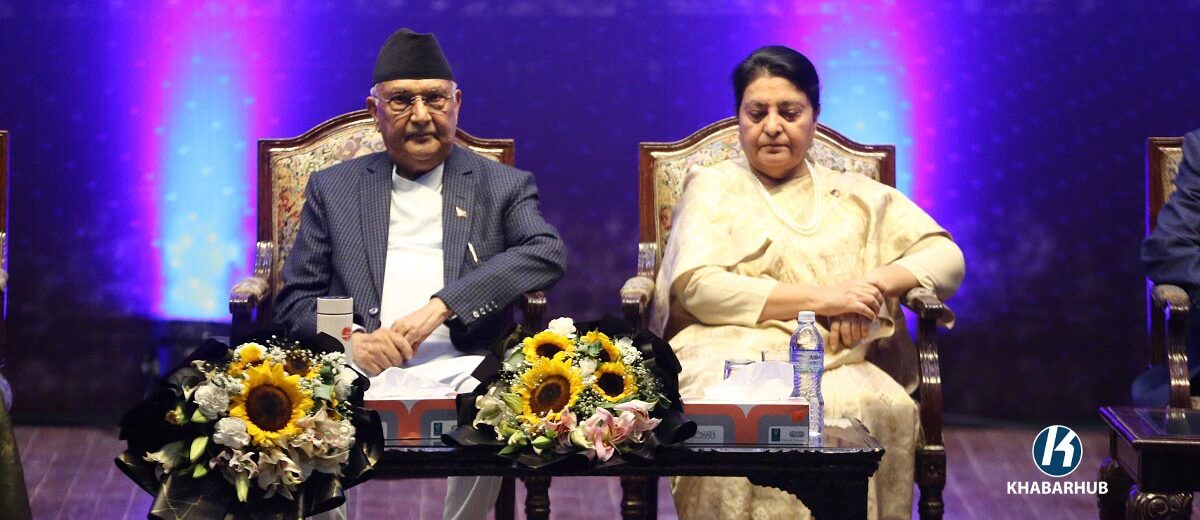
KATHMANDU: Rumors of a major leadership change in Nepal’s ruling party, CPN-UML, have intensified in recent weeks, with speculation rife that former President Bidya Devi Bhandari is poised to replace party chair and Prime Minister KP Sharma Oli.
While this narrative has found traction not only in Kathmandu’s media circles but also among party cadres, insiders suggest the reality may be less dramatic—and more calculated.
As the party gears up for its national convention scheduled for December, the possibility of a leadership handover from Oli to Bhandari has ignited debate.
Would Bhandari, if elected, steer the party in a new ideological direction or simply serve as a symbolic change—“old wine in a new bottle”?
Three likely scenarios
Observers point to three potential outcomes from the upcoming convention.
First: The most plausible outcome is that Bhandari assumes leadership with Oli’s full support, signaling not a rupture but continuity of the “Oli-Bidya alliance” that has long shaped the party’s core. In this case, regardless of who holds the title, the party’s political direction, ideological stance, and organizational behavior would remain largely unchanged.
Second: Should Bhandari contest the leadership without Oli’s endorsement, or vice versa, internal factionalism could surface. However, this rift would likely be political rather than ideological, characterized more by personal rivalries than principle-based debate. Either way, such disunity would weaken UML’s leadership position further.
Third: Some UML members hope Bhandari’s rise could lead to a less confrontational approach to politics—no alliance with the Nepali Congress, closer ties with China, and greater cooperation among leftist parties. Yet, Bhandari’s core team is unlikely to welcome unity with the Maoists. Rather, critics argue she might steer the party further into regressive, hardline territory.
One party, one ideology?
Despite the perceived difference in personas, analysts argue there is little ideological distinction between Oli and Bhandari. Both are staunch adherents of the late Madan Bhandari’s “People’s Multiparty Democracy” line and share similar conservative stances on issues such as federalism, identity politics, and the Maoist conflict.
In fact, many point out that figures like Ishwar Pokharel and Shankar Pokharel—other key leaders within UML—mirror the same political temperament. None are particularly tolerant of dissenting views. Thus, the so-called rivalry between Oli and Bhandari may be more performative than real.
During a speech on the 74th birth anniversary of Madan Bhandari, Oli mocked those anticipating a political “explosion” within UML.
“Some expect me or Bidya Bhandari to drop a bombshell—boom!—and destroy the UML. But nothing is going to explode. No bomb, no bullet, no war. The UML is one and will remain united,” he declared.
Bhandari’s return to partisan politics
At the same event, Bhandari publicly confirmed that she had renewed her party membership. Declaring her pride in returning to the UML fold, she emphasized her commitment to social justice and national development.
“After serving in other political roles, I’ve decided to continue my journey with UML. I have no personal ambition, my only goal is the welfare of the people and the nation,” she said.
But many remain skeptical. Critics point to Bhandari’s controversial tenure as president, particularly her support for Oli during two parliamentary dissolutions, her polarizing stance on the citizenship bill, and her failure to rise above party lines.
Unlike former President Ram Baran Yadav, who chose political neutrality after office, Bhandari’s decision to rejoin UML has raised questions about her political maturity and long-term ambitions.
A leadership swap or a setup?
Analysts argue that Bhandari’s apparent ambitions might not be driven by a distinct political vision, but rather a shared interest with Oli in maintaining control.
Her recent visit to Baluwatar and lengthy discussions with Oli further fuel speculation that any upcoming leadership transition would be a “match-fixing” exercise rather than a genuine contest.
The long-standing unity of the Oli-Bhandari camp—from opposing Madhav Kumar Nepal to resisting party unification with Maoists—suggests that their current divergence is more strategic than real.
Even Maoist Chair Pushpa Kamal Dahal (Prachanda), in a recent interview, stated, “I don’t see any real difference between KP Oli and Bidya Bhandari in terms of ideas, agenda, or political culture. They were both responsible for the unconstitutional dissolutions of parliament.”
Despite rumors, a real shake-up in UML’s leadership appears unlikely. If Bhandari does rise to the helm, it would likely be with Oli’s blessing and part of a larger effort to preserve power under a new banner, without changing the party’s core philosophy.
So, for those anticipating fireworks in UML politics, KP Oli has a message, “Don’t expect any bomb to explode—no need to dream of destruction. UML remains united.”






Comment