




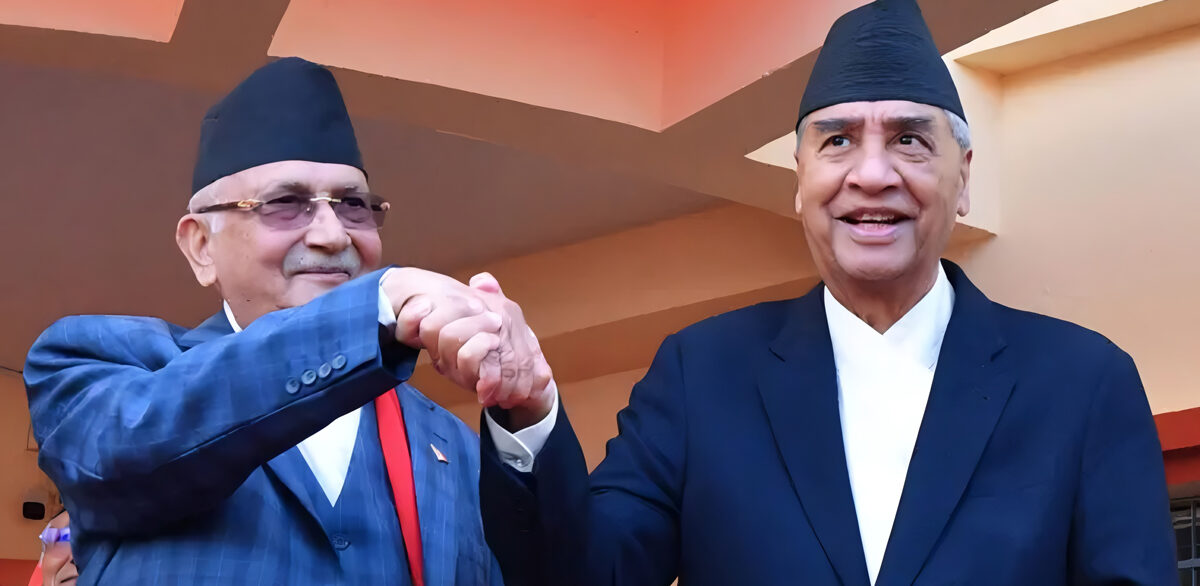
KATHMANDU: The seven-point agreement between Nepal’s two largest parties—the Nepali Congress and the CPN-UML—has remained limited to a power-sharing arrangement, with no progress on its key promise: amending the Constitution.
Despite a year having passed since the agreement was signed, no formal steps have been taken to initiate the constitutional amendment process.
On the midnight of July 1, 2024, Nepali Congress President Sher Bahadur Deuba and CPN-UML Chair KP Sharma Oli agreed to form a new coalition government by toppling the Maoist Centre-led administration. Notably, the second point of their agreement prioritized constitutional amendment.
“The government of national consensus will review the strengths, weaknesses, and complexities that have emerged in practice since the constitution came into effect, and prioritize amending the constitution and formulating laws accordingly for political stability,” reads the second clause of the agreement.
As the agreement completes its one-year mark today, there have been no substantive discussions between the two parties—or with other political stakeholders—on constitutional reform.
Although some Nepali Congress leaders have repeatedly raised the issue, their appeals have failed to gain traction within the government.
The seven-point agreement had envisioned a review of the constitution’s implementation over the past decade. Based on that review, it proposed strengthening its strong points and amending weaker provisions.
However, leaders from both parties admit that the coalition lacks the two-thirds majority required for a constitutional amendment—hindering real progress.
“There’s consensus that the constitution’s strengths should be preserved and its weaknesses improved through amendment. But Congress and UML alone cannot reach the two-thirds threshold,” said UML Chief Whip Mahesh Bartaula.
“When we consider introducing an amendment proposal, we also weigh the risk that it won’t pass and could trigger uncontrolled political debate.”
Congress leaders have stated that the constitutional amendment issue will be discussed at the party’s Central Working Committee meeting, which began on Monday.
“This issue is on the agenda of the Central Working Committee meeting that started on Monday,” confirmed Min Bishwakarma, head of the Congress Information, Communication, and Publicity Department, speaking to Khabarhub.
Bishwakarma noted that the Congress is not merely advocating for constitutional amendment, but also a comprehensive review of its implementation.
“The seven-point agreement signed on July 1 last year isn’t just about amendments. The Congress has stressed the need to seriously review the implementation and amend only those provisions that have proven difficult in practice,” he said.
He added that the ruling alliance has been in a review phase over the past year and that preparations are underway to formally begin the amendment process in 2082 BS.
“We conducted a review in 2081 BS, and now we’re preparing to initiate the amendment process in 2082 BS. Discussions are underway to form a task force soon,” Bishwakarma said.
UML Chief Whip Bartaula also pointed to the lack of a two-thirds majority as the primary obstacle: “The mathematics simply doesn’t support a constitutional amendment right now. That’s the main reason this issue hasn’t moved forward.”
Still, Bartaula emphasized that both parties recognize the need for constitutional changes. “There’s a shared understanding within the Congress-UML alliance about the need for amendment—they’ve accepted that much,” he said.
However, he cautioned that constitutional reform will only be possible when both “subjective and objective conditions” align. “Even though Congress and UML have created subjective conditions, the objective reality doesn’t support it,” Bartaula noted. “That misalignment is why the amendment process hasn’t progressed.”
He also rejected accusations that there has been no dialogue on the issue between the two ruling parties.
“It’s not that discussions haven’t taken place between the two parties—they have,” said UML Chief Whip Bartaula. “However, some matters have not been made public. We believe the amendment issue will move forward at the appropriate time.”
Meanwhile, the main opposition, the Maoist Center, has strongly criticized the Nepali Congress-UML alliance, accusing them of using constitutional amendment as a pretext to change the government when no other option was available.
“The Congress-UML floated the amendment agenda only after they saw no alternative path to forming a new government,” said Maoist Center Chief Whip Hitraj Pandey.
He added that party Chairman Pushpa Kamal Dahal ‘Prachanda’ had already exposed this motive during a meeting of the House of Representatives. Pandey reiterated the allegation that the current coalition government is serving the interests of power brokers rather than the public.
“Our chairman has said this repeatedly in Parliament as the leader of the main opposition party,” Pandey stated. “This government has not acted in the interest of the people. It has clearly tilted in favor of brokers—and that remains the case even now.”
The Congress and UML had initially approved the seven-point agreement behind closed doors. Both the UML Secretariat and the Nepali Congress Central Working Committee later ratified the midnight deal reached between Deuba and Oli, setting the foundation for the current power-sharing arrangement.
Following the Working Committee meeting, the Nepali Congress issued an official statement endorsing the agreement, expressing its commitment to forming a national consensus government as per the accord.
Similarly, the UML Secretariat passed a resolution to support the same agreement, which outlined plans to establish a national consensus government and to pursue constitutional amendments aimed at ensuring political stability.
At the time, the parties faced backlash for endorsing such a significant agreement without publicly disclosing its contents.
The Seven-Point Agreement Between Congress and UML:
- Formation of a National Consensus Government under Article 76(2) of the Constitution to fast-track national development, control corruption, promote good governance, protect national interests, ensure political stability, and involve other political parties.
- Review and Amendment of the Constitution to address practical strengths, weaknesses, and complexities since its implementation, with necessary legal reforms to reinforce political stability.
- Revitalization of the Economy by ending stagnation, fostering a trustworthy investment climate, encouraging both domestic and foreign investment, and creating adequate employment opportunities within the country.
- Power-Sharing Agreement: Leadership of the national consensus government would be held by UML Chair KP Sharma Oli for the first two years, followed by Nepali Congress President Sher Bahadur Deuba until the general elections scheduled for Mangsir 2084.
- Anti-Corruption and Governance Reform: Launching a campaign for national development by cracking down on corruption, protecting national interests, and formulating a minimum common program to guide the government’s operation.
- Inclusive Government Structure: The two major parties would participate equally in governance, ensuring leadership balance and accommodating other political parties in the national consensus government.
- Federal and Local-Level Coordination: Provincial governments would be formed and operated in line with the spirit of consensus, with a focus on accelerating development at the provincial and local levels in accordance with public aspirations.






Comment