




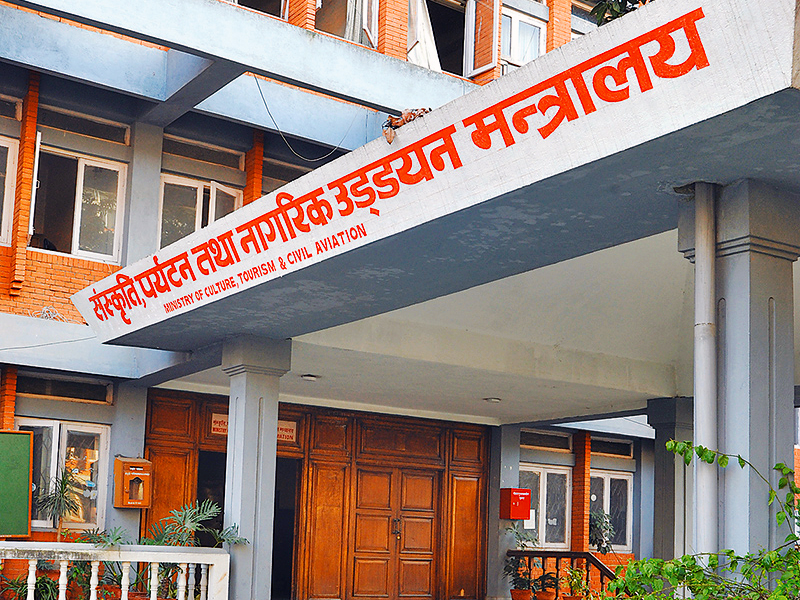
KATHMANDU: The Ministry of Culture, Tourism and Civil Aviation has released the draft of the Aviation Policy 2025 for public discussion, marking Nepal’s first attempt in 19 years to revise its aviation regulatory framework.
The new policy aims to respond to the significant changes and challenges that have emerged in the aviation sector since the introduction of the Aviation Policy 2006.
According to the ministry, the proposed policy outlines a range of reforms, including clear provisions related to aircraft import age limits, foreign management at underutilized airports, and foreign investment restrictions in Nepal’s aviation sector.
The draft specifies that Nepal will not allow the import of pressurized aircraft older than 15 years, or those that have completed 50 percent of their economic design life or 35,000 pressurization cycles.
For non-pressurized aircraft, the draft prohibits the import of aircraft older than 20 years. The provision is aimed at improving aviation safety, which has long been a concern due to the age and technical condition of some aircraft operating in the country.
The policy also addresses the long-standing issue of underutilized infrastructure, particularly at the Gautam Buddha International Airport in Bhairahawa and the Pokhara International Airport.
Despite billions of rupees in investment, these airports have failed to operate at full capacity. The draft proposes international partnerships for the management and promotion of both airports to boost operations and improve their viability.
Another notable provision is the proposal to make ground handling services competitive. Currently, Nepal Airlines Corporation holds a monopoly on ground handling at Tribhuvan International Airport. The draft suggests opening this service up to competition to improve efficiency and service quality.
In a significant policy shift, the ministry has also proposed allowing Nepali entrepreneurs to operate private jets for personal use. However, these jets will not be allowed to conduct commercial flights. This move aims to expand private aviation access while keeping commercial operations under regulation.
Regarding foreign investment, the policy makes it clear that 100 percent foreign ownership will not be permitted in Nepal’s aviation industry.
For international airlines and flying schools, up to 90 percent foreign investment would be allowed. For domestic air services, the cap is set at 49 percent, while up to 95 percent foreign investment is permitted in aircraft maintenance, manufacturing, or design. Other aviation-related service providers may receive up to 80 percent foreign investment.
The ministry has invited comments and feedback from stakeholders and the public before finalizing the policy. If enacted in its current form, the Aviation Policy 2082 would significantly reshape Nepal’s civil aviation landscape with tighter safety standards, greater openness to international collaboration, and clearer investment rules.





Comment