




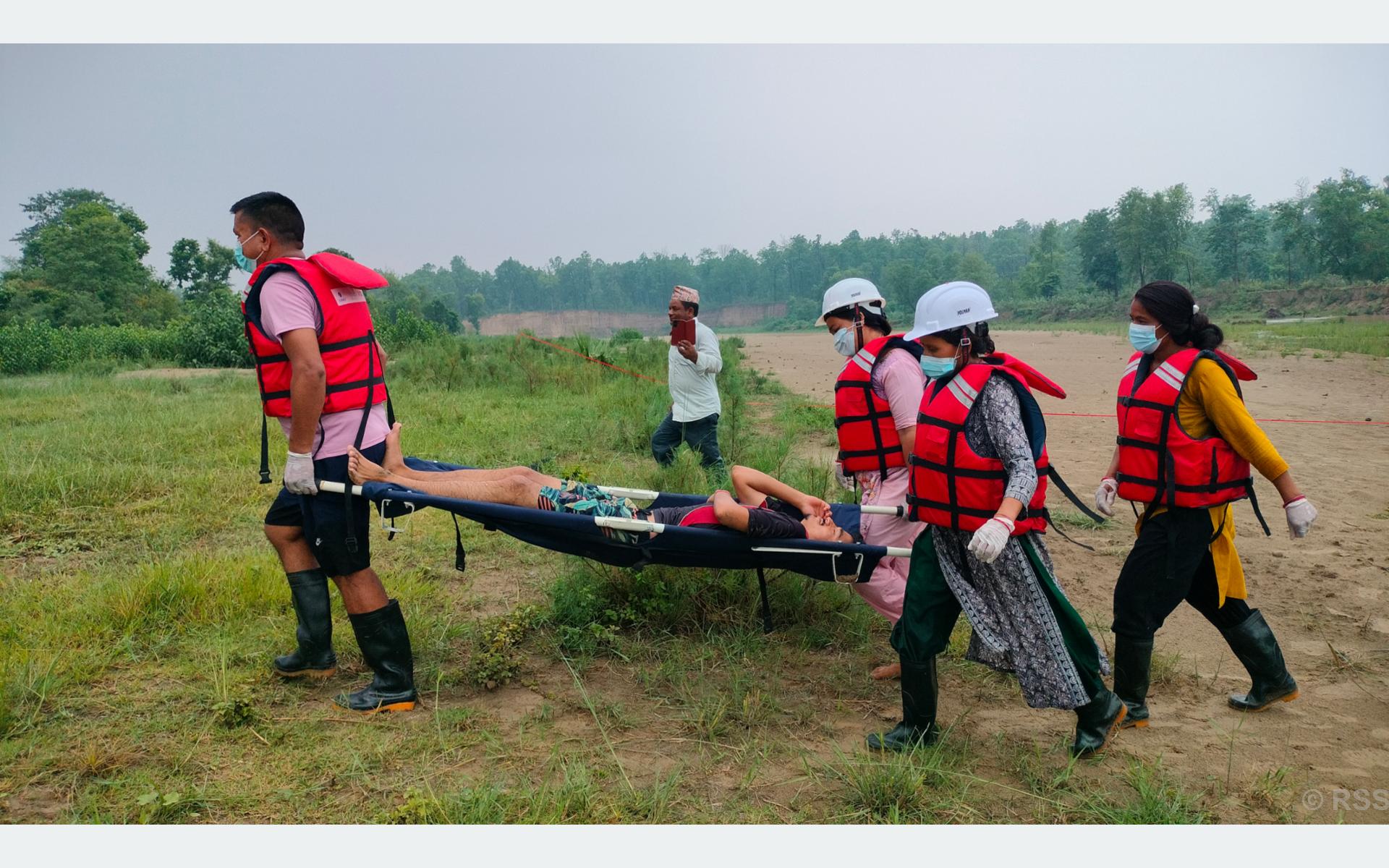
KANCHANPUR: In a proactive step toward enhancing disaster resilience, residents of Athaniphanta in Krishnapur Municipality-2 have come together to carry out a community-based flood preparedness drill.
The initiative, hailed as a model exercise, has strengthened local capacity, awareness, and coordination in managing potential flood disasters.
The simulation, along the Banahara River, was part of the Climate Resilient Community Program, a collaborative initiative between the Nepal National Social Welfare Association (NNSWA) and the international organization Mercy Corps.
The program showcased practical steps to be taken before, during, and after a disaster through real-time demonstrations.
Three task forces—Early Warning, Rescue, and First Aid—each demonstrated their roles during the exercise. Mahesh Ghimire, coordinator of the program, said the drill illustrated how a coordinated community response can minimize harm during a disaster.
“The main responsibility of the Early Warning Task Force is to gather, assess, and disseminate timely information ahead of any disaster, such as floods,” he explained.
“Once the threat is identified, the team quickly alerts the community, informs relevant authorities, and mobilizes warnings in at-risk areas.”
The task force emphasized using community information centers, mobile messages, door-to-door notifications, sirens, and loudspeakers to disseminate alerts.
“When disaster strikes, the Rescue Task Force immediately activates,” said Satyaraj Kathayat, chairperson of the Community Disaster Management Committee. “The rescue team prioritizes evacuating children, the elderly, and people with disabilities to safe locations.”
He added that medical attention is often urgently needed during disasters. The First Aid Task Force demonstrated the setup of a temporary medical station in a safe area where they treated simulated injuries, controlled bleeding, and administered basic medications.
Prem Bogati, the disaster contact officer of the municipality, highlighted the importance of coordination between early warning, rescue, and medical teams. “If information, evacuation, and treatment are well-integrated, disaster impacts can be significantly reduced,” he said.
He noted that past flood events caused extensive damage due to lack of preparedness. However, the regular flood alerts issued by the Department of Hydrology and Meteorology have helped communities respond more effectively in recent years. With improved preparedness, the number of casualties has decreased.
Bogati also emphasized that riverbank erosion can be prevented by planting trees and grass along vulnerable areas—something the community should prioritize.
The main objective of the Climate Resilient Community Program is to reduce the risks of natural disasters like floods and ensure the safety of lives and property at the local level.






Comment