




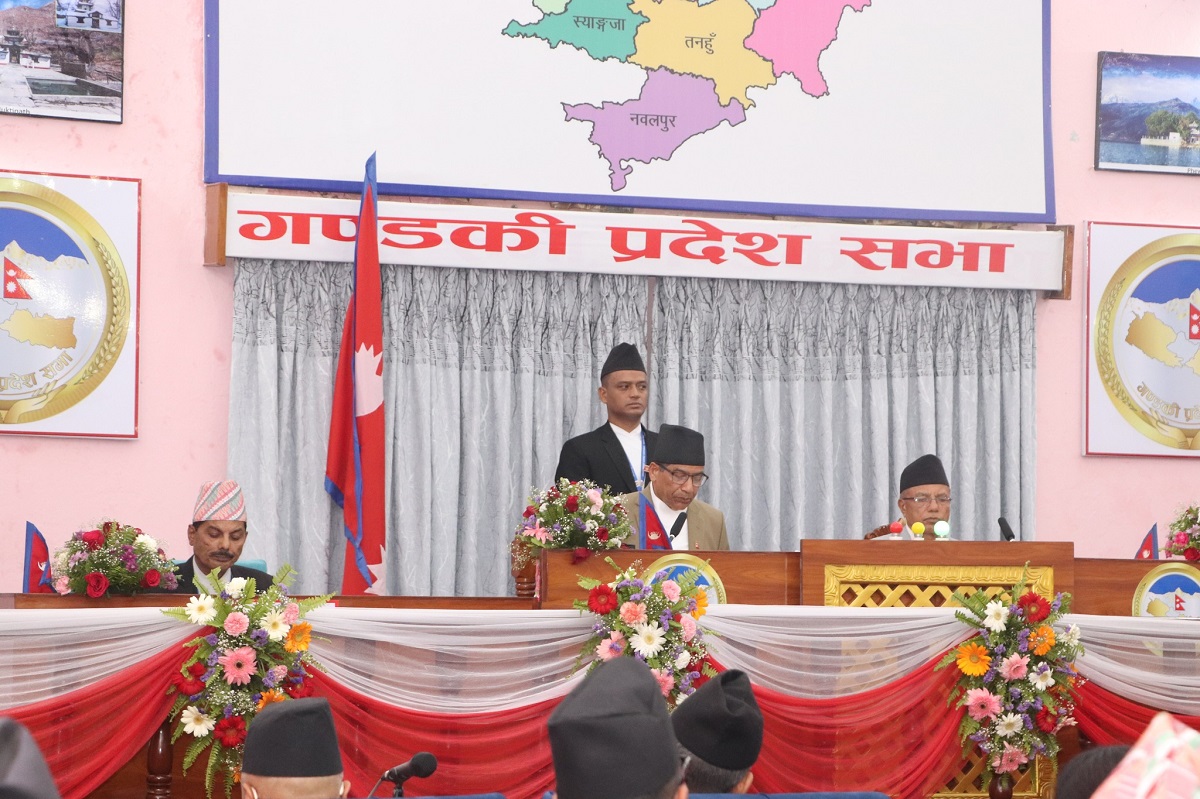
POKHARA: The Gandaki provincial government has announced its annual policy and programs for the upcoming fiscal year, repeating many old initiatives but adding new slogans to its agenda.
Provincial Chief Dilli Ram Bhatta presented the document at the Provincial Assembly on Wednesday.
According to Bhatta, the policies are based on past administrative experiences, current internal revenues, and the national and international context. The government plans to make its organizational structure more efficient through recommendations from the committee on administrative restructuring and position review.
Interestingly, just a day after suspending the ride-sharing regulations under federal direction, the policy document pledged to make ride-sharing services more effective. The government also confirmed that the previously dissolved Science and Technology Academy’s responsibilities will now be handled by Gandaki University.
So far, the Gandaki Provincial Assembly has enacted 78 laws. Bhatta said that the province has continued to implement both exclusive and shared powers under the constitution by making legal arrangements as needed.
To ensure better project selection and budget allocation, the government has introduced a Provincial Project Bank Information System. This system is expected to facilitate selection based on need, feasibility, and resource availability. Projects in poor condition or with structural issues will be prioritized based on study recommendations.
Currently, 99.54% of households in the province have access to electricity, and around 152,000 private taps have been installed under the ‘One House, One Tap’ initiative.
In infrastructure, the province has completed 930 km of paved roads, 700 km of gravel roads, 110 road bridges, and 84 suspension bridges. These have significantly improved accessibility for citizens, the policy noted.
The policy also emphasizes the continuation of the Janata Awas (People’s Housing) Program for disadvantaged, endangered, highly marginalized, and Dalit communities. Efforts are ongoing to preserve local arts and cultures through targeted programs for different ethnic and linguistic groups.
The government has adopted strategies to tackle natural disasters and is continuing reconstruction of homes damaged by disasters via the District Disaster Management Fund.
The new policy outlines the provincial government’s priorities, development plans, and guidelines for the fiscal year. Debate on the policy’s principles and priorities has already taken place in the assembly. As per constitutional provision, the province must present its budget by mid-June (Asar 1).
This marks Gandaki’s eighth annual policy and program. However, critics have pointed out a recurring lack of coordination between the policy and budget, which has hampered development outcomes. Despite a relatively higher economic growth rate than the federal government and other provinces, expectations for next year’s budget have been dampened due to reductions in federal grants and weak internal revenue collection.




Comment