




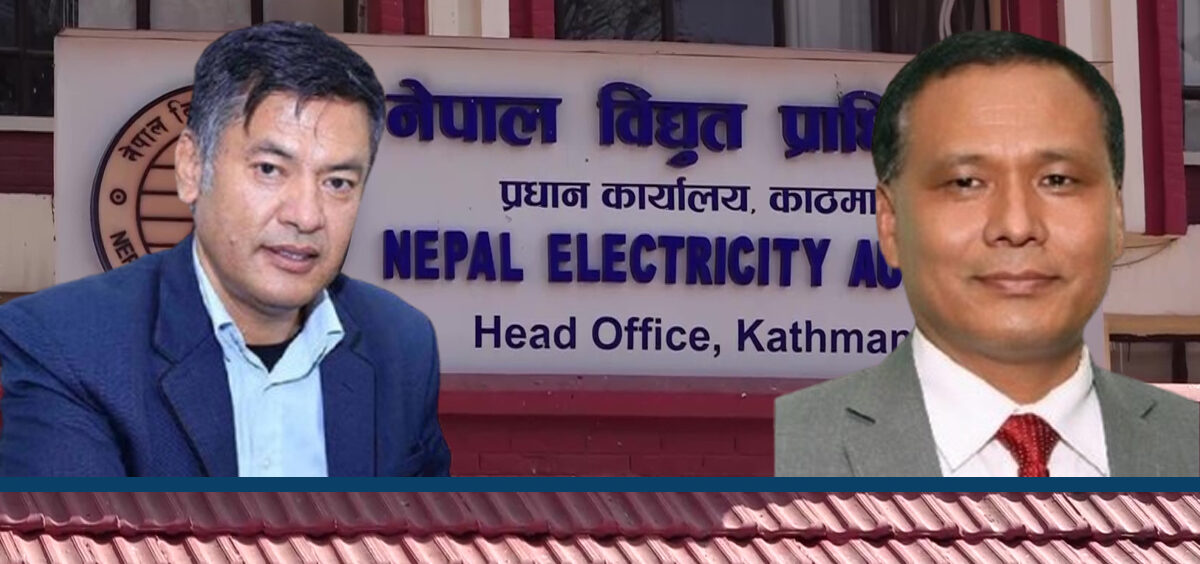
KATHMANDU: Nepal Electricity Authority (NEA) Executive Director Hitendra Dev Shakya, in a press conference held on Friday, released a white paper highlighting the Authority’s worsening financial crisis.
He said that the NEA is facing an increasing “resource crunch” and is currently in a near-bankrupt state. Shakya warned that unless the government intervenes with support, the situation will become extremely difficult for the Authority to manage.
He stated that the NEA’s financial condition has reached a point where the government’s investment in the energy sector, which could yield immediate returns, is now critical.
Had the government provided additional budget allocations, Shakya claimed, the pressure on NEA would have been somewhat eased. When presenting the white paper and financial data, a journalist asked whether the Authority was trying to justify an electricity tariff hike by presenting deficit figures.
In response, Shakya candidly said that something must be done—either the government should provide loans, or electricity tariffs should be increased, or obligations should be adjusted. “We can’t go on pretending everything is fine. How long can we keep hiding the reality?” he said.
Shakya also revealed that the NEA has not been able to pay over Rs 11 billion to construction contractors and has made commitments worth Rs 70 billion in various projects.
If those contractors come to collect on those commitments, he said, the NEA will be in a very difficult position. Without additional government loans, the NEA will struggle to meet these financial obligations and will likely face serious operational obstacles.
The situation presented in the white paper aligns closely with the 61st report of the Office of the Auditor General, which similarly pointed to massive liabilities.
According to the report, the NEA has capital and liabilities totaling Rs 577.2 billion, which includes long-term debt of Rs 216.3 billion, deferred tax liabilities of Rs 8.38 billion, other current liabilities of Rs 45.3 billion, and additional liabilities amounting to Rs 65.72 billion.
In terms of assets, the Auditor General recorded NEA’s fixed assets at Rs 215.5 billion, projects under construction at Rs 176.42 billion, share investments at Rs 27.85 billion, other assets at Rs 44.46 billion, and current assets at Rs 112.97 billion. The report also noted that the NEA has outstanding arrears of Rs 44.32 billion.
However, Shakya’s white paper reports higher totals, estimating NEA’s overall assets at Rs 644 billion. Of this, Rs 235 billion are fixed assets and Rs 220 billion are projects under construction, figures that are significantly higher than those shown by the Auditor General’s last fiscal assessment.
Shakya, in his recently released white paper, stated that the Nepal Electricity Authority (NEA) owes Rs 11.61 billion in pending payments to contractors, Rs 32.5 billion in interest payments on government loans and Tanakpur electricity, and Rs 47.87 billion in retirement benefits as calculated by the Office of the Auditor General.
According to the white paper, the NEA’s total liabilities have reached Rs 385 billion. Shakya also noted that some of the assets and expenses recorded in the Auditor General’s report had been previously omitted in financial disclosures.
As of mid-Falgun, the NEA had Rs 44.54 billion in arrears, including dues from dedicated feeders and trunk lines, while its total accumulated profit during the same period stood at Rs 46.47 billion.
However, after deducting liabilities, Shakya reported a net loss of Rs 5.26 billion up to mid-Falgun. He also revealed that only Rs 2 billion remained in the NEA’s current account.
Despite these challenges, Shakya stated that the Authority’s overall financial position remained positive, citing a low liabilities-to-assets ratio.
He also detailed government contributions: Rs 20 billion in FY 2078/79, Rs 13 billion in FY 2080/81, and Rs 4.26 billion in the current fiscal year. Of the latter, only Rs 1.46 billion had been received by mid-Falgun.
Broadly, both the white paper and the Auditor General’s report indicate a steady increase in the NEA’s assets, liabilities, and overall transactions in recent years.
However, critics have pointed out that Shakya emphasized financial losses over growth and investments during his press briefing. This presentation led to media coverage framing the NEA as a financially troubled institution.
Notably, the NEA has consistently held a credit rating of ‘AA Plus,’ reflecting its capacity to meet financial obligations. Yet, Shakya’s claim that the Authority is on the brink of bankruptcy has raised questions about the direction of its current leadership.
To address the immediate cash crunch, Shakya announced plans to take a short-term loan of Rs 10 billion to pay contractors. “What kind of crisis will we face if the government doesn’t support us?” he asked.
Kulman Ghising responds
Just days after being dismissed, former NEA Executive Director Kulman Ghising held a press conference to share his perspective on the NEA’s financial health. He pointed out that the Authority’s total assets had grown from Rs 201.1 billion in FY 2072/73 to Rs 604.4 billion in the current fiscal year—despite three electricity tariff cuts totaling 25%.
Following Shakya’s release of the white paper, Ghising gave interviews to several media outlets and expressed strong criticism. “This white paper was issued with the intent to discredit a person,” he said. “It misrepresents the energy sector’s situation to portray someone negatively. This is not just wrong, it’s damaging.”
Ghising rejected the claim that the NEA is incurring losses, labeling the figures misleading and manipulated. “How does misinformation about losses help anyone? It certainly doesn’t help the country,” he added.
He also suggested that the current narrative was being shaped to justify future electricity tariff hikes, increased PPA rates, and further borrowing.
“We have an accumulated profit of Rs 46.47 billion—Shakya acknowledged that too,” Ghising said. “During my tenure, we generated around Rs 82 billion in profit from FY 2073/74 onwards. We adjusted the Rs 35 billion accumulated loss we inherited, resulting in the current accumulated profit figure.”
Ghising stressed that these earnings, accumulated under his leadership, cannot simply be dismissed, and he accused the white paper of creating confusion for political or financial motives.
He concluded by saying that the NEA remains a profitable entity when considering depreciation and tax audits and criticized the white paper for highlighting unverified and selectively presented expenditures.





Comment