




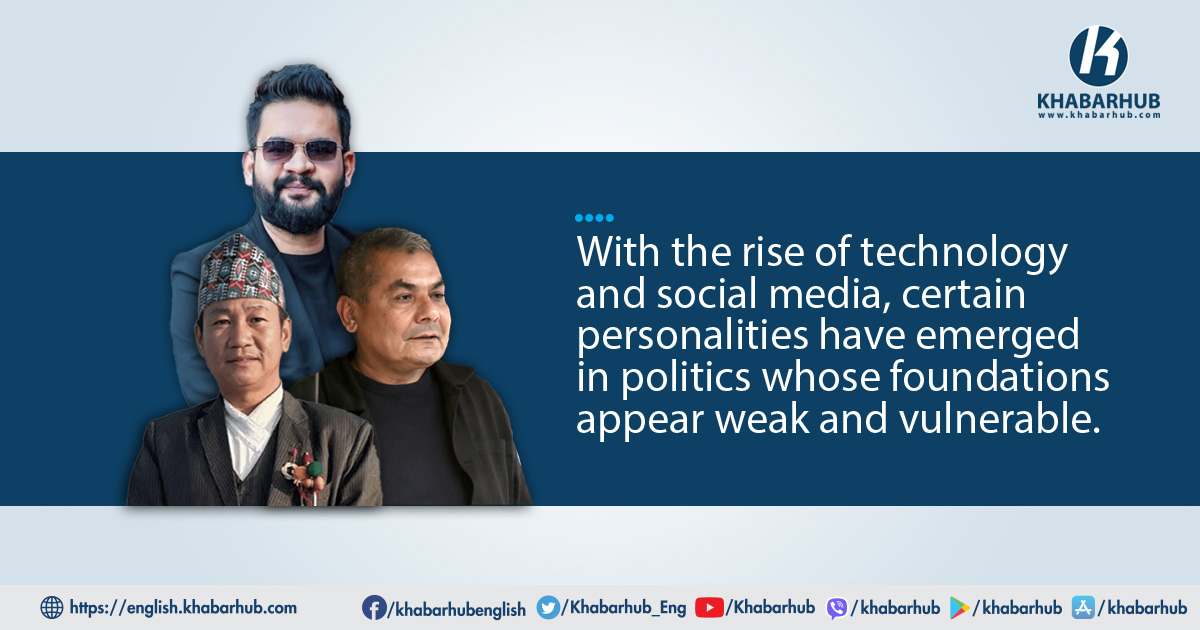
KATHMANDU: A tree with strong roots does not fall even in a storm. Similarly, the pillars of a house are made stronger than its walls. A well-grounded person, too, does not falter at the slightest disaster.
However, with the rise of technology and social media, certain personalities have emerged in politics whose foundations appear weak and vulnerable.
In this piece, we delve into the stories of such figures—individuals whose fame was born on social media, but whose political careers have faced numerous challenges, often crumbling under their own weight.
From TV presenter to Deputy Prime Minister: Rabi Lamichhane
Rabi Lamichhane, president of the Rastriya Swatantra Party, was elected as a member of the House of Representatives from Chitwan 2 in the 2079 BS elections.
Before entering politics, Lamichhane gained fame as a television presenter on News24, with his show ‘Sidha Kura Janata Sanga’. The program resonated with the masses, as Lamichhane provided a platform for ordinary citizens to voice complaints about fraud and corruption.
His investigative efforts, especially in rescuing girls from human trafficking, won him public admiration, positioning him as a trustworthy leader who achieved what the government could not.
He also earned a place in the Guinness World Records for conducting interviews for more than 60 hours without a break. Lamichhane’s prominence seemed poised to extend beyond journalism, and many believed he could lead the country.
However, things took a turn for the worse in Bhadra 2076 BS when his colleague Shalikram Pudasaini, a News24 journalist, tragically committed suicide. A video recorded by Pudasaini before his death implicated Lamichhane, accusing him of being the reason behind his despair.
Lamichhane was arrested, but the Chitwan District Court released him on bail due to insufficient evidence.
As the drama unfolded, Lamichhane’s personal life also came under scrutiny. Allegations surfaced regarding his neglect of his first wife, Isa, and their two daughters.
After divorcing Isa, Lamichhane married Nikita Poudel, the former chairperson of the Nepal Film Development Board. Despite the controversy surrounding his personal life, Lamichhane’s popularity continued to grow.
In the 2079 elections, Lamichhane founded the Rastriya Swatantra Party and successfully contested from Chitwan 2. His party secured 21 seats in its debut election, and Lamichhane emerged victorious, defeating the Nepali Congress candidate.
Lamichhane’s rise seemed unstoppable as he was appointed Deputy Prime Minister and Home Minister. Yet, his tenure was short-lived due to a controversy surrounding his citizenship status, leading to his dismissal from the Home Ministry by the Supreme Court.
Following his dismissal, Lamichhane’s frustration boiled over in a press conference where he harshly criticized media owners, editors, and political leaders.
His outburst disappointed many of his supporters, as it revealed his lack of political maturity. Despite this, Lamichhane retained a loyal following.
After resolving his citizenship issue, Lamichhane re-contested his seat in a by-election and won once again. However, fresh allegations of embezzlement from cooperatives have tarnished his reputation. Currently in judicial custody at Bhairahawa jail, Lamichhane faces charges of cooperative fraud. Once hailed as a hero, his popularity has taken a sharp decline, and those who once pledged their allegiance to him have faded into silence.
From rapper to Mayor: The journey of Balen Shah
Balendra Shah, known as Balen, was born in Kathmandu in 2047 BS to a Madhesi family with roots in Mahottari.
He developed a passion for music and poetry early on, and in 2069 BS, while still in Grade 9, he wrote and performed his first song, Sadak Balak (Street Child). Over time, Balen became a well-known rapper, music producer, songwriter, and structural engineer.
Balen holds a bachelor’s degree in civil engineering from the White House Institute of Technology and a master’s degree in structural engineering from Karnataka, India.
He also became involved in Nepalese politics following the 2072 BS earthquake, actively participating in rescue and relief efforts, particularly in mapping and assessing damaged structures.
Initially, Balen was involved with the Bibeksheel and Sajha parties. However, after their split, he ran as an independent candidate for Mayor of Kathmandu in the 2079 BS local elections, claiming that no political party represented his values.
His decision to run as an independent candidate garnered national attention, and on 12 Jestha 2079 BS, he was elected Mayor of Kathmandu, defeating seasoned political figure Sirjana Singh of the Nepali Congress.
Balen’s rise from rapper to mayor was symbolic of a desire for change and a break from traditional political leadership. However, his tenure as mayor has been marked by controversy.
His attempts to organize sidewalks, while commendable in some ways, led to the displacement of residents and sparked criticism over his handling of urban development.
His sometimes erratic responses to issues, including making controversial statements on social media and escalating tensions with officials, have caused his popularity to wane.
Once seen as a promising leader, Balen is increasingly viewed as impatient and dictatorial by some, and his political future remains uncertain.
From social activist to Mayor: Harka Sampang
Harka Sampang, the Mayor of Dharan, was born in 2039 BS in the village of Chokhane, Khotang. He moved to Dharan in 2055 BS for higher education and eventually earned a degree in Politics and Sociology from Mahendra Multiple Campus.
During his time as a student, Sampang worked as a teacher and later spent six years in Iraq and Afghanistan before returning to Nepal.
Sampang became well-known as a social activist, speaking out against corruption, public injustices, and border encroachment. He led protests against the Millennium Challenge Corporation (MCC) agreement and fought against the expansion of the Dhankute Road, which displaced hundreds of families.
His activism earned him respect, and in 2079 BS, he ran for mayor of Dharan as an independent candidate. He emerged victorious, promising to address the water scarcity issues in the city.
However, after his victory, Sampang’s leadership began to show signs of instability. His statements, claiming that he was the law and the state, and his inability to collaborate with others, led to growing concerns about his ability to govern effectively.
His erratic behavior, including insulting journalists and disregarding the boundaries of his role, further damaged his credibility. Sampang’s focus on media attention rather than fulfilling his mayoral duties has caused many to question his leadership, and his potential remains largely unfulfilled.
From 8th grade fail to medical college Director: The story of Durga Prasai
Durga Prasai, originally from Birtamod, Jhapa, became a national figure after serving rice made from Marsi (a type of brown rice) to CPN-UML Chairman KP Sharma Oli and Maoist Chairman Pushpa Kamal Dahal ‘Prachanda’.
Prasai’s humble beginnings, working in a grill factory in Europe, followed by a failed business venture in buffalo farming, did not deter him.
He eventually shifted his political allegiance from the Nepali Congress to the Maoists and made considerable wealth through real estate ventures.
Prasai’s connections with powerful political figures helped him rise to prominence.
After joining the CPN-UML, he opposed Dr. Govinda KC’s movement and became the director of a medical college. Despite his growing wealth and influence, Prasai lacked formal education and self-discipline, and his behavior was often inappropriate.
His involvement in the violent March 28th movement led to his arrest after fleeing to India.
Prasai, who once rallied support through his political connections, now faces the harsh reality of public disillusionment.
His followers, who once placed their trust in him, have begun to distance themselves, and his ambitions of regaining royal power have proven to be a distant dream.



Comment