




KATHMANDU: Former King Gyanendra Shah has recently reignited his aspirations to return to the throne.
In a video message on Falgun 6, he appealed for “everyone’s cooperation to save the nation,” a statement interpreted by many as a veiled call to reinstate the monarchy. This intent was echoed again in his New Year’s message.
However, Shah’s actions since Falgun have appeared erratic and politically immature, raising doubts about the viability of his comeback.
Often criticized for the political miscalculations that led to his exit from Narayanhiti Palace, Shah seems to be repeating past mistakes, this time with even less strategic clarity.
The violent protests that erupted in Tinkune, Kathmandu, on March 28 in his name have severely undermined two of his key supporters—Durga Prasai and Navaraj Subedi—rendering their roles in his camp ineffective.
In response to the backlash, Shah appeared to distance himself from the violence in a New Year’s video message, emphasizing the need for peace.
This move has implicitly discredited Prasai’s rebellious activities, placing Shah on the defensive while government voices continue to hold him accountable for the unrest.
For example, during the RPP General Convention two years ago, Shah was accused of “micromanaging” party affairs. Kamal Thapa, a key figure in the RPP, publicly alleged that Shah’s interference led to his defeat by Rajendra Lingden, whom Thapa claims became party president with the former king’s backing.
Following this, Shah attempted to court support from the Rastriya Prajatantra Party (RPP). However, RPP leaders questioned his ties to Prasai and Subedi, expressing concern that the former monarch might be trying to sow discord within the party. This hesitation reveals a lack of trust between Shah and the RPP leadership.
The former king’s latest political misstep was his association with Durga Prasai, who declared himself a “people’s leader” after a visit to Nirmal Niwas in early Chaitra.
Earlier, on Falgun 25, while welcoming Shah at the airport, Prasai publicly disparaged key RPP leaders, including Kamal Thapa and Rajendra Lingden, claiming to be the only true loyalist to the monarch.
Ironically, it was Shah’s own name that was dragged into controversy when Prasai and Subedi, claiming to act on his behalf, challenged the RPP and instigated violence.
With his ties to Prasai and Subedi proving costly, Shah recently invited seven top RPP leaders to dinner at Nirmal Niwas. However, when questioned about his relationship with the two controversial figures, attendees say he gave vague and evasive responses.
The dinner, arranged through Shah’s secretariat, brought RPP leaders to Nirmal Niwas at 11:50 a.m. last Friday.
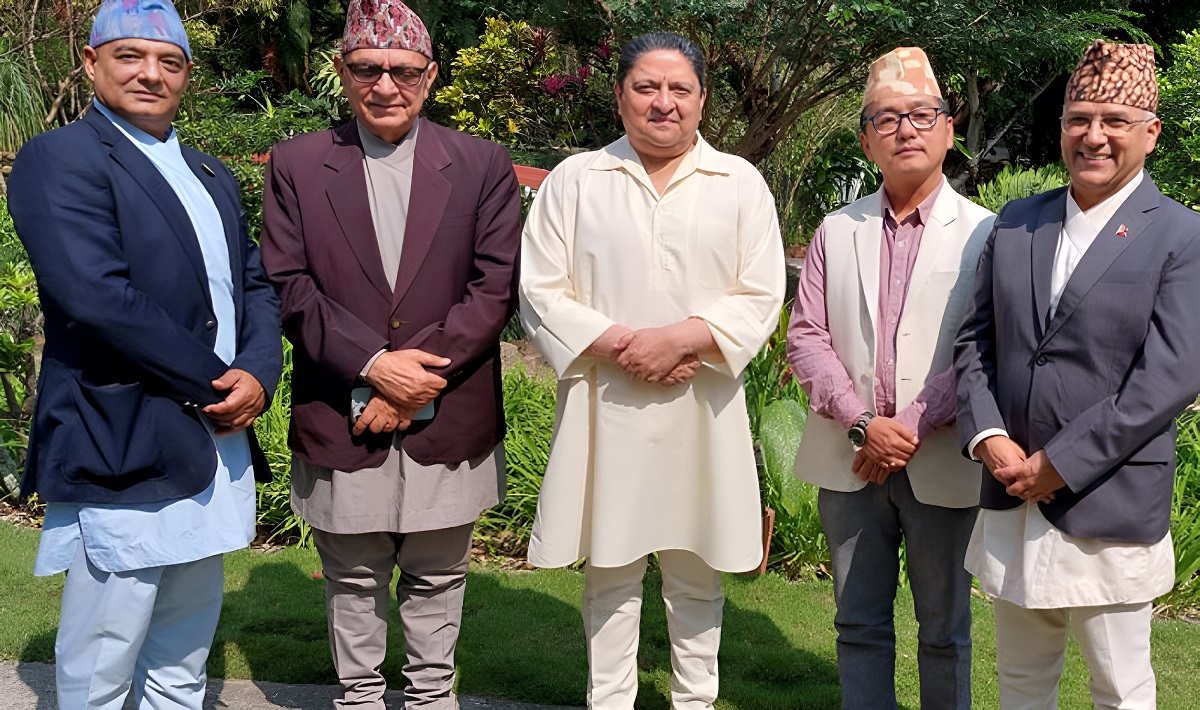
Present at the meeting were RPP Chair Rajendra Lingden, former Chair Pashupati Shumsher Rana, Dr. Prakash Chandra Lohani, Vice President Buddhiman Tamang, MPs Bikram Pandey and Dhruba Bahadur Pradhan, and Chief Whip Gyanendra Shahi.
According to sources, Shah denied appointing Navaraj Subedi as movement coordinator or Durga Prasai as “people’s commander,” as previously claimed by their supporters.
RPP leaders left with the impression that Shah’s outreach was driven by his current political vulnerability and his recognition of the RPP’s necessity.
“The king admitted he didn’t formally form a committee involving Nawaraj and Durga,” said one leader who attended the meeting. “He claimed to have no knowledge of their ‘commanding roles’ and instead praised the RPP’s peaceful protests.”
Despite his praise for the RPP, Shah reportedly did not explicitly endorse Lingden’s leadership of the pro-monarchy movement.
“Everyone knows Prasai was used to sabotage the peaceful momentum of our movement,” remarked a senior RPP leader.
“Our meeting lasted about two and a half hours, but he didn’t acknowledge involvement in not just Subedi and Prasai’s leadership roles, but also that of Jagman Gurung.”
Shah denies backing Prasai, dodges responsibility
According to RPP leaders, former King Shah repeatedly insisted during their recent meeting that he did not assign the title of ‘people’s commander’ to anyone.
“We were surprised,” said one RPP leader. “We had received credible information that he had formed a team comprising Durga Prasai, Nawaraj Subedi, and Jagaman Gurung. But he denied it outright.”
During the same meeting, RPP leader Gyanendra Shahi raised the issue of a photo showing Prasai leaving Nirmal Niwas.
Shah responded by claiming he had never met Prasai. “There was speculation that Prasai may have met some staff from the former king’s residence,” an RPP leader told Khabarhub.
“But the king brushed it off, saying, ‘I haven’t met him—when did Durga Prasai come here?’”
Despite distancing himself from Prasai, the former king praised the RPP for conducting a peaceful movement.
He went further, encouraging the party to offer flowers to police during protests and stating that violence is not a sustainable solution.
At one point in the conversation, the former king reportedly said, “The nation cannot be rebuilt at this pace. Rajendra, what are you waiting for?”
RPP Chairman Rajendra Lingden replied that, without a majority in parliament, they could only raise their voice from the opposition bench.
In response, Shah said the monarchy is an institution for all, and that the movement should also be inclusive. “We must now walk the path of our own soil—this country cannot be built on imported ideologies,” he added.
Shah’s granddaughter Shitashma was also present during the gathering, but Komal Shah was not seen.
The former king dined with the seven RPP leaders, although Pashupati Shamsher Rana abstained due to medication.
The meal included seasonal vegetables, cauliflower and potato curry, greens, beans, chicken, and two varieties of lentils, all served on ceramic plates (jarke thal).
‘Constitutional’ in words, ‘micromanagement’ in action
While Shah’s recent New Year message emphasized his support for a constitutional monarchy and invoked Prithvipath, his political actions tell a different story.
Why did Shah violate the constitution during his rule from 2059 to 2063 BS? Why didn’t he affirm his belief in constitutional monarchy back then?
Meanwhile, even royalists admit that the low turnout at the RPP’s program on Sunday to defy the ban has had a psychological impact on the royalist movement.
Many—including monarchists—now question whether he can truly be trusted to remain within constitutional bounds without acknowledging past mistakes.
For example, during the RPP General Convention two years ago, Shah was accused of “micromanaging” party affairs. Kamal Thapa, a key figure in the RPP, publicly alleged that Shah’s interference led to his defeat by Rajendra Lingden, whom Thapa claims became party president with the former king’s backing.
Thapa has since left the RPP, asserting that the monarchy should not meddle in political parties if it aims to return.
Despite speaking of constitutional monarchy, Shah has reportedly been pulling strings behind the scenes. His actions—especially his attempts to sway or fragment political forces—have cast doubt even among monarchist leaders.
As one insider put it: “Shah talks about constitutionalism, but acts like a political king.”
Back on Falgun 7, Shah hinted at becoming politically active again, calling for public support. Less than a month later, 86-year-old RPP Central Committee member Nawaraj Subedi left the party after meeting Shah and declared himself coordinator of a new movement. RPP leaders believe this split was encouraged, if not orchestrated, by the former king.
A legacy of shortsightedness
Even among former Panchayat-era politicians, Shah is often described as impulsive and shortsighted. Historical accounts suggest he engaged in questionable business practices and was involved in palace controversies long before taking the throne.
Shah never embraced the multi-party democracy established by his brother King Birendra in 2046 BS.
After ascending the throne in 2058 BS, he dissolved the 2047 BS Constitution and consolidated power—pushing even centrist parties like the Congress and UML toward republicanism. This move is widely seen as a pivotal misstep that accelerated the monarchy’s downfall.
Now, as a common citizen, Shah is once again trying to make a comeback—this time through backdoor maneuvering within the RPP.
But leaders like Kamal Thapa have warned against a monarchy returning through agitation or unilateral action.
“The monarchy must return with national consensus,” Thapa has said. “A throne won through rebellion cannot unify the nation.”
Still, Shah continues to oscillate—at times seeking support from controversial figures like Durga Prasai, and at others trying to align with RPP leadership.
After Nawaraj Subedi was placed under house arrest, culture expert Jagaman Gurung was selected as the coordinator of the Royal Institution Restoration Committee.
But in doing so, his strategy appears as confused as his intentions: torn between a royal revival and political micromanagement.
Meanwhile, even royalists admit that the low turnout at the RPP’s program on Sunday to defy the ban has had a psychological impact on the royalist movement.
“They’re telling the workers to gather at Babar Mahal and defy the ban, while the leaders are safely staying inside Singha Durbar?” an RPP worker told Khabarhub.
“They want us to carry out a peaceful movement and break the ban? Sunday’s demonstration revealed the immaturity of the RPP leadership, which is why there are growing signs that the movement might progress under the leadership of Rajendra Lingden, just as it did under Durga Prasai.”
On the other hand, the former king’s position has become even more uncertain. Should he align himself with Durga Prasai or the RPP? He is caught in a dilemma.
The former king has already betrayed Kamal Thapa at the general convention, further complicating his situation.
Jagaman in shock
After Nawaraj Subedi was placed under house arrest, culture expert Jagaman Gurung was selected as the coordinator of the Royal Institution Restoration Committee.
Gurung stepped up after Subedi was arrested, claiming he should take over leadership.
However, Jagman himself is now confused. While he certainly has the support of former King Gyanendra, he is questioning his role.
“Who made me the coordinator? Whose coordinator am I? Where do I truly belong?” Jagaman has been asking his close associates.


Comment