




The recent Secondary Education Examination (SEE) results have highlighted the deteriorating state of education in Nepal.
Despite substantial investments aimed at improving education quality, student performance continues to decline annually.
The SEE results, published on June 27, revealed that 52.14% of students failed to meet the grading criteria.
Examination Overview
The National Examination Board (NEB) reported that out of 464,765 students who took the SEE exam, only 222,472 (47.86%) qualified for enrollment in Grade 11.
A staggering 242,313 students fell into the non-grading category, with 115,834 failing in two subjects.
The results were based on the new curriculum and the Letter Grading Directive, 2078, which requires students to achieve a minimum GPA of 1.6 in each subject to pass.
Government Response
In response to the disappointing results, the government altered the directive to allow all students to participate in a grade improvement exam, as announced by Prime Minister Pushpa Kamal Dahal’s secretary Ramesh Malla on Facebook on Friday evening.
Expert Opinions
Experts have provided varying perspectives on the poor pass percentage:
Ramesh Prasad Sharma, a veteran educator, argues that the SEE results reflect a longstanding decline in education quality, previously manipulated to appear better. He emphasizes the need to redefine educational goals.
Dr. Bidyanath Koirala, an education expert, attributes the high failure rate to deficiencies in both teaching and learning. He stresses the importance of updating teaching methods to meet the evolving needs of students and calls for greater accountability among teachers.
Persistent Issues
Repeatedly, the government has formed investigation committees following poor SEE results, yet their recommendations often go unheeded.
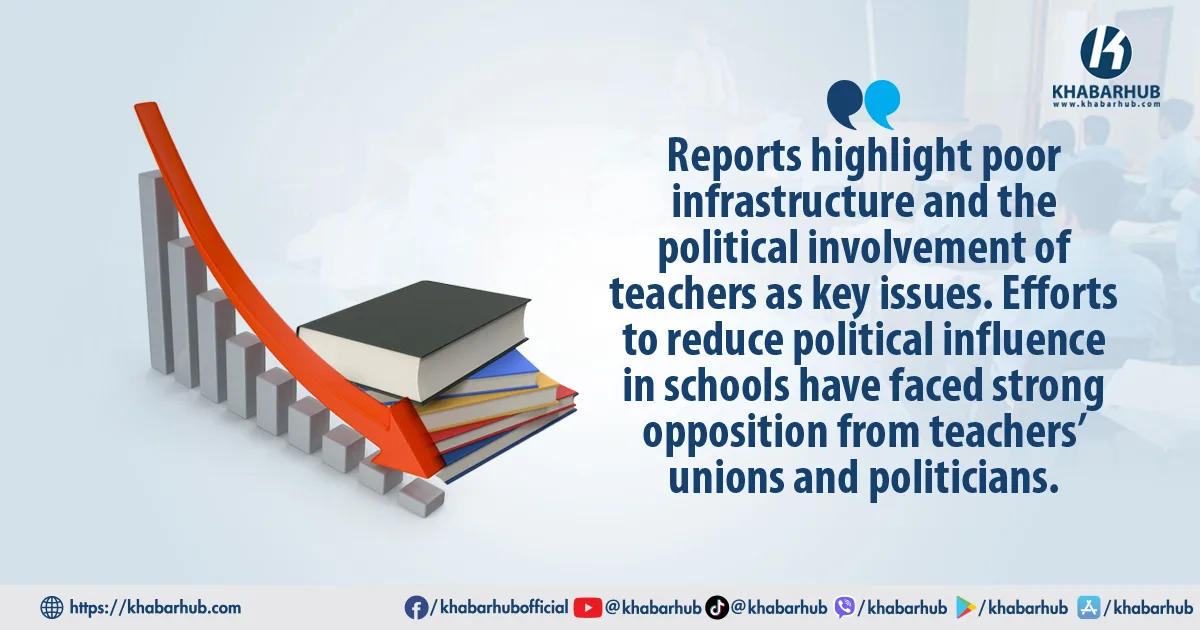
Reports highlight poor infrastructure and the political involvement of teachers as key issues. Efforts to reduce political influence in schools have faced strong opposition from teachers’ unions and politicians.
Call for Action
Dr. Koirala advocates for proactive measures from all levels of government and teachers’ associations to address the root causes of the education crisis.
Despite recognizing the detrimental impact of political involvement in education, no political party has taken a definitive stand for quality education due to concerns over losing voter support.
They (the political parties) think anything unpleasant to teachers can make them lose the teachers’ support and the support of the public as well for the teachers work as the party agents in local levels in most places.
Conclusion
The ongoing crisis in Nepal’s education system requires urgent and bold action. The willingness to address political interference and prioritize educational quality is essential to bring about meaningful change.

Comment