




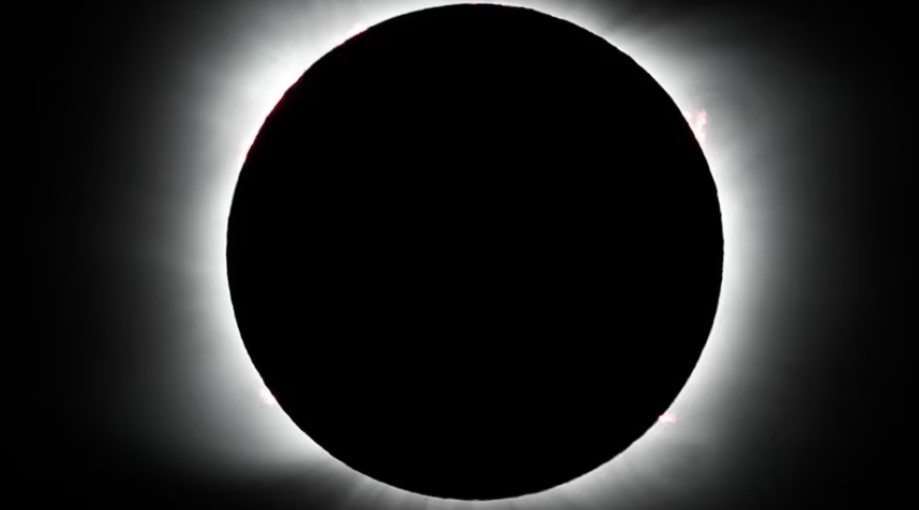
NEW YORK: Dust off your eclipse glasses: It’s only a year until a total solar eclipse sweeps across North America.
On April 8, 2024, the moon will cast its shadow across a stretch of the U.S., Mexico and Canada, plunging millions of people into midday darkness.
It’s been less than six years since a total solar eclipse cut across the U.S., from coast to coast. That was on August 21, 2017.
If you miss next year’s spectacle, you’ll have to wait 20 years until the next one hits the U.S. But that total eclipse will be visible only in Montana and the Dakotas.
Here’s what to know to get ready for the 2024 show:
Where can I see it?
Next year’s eclipse will slice a diagonal line across North America on April 8, which falls on a Monday.
It will start in the Pacific and first reach land over Mexico around 11:07 a.m. local time, NASA predicts. Then, it’ll cross over into Texas and move across parts of the Midwest and Northeast in the afternoon.
All in all, it will hit parts of 13 U.S. states: Texas, Oklahoma, Arkansas, Missouri, Illinois, Kentucky, Indiana, Ohio, Pennsylvania, New York, Vermont, New Hampshire and Maine. Cities in its path include Dallas; Little Rock, Arkansas; Indianapolis; Cleveland and Buffalo, New York.
Parts of Canada, including Quebec and Newfoundland, will also get a glimpse before the eclipse heads out to sea in the early evening.
A total eclipse will be visible within a 115-mile-wide swath — the path of totality. Outside that path, you can still see a partial solar eclipse, where the moon takes a bite out of the sun and turns it into a crescent shape.
Total eclipses happen about every 18 months, but a lot of times they cross over remote areas where few people see them.
What happens during an eclipse?
Solar eclipses occur when the moon passes between the Earth and the sun, blocking the sun’s light from reaching us.
Even though the moon is about 400 times smaller than the sun, it’s also about 400 times closer to Earth, said University of Colorado astronomer Doug Duncan. So when the orbits line up just right, the little moon can block out the whole sun. Those who are standing in the right spots will experience totality: when the moon casts its shadow over the landscape.
“In just seconds, you go from bright, bright daylight to like the middle of the night,” said Debby Brown, who saw her first total eclipse in 2017 with Duncan in Grand Teton National Park in Wyoming.
“The stars are out. All of a sudden, all the animals are quiet,” said Brown, of Arlington, Virginia.
During the 2024 eclipse, totality will stretch to around four and a half minutes — almost twice as long as in 2017.
What’s the best spot?
To catch the full eclipse experience, planning ahead is key, Duncan said. Weather could be a big factor since the eclipse is coming in the spring, when conditions are unpredictable. That’s why Duncan selected Texas for his eclipse tour next year, where the odds of clear skies are better.
Your choice also depends on what kind of experience you’re looking for, said Bob Baer, who’s coordinating eclipse plans at Southern Illinois University in Carbondale.
Carbondale — in the crossroads of both the 2017 and 2024 eclipse paths — will hold a viewing event at the school’s stadium again. It’s a big group experience, Baer said: “The last 20 minutes before totality, the stadium gets as loud as a football game.”
But you can find events of all different flavors planned along the eclipse path: luxury cruises in Mexico, music festivals in Texas, farm camping in Arkansas, planetarium visits in upstate New York.
“The goal, at the end of the day, is to get as many people outside as possible, looking up during totality,” said Dan Schneiderman, who is helping the Rochester Museum and Science Center plan events.
You’ll want to grab eclipse glasses to see the partial phases before and after totality, Schneiderman added. Looking at the partially covered sun without protection can cause serious eye damage.
Brown and her husband are planning to join Duncan’s eclipse tour in Austin. Her first eclipse experience flew by.
“I’m looking forward to being able to enjoy this even longer,” Brown said. “To be able to just lean into the moment.”
What other eclipses are coming up?
The U.S. will get some eclipse action ahead of the big event in 2024. There will be an annular eclipse — when the sun isn’t completely covered but appears like a ring of fire in the sky — later this year, on October 14.
The path of that eclipse will cross from Oregon down through California, Nevada, Utah, Arizona, New Mexico and Texas.
Later this month, there will be a rare hybrid eclipse, which switches between a total and an annular eclipse at different points along its path. But few people will see it. The April 20 eclipse is mostly over the Indian Ocean and crosses over only a few slivers of Australia and Southeast Asia.
With a 20-year gap until the next total solar eclipse in the U.S., Duncan says it will be worth it to be in the path of totality next year. He’s witnessed 12 total eclipses so far.
Seeing a partial eclipse — even if it’s 90% covered — means “you missed all the good stuff,” he said.
(AP/VOA)





Comment