




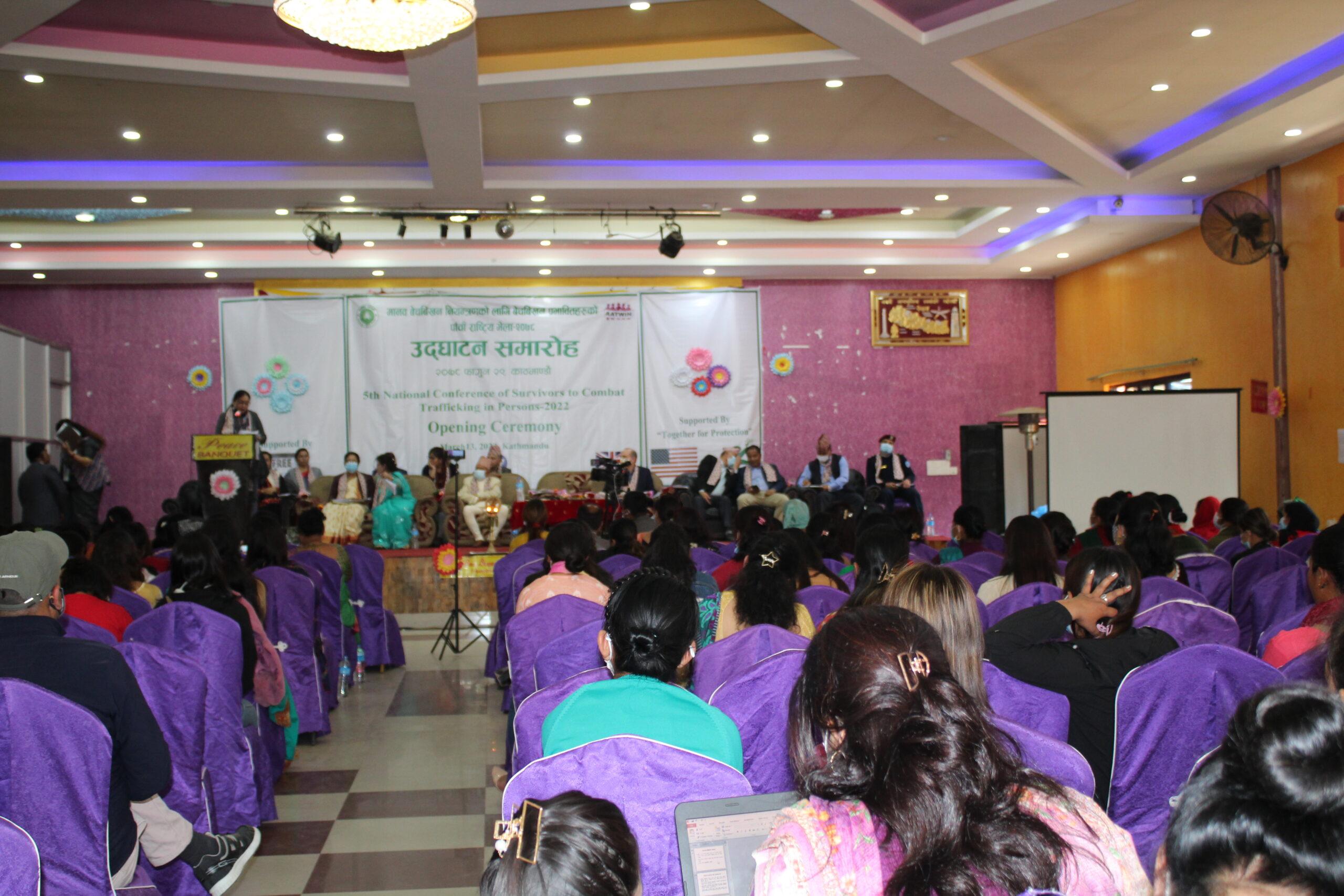
KATHMANDU: A two-day national conference of survivors of human trafficking started in Kathmandu on Sunday.
Addressing the opening ceremony of the program, Chari Maya Tamang, an activist against Trafficking in Persons (TIP) said that the conference will discuss issues surrounding the problems of the survivors including the drafting of laws in consonance with the Palmero Protocol.
Stating that prevalent laws do not adequately address the difficulties of the survivors of TIP, she said that some of the survivors of TIP and their children have been deprived of citizenship, which has complicated their lives.
Besides the problem of reintegration into society, survivors also face the problem of dignified work life, according to Tamang. She urged the participants to fight in unison against the global heinous crime that has been violating human rights.
Speaking at the program Chief of Party, Hamro Samman Project, Winrock International Zainab Akhtar said that combating TIP falls under the focused priority of the project.
She said that Hamro Samman, Winrock International has been working with federal, provincial and local governments to tackle problems of TIP. District Committees for Controlling Human Trafficking (DCCHT), Local Committees for Controlling Human Trafficking (LCCHT) and Ward Committee for Controlling Human Trafficking (LCCHT) supported by Hamro Samman are now functional to combat TIP, she shared.
“I would like to express commitment from Hamro Samman, Winrock International and to work with the Government of Nepal, our civil society partners and the private sector to fight against TIP,” said Akhtar adding that Hamro Samman was committed to providing access to justice to the survivors. She also thanked the government and Nepal police for their support in the battle against TIP.
Mina Poudel, a representative from the Ministry of Women, Children and Senior Citizens said that fighting against human trafficking required coordinated efforts from the government, civil society organizations and journalists.
Parliamentarian Anjana Bisunke said that new strategies should be developed to address the challenges posed by the changing dynamics of TIP.
Speaking at the program, Kamala Parajuli, chairperson of the National Women Commission said local representatives of local wards need to follow up on the movement of citizens for foreign employment. “That will help for prevention of TIP. If people get registered at the local level, the problem can be solved to a large extent,” she said.
Over 100 survivors from across the country are participating in the event. The event is organized by Shakti Samuha, an organization formed by survivors.




Comment