




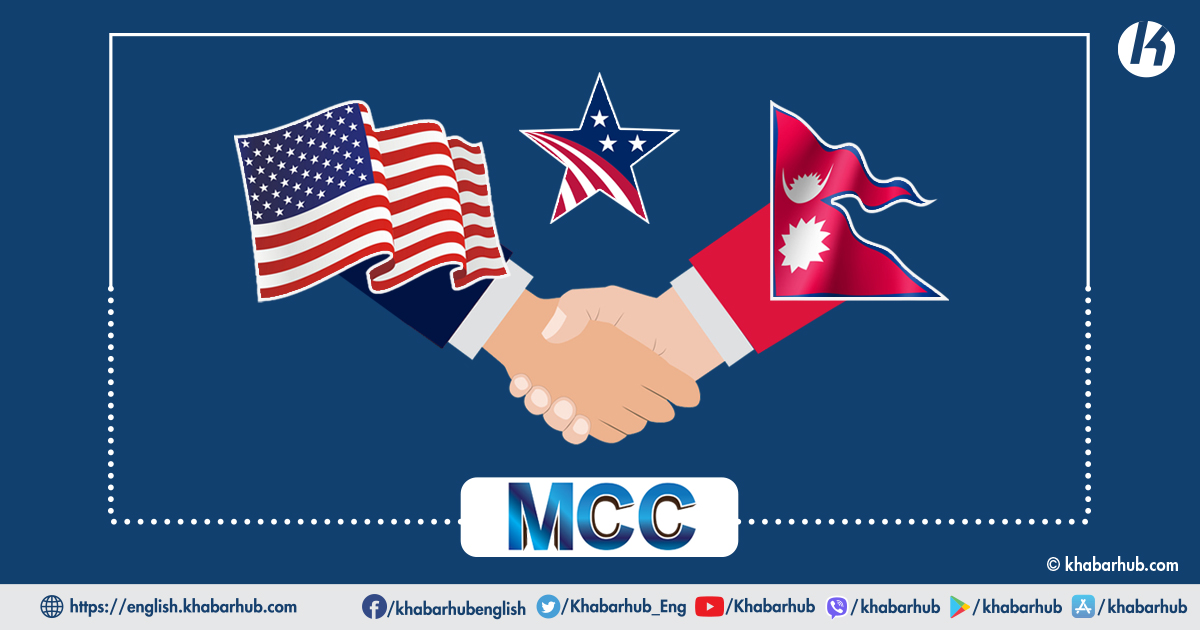
KATHMANDU: Nepal’s House of Representatives (HoR) on Sunday ratified the Millennium Challenge Corporation (MCC) Compact with what it said “interpretative declaration”.
Earlier today, a meeting of the ruling coalition held at the Prime Minister’s official residence in Baluwatar had decided to ratify the MCC agreement by including the government’s answers and interpretative declaration on the questions raised in the Parliament.
According to the ruling coalition, the five-point “interpretative declaration” includes that the parties will not consider MCC a part of US military strategy (IPS).
Likewise, the parties have also said that the MCC Compact will not be above Nepal’s constitution and laws.
Likewise, the ruling coalition has said that MCC Compact will be taken only as financial assistance, and that the audit should be done by the Office of the Comptroller and Auditor General of Nepal.
Likewise, the points of the interpretative declaration prepared by the Ministry of Finance should be considered.
The parties have also said that they would even revert the decision on the basis of political consensus.
Prior to that the ruling parties were in internal discussions on the issue.
Prime Minister Sher Bahadur Deuba, CPN-Maoist Chairman Pushpa Kamal Dahal “Prachanda”, Unified Socialist Chairman Madhav Kumar Nepal, JSP Chairman Upendra Yadav and other top leaders of the coalition parties attended the meeting.
Leaders including Nepali Congress leader Ram Chandra Poudel, General Secretary Gagan Thapa and former General Secretary Krishna Prasad Sitaula were also in the meeting.
The U.S. Government’s MCC signed a $500 million compact with the Government of Nepal in September 2017 aimed at maintaining road quality, increase the availability and reliability of electricity, and facilitate cross-border electricity trade between Nepal and India—helping to spur investments, accelerate economic growth, and reduce poverty.
This will help support the Nepal to better deliver critical services to its people, ease the movement of goods around the country, and open new opportunities for private investment—all to create sustainable development for the people of Nepal.
According to MCC, strengthening the reliability of key infrastructure will put the country’s economy on a firmer growth trajectory, advance stability, support regional security, and reduce poverty.
An additional $130 million contribution from the Government of Nepal in support of the compact—the largest up-front partner country contribution in MCC’s history—will enable even greater impact and benefits for the Nepali people.





Comment