




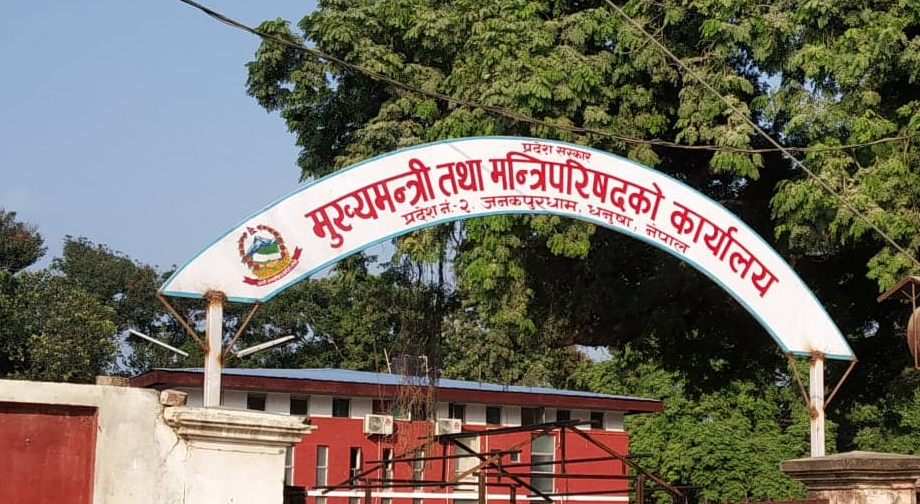
JANAKPURDHAM: The Province no 2 government has aimed at achieving high economic growth rate and lowering the rate of poverty within the coming five years to bring qualitative change in the living standard of its citizens.
In this connection, the province government has formulated the First Periodic Plan (Fiscal Year 2020/21 to Fiscal Year 2024/2025) with identification of high human development and the main vision of prosperous Madhes society.
The periodic plan has set the target of achieving targeted outcome of 11 per cent from the present economic growth of 6.53 per cent during the five years period.
The plan prepared by the Provincial Policy and Planning Commission (PPPC) contains the outline of the vision, goal, action plan, programs, expected outcomes and results incorporating the multi-dimensional topics of provincial development and construction.
Accordingly, the plan has adopted the strategy of reducing the overall poverty rate from 27.7 per cent to 21 per cent during the plan period. According to the Economic Survey 2019, the GDP of Province-2 in Fiscal Year 2019/20 was 444.49 billion.
Based on this GDP figure, the pan envisages increasing the GDP by 0.5 percentage point every year and the economic growth rate is projected to reach 11 per cent by the end of the plan period. The main targets set in the plan include: increasing the agricultural productivity and production, contribution to the inter-province demand and supply through food grain reserves, job creation for the human resources of the productive age group in the province, linking the local products in the industrialization and increased investments in qualitative health and education.
The plan has set strategies as increasing the production of local agricultural crops and basic foodstuffs, and investing in the production of human resources with the capacity and skills required for the local employment and possible areas of employment to be generated in the agriculture and industry sectors.
Similarly, it is stated in the plan that the private sector would be encouraged to set up and operate industries that address the agriculture and tourism sectors on the basis of economic viability so as to utilize the existing road networks, that the agriculture-based industries would be made the vehicle of development through its commercialization, diversification and modernization, and that modern and new technology would be developed in the agricultural research sector.
Likewise, the plan states that the land conservation and use policy would be formulated to prevent activities that have adverse effect on water conservation considering the Chure region as the main basis of water conservation in the province.
As per the data, 74 percent of the total national production is produced in this province, known as the food store of the country.
Out of the total fertile land, 89.9 per cent has been cultivated while of the 565,091 hectare land having irrigation facility, 65.8 per cent land has been getting irrigation facility from Koshi, Kamala rivers, Bagmati irrigation canal and other small rivulets.
Similarly, out of 50,000 metric tonnes of national fish production, 60 percent is produced in this province and around 4,000 ponds are in the province for fisheries.
All types of major food crops and cash crops are produced in the province due to favourable weather. Sixty-eight percent of total nation production of mango is produced in the province. Likewise, out of total 64,483 hectares of sugarcane cultivated across the nation, sugarcane is cultivated on 53,300 hectares of land in the province.
There are 17 sugar mills in the country. Of them, eight are in operation in the province and it produces 2.467 million metric tonnes of sugar against 3.233 million metric tonnes of the total national sugar production, reads the data.
Out of total industrial houses in the country, the province has 12.7 per cent and it has occupied 16.2 percent out of the total gross domestic product of the country. Vice-Chairperson of Provincial Policy and Planning Commission, Dr Bhogendra Jha said that a strategy has been formulated to increase the GDP to Rs. 683.62 billion during the plan period based on these facts.
As per the plan of the provincial planning commission, it has been estimated that a total of Rs 115.196 billion fixed capital should be invested as per the goal determined by the commission. In view of expansion of private sector and the government’s role in it, it is expected to be 38 percent investment from public sector, 58 percent from private sector and four percent from cooperatives. Investment from public sector is expected to focus on infrastructure, education, health and agriculture while cooperatives focus on agriculture, cottage industry and trade, financial sector, education and health.
Of the total investment from the fiscal year, 2019/20 to 2023/24, public sector accounts for Rs 437.07 billion, private sector for Rs 668.01 billion and cooperatives for Rs 46.07 billion, it is expected. Until that period, per capita income is expected to rise to USD 1000 from existing USD 799. In the FY, 2018/19, income inequality index of the province stood at 29.5 percent while share of poor people in income was 10.85 percent and their access to financial service 18.3 and semi-unemployment 24.7 percent.
Mahottari which has the lowest income as compared to other districts in the province has USD 681 per capita income, being lowest than average. According to the 2014 human development report, of eight districts within the province, Mahottari recorded 0.388 percent as inter district income inequality index and Rautahat 0.386 percent.
Until end of the periodic plan, two economic zones, eight industrial villages, six industrial areas and 11 industrial corridors are expected while the number of big and small industries 275 and 500 respectively. Likewise, cottage and small industries are expected to be 18,000 and 105,000 human resources are expected to get engaged in them.






Comment