




Nepal has survived for centuries in one of the world’s most difficult geopolitical environments. Its survival has never been accidental. Geography, diplomacy, political adaptability and the ability to manage asymmetry have all played a role. Yet survival has also carried a cost. At critical moments in its history, Nepal has struggled to translate geopolitical survival into a coherent internal strategy and a clearly defined national purpose.
Two important works help illuminate this paradox: Ludwig F. Stiller’s The Silent Cry: The People of Nepal, 1816–1839 and Leo E. Rose’s Nepal: Strategy for Survival. Written from different historical perspectives, the two works appear to ask different questions. Stiller examines Nepal’s internal political and social conditions following the upheaval of the Anglo-Nepalese War and the Treaty of Sugauli. Rose examines the evolution of Nepal’s foreign relations and its efforts to preserve autonomy in the face of powerful neighbours, particularly India and China.
Read together, however, they provide a powerful framework for understanding Nepal’s enduring strategic dilemma.
Stiller helps us understand the internal vulnerability of the state. Rose helps us understand the external strategy of survival. Nepal in 2026 must now bring these two dimensions together.
The challenge is no longer simply how Nepal survives between larger powers. It is how Nepal develops the internal strength and strategic capability to shape its own future.
That is the transition from survival to strategic agency.
The Silent Cry: Nepal After Sugauli
Stiller’s The Silent Cry examines Nepal during the critical period from 1816 to 1839, beginning in the aftermath of the Anglo-Nepalese War and the Treaty of Sugauli and extending through the political decline and death of Bhimsen Thapa.
A divided political system provides opportunities for external actors to influence domestic choices without directly challenging sovereignty. Therefore, the first line of strategic defence is not always the border. It is institutional cohesion at home. This is one of the most important lessons that emerges when Rose and Stiller are read together.
The significance of this period lies not simply in territorial losses. The deeper problem was that Nepal had entered a fundamentally different strategic environment. The period of territorial expansion had ended. British power in India had become the dominant external force in the subcontinent. Nepal had to adjust to a new geopolitical reality. This required more than diplomatic accommodation. It required internal political and institutional adjustment to a new strategic age.
Stiller’s account is important because it reveals the difficulty of that adjustment. Political competition, elite rivalry, administrative pressures and the relationship between the Kathmandu political centre and the wider population became increasingly important.
The “silent cry” therefore represents more than social suffering. It can be understood as the accumulated voice of a society whose political centre was struggling to respond adequately to the changing conditions around it. The lesson is profound: A state can survive an external shock and still remain internally unprepared for the consequences of that shock. That distinction matters enormously for Nepal today.
From Strategic Shock to Political Adjustment
The history of post-Sugauli Nepal illustrates a recurring problem in statecraft. External circumstances can change faster than political institutions. When the external environment changes, a state must redefine its interests, institutions and methods of survival. If it fails to do so, political energy becomes absorbed by internal competition.
This does not necessarily mean that political competition itself is dangerous. Political competition is natural. The danger arises when competition over power replaces competition over national purpose. This is one of the strongest lessons that can be drawn from Stiller for contemporary Nepal.
Nepal today is not the Nepal of 1816. It is a federal democratic republic with vastly greater international connectivity and political participation. Yet the underlying strategic question remains relevant: Can Nepal’s political system adapt to a changing external environment while simultaneously responding to changing expectations within society? That is the contemporary version of the silent cry.
Rose: The Strategy of Survival
If Stiller helps us understand the internal dimension, Leo E. Rose provides the external strategic framework. Rose’s Nepal: Strategy for Survival, originally published by the University of California Press in 1971, examines the historical foundations of Nepal’s foreign relations and its changing relationship with the major powers around it. The book traces Nepal’s experience from the wars with Tibet and China and the Anglo-Nepalese War through the Rana period, the post-1945 transformation, the crisis with New Delhi and the development of the politics of balance.
Rose’s central contribution is to demonstrate that Nepal’s foreign policy cannot be understood independently of geography. Nepal is a small state positioned between larger powers. Its survival therefore depends not on achieving parity with those powers but on managing asymmetry.
Nepal cannot change its geography. It cannot move away from India and China. It cannot eliminate the interests of larger powers in the Himalayas. What it can do is develop diplomatic strategies that preserve room for manoeuvre. This is the essence of Nepal’s strategic tradition.
Do not confront a larger power unnecessarily. Do not become dependent on one power. Maintain relationships with multiple powers. Preserve autonomy. Exploit geopolitical space through diplomacy. This is what has often been described as Nepal’s “diplomacy of the weak.”
But there is an important qualification. Weakness does not necessarily mean helplessness. For a small state, geography, diplomacy, timing, political intelligence and strategic patience can compensate for material limitations. Nepal’s history demonstrates precisely that.
The Two Books Together
The intellectual value of bringing Stiller and Rose together lies in their complementarity. Rose asks: How does Nepal survive externally? Stiller asks: What happens inside Nepal when the state is confronted with major change? One examines external strategy. The other reveals internal vulnerability.
Together, they suggest that Nepal’s sovereignty has always depended on two forms of resilience: external strategic resilience and internal political resilience. The first prevents absorption by larger powers. The second prevents internal weakness from undermining the state. Nepal has historically invested heavily in the first. Its next strategic transition requires greater attention to the second.
Nepal’s Traditional Strategic Equation
For much of modern history, Nepal’s external strategic equation was primarily understood through its relationship with India and China. The objective was not to choose permanently between them but to maintain sufficient space between them and preserve strategic balance. That strategic logic remains relevant. But the environment has become more complex.
India remains Nepal’s most important economic, geographic and connectivity partner. China has expanded its economic, infrastructural and strategic engagement across the Himalayan region. The U.S. and other external middle powers have also developed significant interests in Nepal within a broader Indo-Pacific and global strategic context. Nepal is therefore no longer operating in a simple two-dimensional strategic environment. It faces a three-dimensional geopolitical equation. This makes the traditional balancing strategy both more important and more difficult.
The New High-Wire Act
Nepal’s strategic position today can be described as a high-wire act. The country must engage India without becoming strategically dependent on India. It must engage China without becoming strategically dependent on China. It must engage the U.S. and other distant powers without allowing Nepal to become an arena for great-power rivalry. It must preserve strategic autonomy without confusing autonomy with isolation. And it must pursue economic diplomacy that creates more economic opportunities without allowing dependence to become a source of political vulnerability.
This requires something more sophisticated than traditional neutrality. It requires an active non-alignment policy. Active non-alignment means engaging multiple powers, selectively cooperating with them and extracting benefits from each relationship while preserving independent decision-making. The principle is simple: Engage everyone. Depend on no one. Align selectively in accordance with the national interest.
From Buffer State to Strategic Bridge
This is where Nepal’s geography must be reinterpreted. For centuries, Nepal has often been viewed through the language of buffer states, strategic frontiers and geopolitical vulnerability. That perception must change. Nepal can instead become a vibrant bridge state.
Its location between two major civilisational and economic centres provides potential opportunities in: Energy, Trade, Tourism, Logistics, Digital connectivity, Infrastructure, Finance, Water resources, and Regional diplomacy.
The concept of a “bridge” should not be understood merely as a slogan. A bridge has value because others need to cross it. Therefore, Nepal must build institutional capabilities that make its territory, economy and institutions strategically relevant to regional connectivity.
This leads to a more ambitious idea: Nepal as a dual-key strategic gateway. Connectivity between the Himalayan region and South Asia should not simply pass through Nepal. It should involve Nepal as an active stakeholder. The objective should be to ensure that Nepal is not merely an object of competing connectivity initiatives but a participant capable of determining how connectivity serves its national interest.
Geography provides the opportunity. State capacity determines whether that opportunity becomes strategic power.
The Internal Trojan Horse
But external strategy alone is not enough. This is where Stiller’s warning becomes especially relevant. The greatest vulnerability of a small state is not always external penetration. Sometimes it is internal fragmentation.
When political factions become excessively dependent on external political, economic or strategic support, domestic competition can become a channel through which external interests influence national decision-making.
It should also ask: “What does Nepal want from its relationships with India, China, the United States and the wider world?” That is a fundamentally different strategic mindset.
This should not be interpreted as a rejection of international cooperation. International engagement is essential. The danger arises when external relationships become instruments of domestic political competition. That is the internal Trojan horse.
A divided political system provides opportunities for external actors to influence domestic choices without directly challenging sovereignty. Therefore, the first line of strategic defence is not always the border. It is institutional cohesion at home. This is one of the most important lessons that emerges when Rose and Stiller are read together.
Nepal’s Political Transformation: From Expectation to Confusion
Nepal has undergone extraordinary political transformation. The country moved from monarchy to republic, from a unitary system to federalism and from a Hindu state to a secular republic. These transformations generated enormous expectations. But expectations eventually confront reality.
When institutions fail to deliver economic opportunities, effective governance, accountability and national direction, political transformation itself becomes insufficient. Nepal’s recent political experience can therefore be understood through four stages: expectation, resistance to internal, intra-political and geopolitical change, strategic confusion, and strategic choice.
The first stage was expectation. The second involved resistance to structural and political change. The third is the current danger: confusion over what the next national objective should be. The fourth is the choice Nepal now faces. That choice is not simply between political parties. It is between continuing a cycle of political adjustment and beginning a deeper process of strategic state transformation.
Political Change Is Not Strategic Change
This distinction is fundamental. A change of government is political. A change of constitutional structure is political. An election is political. A change in national strategic direction is something much deeper. Nepal can change governments repeatedly without changing the strategic trajectory of the state. This is why the country risks entering what may be called strategic silence.
The people may be demanding change. Political parties may be promising change. Governments may be changing. But the state itself may still lack a sufficiently clear answer to the question: What should Nepal become?
This is the contemporary counterpart to Stiller’s “silent cry.” The difference is that today’s Nepalese citizens are not silent. The danger is that the state may become strategically silent.
From Survival to Strategic Agency
Rose’s framework was fundamentally concerned with survival. That objective remains indispensable. A state cannot exercise strategic agency if it cannot preserve sovereignty.
But Nepal in 2026 needs to go one step further. It needs to move from survival to resilience, from resilience to capability, and from capability to strategic agency.
Strategic agency means the ability to shape outcomes rather than merely react to them. It means Nepal should not ask only: “What do India, China or the U.S. want from Nepal?”
A small state’s defence strategy should be based not on matching larger powers but on making its sovereignty credible and costly to violate.
It should also ask: “What does Nepal want from its relationships with India, China, the United States and the wider world?” That is a fundamentally different strategic mindset.
The Five Foundations of Strategic Agency
Nepal’s next strategic transition should rest on five foundations.
The first is National Strategic Confidence. Nepal must develop confidence in its own ability to define and defend national interests. Strategic confidence does not mean confrontation. It means clarity. Nepal must know what is non-negotiable, what is negotiable, where partnerships are beneficial and where dependence creates vulnerability.
Second is Active Non-Alignment as a National Foreign Policy. Nepal should retain the strategic flexibility that historically served it well but modernise it for a multipolar environment. Active non-alignment should not mean equidistance for its own sake. It should mean equicentric engagement based on national interest. India, China, the U.S., Australia, Europe, Japan, Russia, South Korea and other partners should be evaluated according to what they contribute to Nepal’s strategic objectives.
Third is Economic Resilience. Economic dependence eventually becomes strategic dependence. A country cannot claim strategic autonomy while remaining excessively vulnerable in trade, energy, transit, technology or finance. Nepal therefore needs to treat economic resilience as an element of national security. Hydropower, digital infrastructure, tourism, technology, agriculture, logistics and financial services should be considered part of a broader national resilience strategy.
Fourth is Institutional Capability. Neither Rose’s diplomacy nor Stiller’s historical warning can be adequately addressed without strong institutions. Nepal needs institutions capable of thinking beyond electoral cycles. Foreign policy, national security, economic planning, intelligence, diplomacy and defence modernisation must be linked to a common national strategy. The objective should be to build a state whose strategic direction does not change every time the government changes.
Fifth is National Cohesion. Strategic autonomy begins at home. A politically fragmented Nepal will find it difficult to balance larger powers. Federalism, secularism and republicanism should therefore be judged not merely by their constitutional existence but by their ability to strengthen legitimacy, inclusion and national cohesion. Nepal’s diversity should become a source of resilience rather than a channel for political fragmentation.
The Military Dimension
There is another lesson that follows from this strategic transition. Diplomacy is most effective when supported by credible national capability. Nepal does not need a military designed to compete with India or China. It needs a military capable of protecting Nepal’s sovereignty, responding to emerging threats and contributing credibly to national resilience.
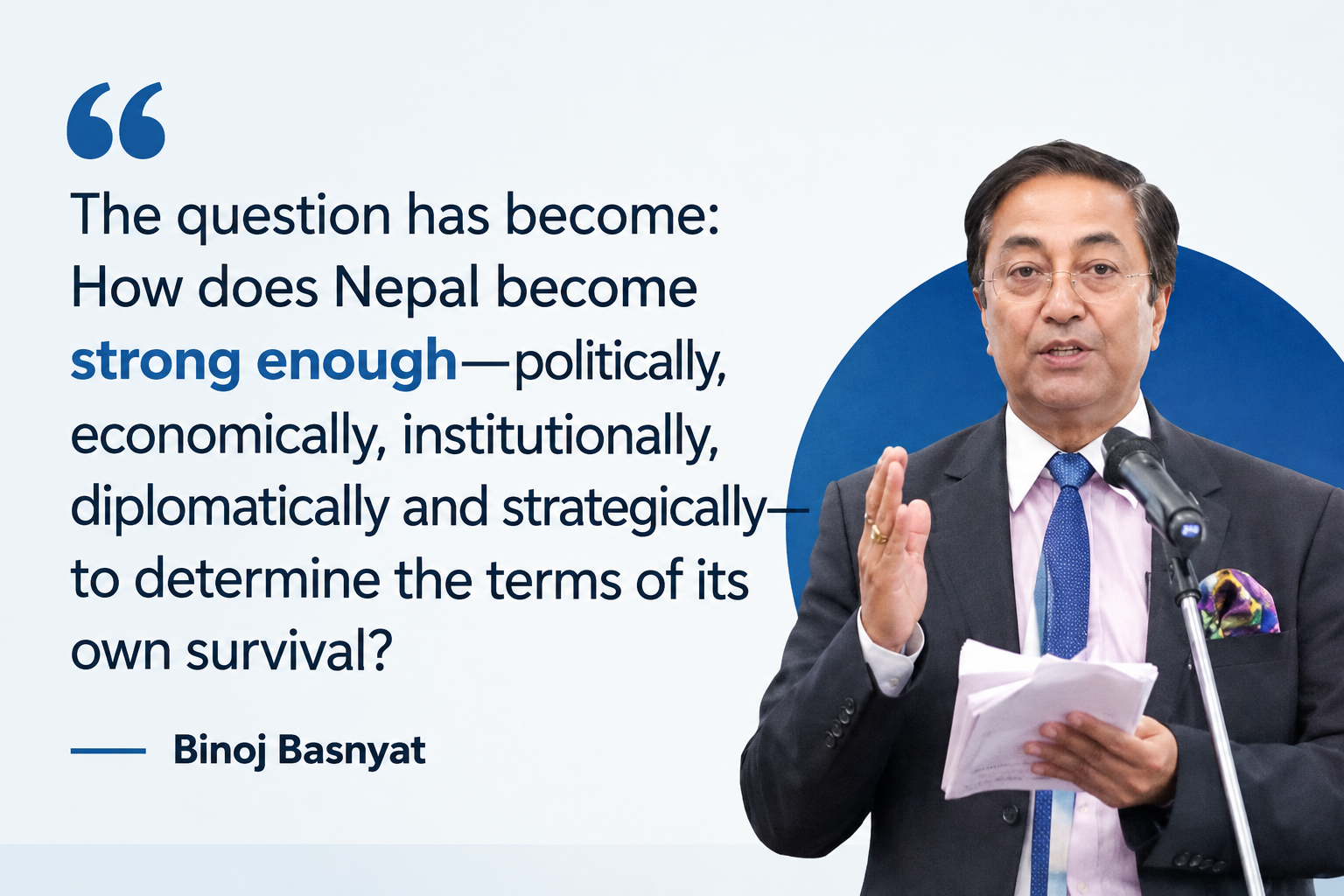
The question has become: How does Nepal become strong enough—politically, economically, institutionally, diplomatically and strategically—to determine the terms of its own survival?
The security environment now includes cyber threats, drones, information warfare, artificial intelligence, border security, disaster response, critical infrastructure protection and conventional defence. The military must therefore become part of a broader national security architecture rather than being treated separately from national development and foreign policy.
A small state’s defence strategy should be based not on matching larger powers but on making its sovereignty credible and costly to violate.
The Strategic Transition
The historical progression can now be understood in three stages.
Stiller’s world: External shock → internal adjustment → political competition → social disconnection.
Rose’s world: Geography → balancing → diplomatic flexibility → preservation of autonomy.
Nepal’s next phase: Strategic autonomy → institutional resilience → economic capability → national confidence → strategic agency.
This must be Nepal’s next phase: “From Buffer State to Strategic State.”
Nepal’s historical identity has often been defined by what surrounds it. That must change. Nepal should increasingly define itself by what it can contribute. It should be not simply a buffer between India and China, not merely a recipient of external assistance, and not simply a strategically located small state, but a strategically capable Himalayan state with economic, diplomatic, technological and security relevance.
The transition can therefore be expressed in four stages: Buffer State to Survival State to Resilient State to Strategic State.
The buffer state is defined by geography. The survival state is defined by diplomacy. The resilient state is defined by institutions and economic capacity. The strategic state is defined by the ability to shape its external environment while protecting national autonomy. That should be Nepal’s ambition.
Conclusion: From the Silent Cry to the Strategic Voice
Stiller and Rose wrote in different historical contexts, but their works together provide a remarkably useful framework for thinking about Nepal.
Stiller reminds us that external survival cannot compensate for internal political and institutional weakness.
Rose reminds us that a small state can preserve its autonomy through strategic diplomacy, careful balancing and intelligent management of asymmetry.
The next chapter in Nepal’s history, with new political, economic, diplomatic and security thinking, should therefore not be another struggle merely to survive.
The lesson for Nepal in 2026 and beyond is therefore neither to abandon Rose nor to remain trapped within his framework. Nepal must preserve the strategic wisdom of survival while building the capabilities required for agency. The country must continue to balance without becoming dependent, engage without becoming aligned, cooperate without surrendering autonomy and use geography without becoming hostage to it.
But the larger challenge is internal. Nepal must ensure that political competition does not replace national strategy, that external partnerships do not become instruments of domestic factionalism, and that public expectations are translated into institutional performance.
The strategic question is no longer simply: How does Nepal survive between larger powers?
The question has become: How does Nepal become strong enough—politically, economically, institutionally, diplomatically and strategically—to determine the terms of its own survival?
That is the transition from survival to strategic agency.
Stiller’s “silent cry” should therefore not remain merely a historical metaphor. It should become a warning against allowing political transformation to continue without strategic direction.
And Rose’s “strategy for survival” should not be the endpoint of Nepalese statecraft.
It should be the foundation upon which a new strategy is built. Nepal has survived by balancing geography. It must now learn to leverage geography. It has survived through diplomacy. It must now build capability behind diplomacy. It has repeatedly transformed its political system. It must now transform the strategic state.
The next chapter in Nepal’s history, with new political, economic, diplomatic and security thinking, should therefore not be another struggle merely to survive. It should be a deliberate transition: from the silent cry to the strategic voice; from strategic silence to strategic clarity; from survival to resilience; and from resilience to strategic agency. That is the next strategic transition Nepal must undertake.
(Basnyat is a retired Major General of the Nepali Army and a strategic affairs analyst focusing on international relations, geopolitics, national security and evolving regional power dynamics. His writings examine the strategic forces shaping regional security, statecraft, foreign policy and the changing geopolitical order.)




Comment