




WASHINGTON DC: US forces have carried out strikes against two Iranian launchers on Larak Island, marking the first known American military attack on Iranian territory since late July, according to a US official.
US Central Command (Centcom) spokesman Cdr Tim Hawkins said Islamic Revolutionary Guard Corps (IRGC) personnel had been seen preparing to launch rockets carrying sea mines into the Strait of Hormuz.
The IRGC said Sunday’s US attack killed and injured several people and warned that Washington would face a response. Iranian state media later reported that the IRGC had launched missile attacks against US military targets in Jordan.
Jordan’s armed forces said they intercepted eight missiles that entered the country’s airspace early Monday. The statement, carried by the state-run Petra News Agency, said the missiles were intercepted by Jordanian air defence systems.
The strike on Larak Island is the first known US attack on Iran since President Donald Trump halted a renewed military campaign in late July.
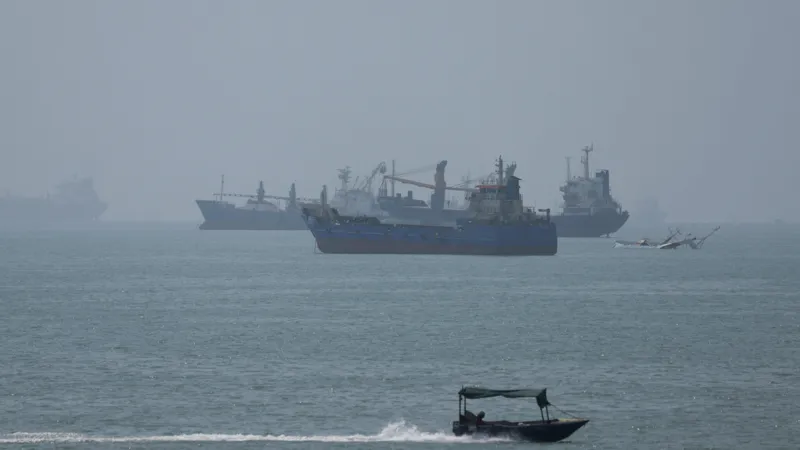
Larak Island lies off the coast of Bandar Abbas and is strategically positioned along the Strait of Hormuz, one of the world’s most important maritime routes. Iran has recently been requiring tanker traffic to pass close to the island for inspection and has reportedly demanded payments of up to $2 million from vessels seeking to cross the waterway.
IRGC spokesman Hossein Mohebbi described the US operation as a “strategic and fatal mistake” by the Trump administration, warning that Washington would face economic and military consequences.
Iranian news agency Tasnim, which is affiliated with the IRGC, reported that drones were used in the attack. It said two people were killed and two others were wounded.
Later, Iranian media reported an IRGC statement claiming that ballistic missiles had been fired at the King Hussein and Al-Azraq US bases in Jordan in retaliation for the Larak Island strike. The IRGC said the attack inflicted “heavy damage” and targeted technical infrastructure, maintenance facilities and positions used by US fighter aircraft, according to an AFP translation.
Trump said last week that all mines Iran had placed in the Strait of Hormuz as part of an attempt to block the waterway had either been removed or detonated. He warned that any vessel or boat found deploying additional mines would be destroyed.
Iranian Deputy Foreign Minister Kazem Gharibabadi rejected the claim, describing it as propaganda intended to mislead.
The latest escalation comes as Iran faces increased economic pressure from Washington. On August 24, the US announced a new sanctions campaign aimed at further isolating Tehran and expanding secondary sanctions against countries and entities maintaining ties with Iran.
Iranian officials and state media have largely dismissed the new measures as another extension of existing US economic sanctions, arguing that Washington’s previous campaign followed its military failure in the recent conflict.
The United States and Israel launched extensive strikes against Iran on February 28. Iran subsequently retaliated with attacks on Israel, US military bases and allied countries in the Gulf, while effectively shutting the Strait of Hormuz to maritime traffic.
The conflict has now entered its seventh month. Before the war, roughly 20 percent of global oil and liquefied natural gas shipments passed through the Strait of Hormuz.
(Inputs from BBC)





Comment