




Nepal is at a pivotal moment in its education system as artificial intelligence (AI) continues to advance. Students can now use AI to understand complex scientific concepts, practise foreign languages, receive feedback on their writing, and solve mathematical problems within seconds. However, this raises an important question: Is our education system ready to harness AI to improve learning?
For decades, school education in Nepal has focused on textbooks, prescribed curricula, and examinations. While these remain important, there is a need to shift towards encouraging students to ask meaningful questions, analyse information critically, exercise sound judgement, and apply their knowledge. This represents a fundamental shift in the education system.
Moving from memorisation to meaningful learning
An examination-focused environment can lead students to concentrate on memorising information rather than understanding how to apply it. Since examinations often emphasise the ability to reproduce textbook content, students may struggle to develop creativity, independent thinking, teamwork, and problem-solving skills.
AI highlights this challenge. If students can use AI to summarise information, write essays, and solve standard problems, memorisation alone offers limited educational value. Instead, we should ask whether students understand the answers, can verify their accuracy, identify their limitations, and apply their knowledge to new situations.
Schools should establish clear rules about acceptable AI use. Students should disclose significant assistance from AI, verify information, and take responsibility for their submitted work. Policies must also be age-appropriate, protect children from inappropriate content, and prevent unnecessary collection of personal information.
Students will still need foundational knowledge in reading, writing, numeracy, science, and history. However, this knowledge must be connected to inquiry, experimentation, and practical application.
Science lessons, for instance, should move beyond memorising definitions of climate change. Students could examine local weather patterns, research innovative farming practices, compare information from credible sources, and develop community-level solutions to environmental risks. AI can help organise information and explain scientific concepts. Nevertheless, students must learn to gather evidence, question assumptions, and justify their conclusions. This approach can transform them from passive learners into active creators of knowledge.
Lessons from research
International research offers valuable insights into how education systems should respond to AI. UNESCO’s Guidance for Generative AI in Education and Research (2023) emphasises the importance of a human-centred approach, privacy protection, appropriate safeguards, and the development of ethical and human capabilities.
Similarly, UNESCO’s AI Competency Framework for Students (2024) identifies four key areas: a human-centred mindset, AI ethics, AI techniques and applications, and AI system design.
These frameworks demonstrate that teaching students to use chatbots is not enough. Students must also understand how AI systems work, where the information they provide comes from, why their answers may be inaccurate, and how these technologies affect individuals and society.
Evidence from Nepal is also emerging. The report Safeguarding Futures: Exploring the Impacts of Generative AI on Child Online Protection in Nepal, published by UNICEF Nepal and ChildSafeNet in December 2024, examines both the opportunities and risks associated with young people’s interactions with generative AI.
As the government works to update school curricula, Nepal has an opportunity to move beyond simply acknowledging the importance of AI and develop a coherent implementation plan. However, international frameworks cannot simply be copied. Policies must reflect Nepal’s linguistic diversity, socioeconomic differences, federal structure, and unequal access to technology.
Avoiding a digital divide
One major concern is that AI could widen existing inequalities. Well-funded urban schools may have reliable internet connections, digital devices, trained teachers, and opportunities to experiment with emerging technologies. In contrast, students in rural, remote, and economically disadvantaged communities may lack these basic resources.
Even within the same school, students may have unequal opportunities because of differences in household income, parental digital literacy, and access to devices.
If AI-supported education depends on families being able to pay for digital services, it could create another form of educational exclusion. Preventing this requires investment in reliable electricity, affordable internet, appropriate devices, accessible digital resources, and teacher training. Offline materials and low-bandwidth resources should also be developed for communities with unreliable internet access.
AI can support students who need additional assistance by providing explanations at different levels of difficulty and generating accessible learning materials. When properly designed, these tools can also help children with disabilities and students who need more time to understand concepts.
However, AI systems can be biased, misunderstand local contexts, and provide misleading explanations. Public investment in educational technology must therefore be based on evidence that the tools are educationally valuable, accessible, safe, and cost-effective. Equity must be built into the system from the outset.
Teachers at the centre
A common concern is that AI will replace teachers. However, teaching involves far more than delivering information. Teachers understand their students’ emotions, build relationships, encourage curiosity, manage conflict, provide moral guidance, and foster a sense of belonging.
AI should be used to make teachers more effective, not replace them. It can assist with preparing lesson plans, developing practice activities, adapting reading materials, identifying patterns in student performance, and providing preliminary feedback. When used thoughtfully, these tools can reduce repetitive tasks and give teachers more time to provide individualised support.
Nevertheless, teachers need adequate training to use AI effectively. A single training session will not be sufficient. They need ongoing professional development in AI literacy, classroom integration, information verification, assessment design, student privacy, and responsible technology use.
Teacher-training institutions, universities, local governments, and school leadership teams should work together to provide sustained support. Teachers must also have opportunities to share experiences, evaluate tools, and contribute to policy development.
Rethinking examinations
Assessment is one of the most significant challenges posed by AI. When students can generate essays, summaries, and answers using these tools, traditional take-home assignments may no longer reliably demonstrate independent learning.
AI systems generally perform better in widely used languages, making it important to develop educational resources that serve students who speak Nepali, Nepal Bhasa, Maithili, Bhojpuri, Tharu, Tamang, and other languages.
However, simply banning AI will not prepare students to exercise sound judgement in higher education or the workplace. Schools should adopt assessment strategies that demonstrate genuine understanding, including supervised writing, oral examinations, practical demonstrations, project-based assessments, portfolios, discussions, and reflective learning journals.
For example, students could be asked to review an AI-generated answer, identify factual errors, explain why they are incorrect, and produce a revised response supported by credible evidence. Such tasks would assess subject knowledge, critical thinking, information literacy, and responsible AI use.
Schools should establish clear rules about acceptable AI use. Students should disclose significant assistance from AI, verify information, and take responsibility for their submitted work. Policies must also be age-appropriate, protect children from inappropriate content, and prevent unnecessary collection of personal information.
We should avoid creating a technological arms race between teachers and AI-detection software. Such tools can produce inaccurate results, and students should never be accused of misconduct solely on the basis of a detection score. Clear expectations, meaningful assessments, and professional judgement offer a more reliable approach.
Preserving and promoting local knowledge
Modernising education in Nepal should not mean abandoning local knowledge. AI systems generally perform better in widely used languages, making it important to develop educational resources that serve students who speak Nepali, Nepal Bhasa, Maithili, Bhojpuri, Tharu, Tamang, and other languages.
Learning materials should also reflect local examples, history, ecological knowledge, and community experiences.
Students should learn to use technology to investigate their own societies. They could research traditional water-management practices, local biodiversity, oral histories, or community responses to earthquakes and floods. AI could help organise, translate, and analyse the information, but students, teachers, and community members should determine how local knowledge is interpreted and presented.
Instead of asking whether AI can help us teach students faster, we should ask whether it can help us build an education system that enables all learners to think more deeply, act more responsibly, and participate more meaningfully in society.
This distinction matters because technological efficiency does not necessarily lead to wisdom. Education must nurture empathy, responsibility, democratic values, environmental awareness, and respect for human dignity. Our goal should be to develop more capable human beings, not people who behave more like machines.
Practical steps for Nepal
Nepal should consider the following measures to integrate AI into education effectively:
Revise school curricula. Introduce age-appropriate AI literacy. Younger students should learn to distinguish human judgement from machine-generated responses, identify unreliable information, and protect personal data. Older students should study algorithms, data, bias, AI-assisted research, and responsible innovation.
Establish national guidelines. The government should develop clear policies covering student privacy, age-appropriate use, academic integrity, accessibility, transparency, data protection, and the evaluation of educational technologies. These guidelines should align with national AI governance and child-protection priorities.
Introduce carefully evaluated pilot programmes. AI-supported learning should initially be tested in a diverse range of community and institutional schools, including urban and rural settings and different socioeconomic contexts. Independent evaluations should examine learning outcomes, student engagement, teacher workload, costs, and unintended consequences.
Invest in teachers and infrastructure. Devices alone will not produce sustainable improvements without training. Internet access will have limited value without meaningful content, and AI platforms will not improve learning without appropriate pedagogical support.
Build effective partnerships. Government agencies, universities, teacher-training institutions, schools, technology developers, and local communities should collaborate to develop affordable, locally relevant, multilingual educational tools. Independent oversight must ensure quality, safety, and accountability.
Ultimately, Nepal must move beyond textbooks and rote learning towards an education system that prepares learners for a more equitable, thoughtful, and humane future.
Monitor educational outcomes. Success should not be measured by the number of devices distributed or digital platforms introduced. Instead, evaluations should determine whether students are learning more effectively, educational inequalities are narrowing, teachers are receiving meaningful support, and children are using technology safely.
Preparing learners for the future
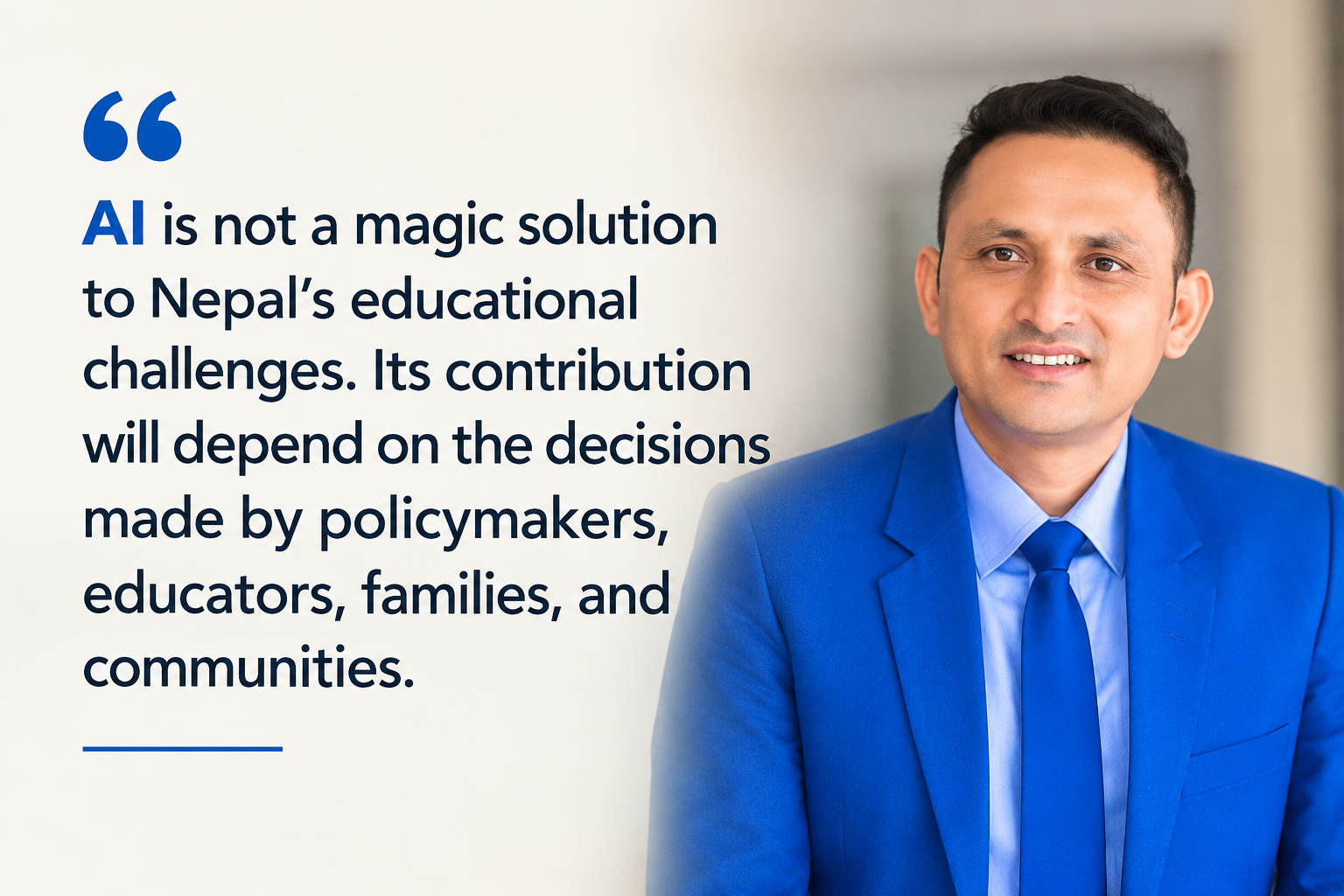
AI is not a magic solution to Nepal’s educational challenges. Its contribution will depend on the decisions made by policymakers, educators, families, and communities. Nepal has an opportunity to address long-standing problems in curriculum design, assessment, teacher training, and educational equity. However, introducing new technologies without reforming the education system would risk reproducing the same problems on new platforms.
Instead of asking whether AI can help us teach students faster, we should ask whether it can help us build an education system that enables all learners to think more deeply, act more responsibly, and participate more meaningfully in society.
Textbooks will remain valuable, teachers will remain essential, and examinations will continue to matter. However, none should be treated as the sole measure of educational success.
The greatest achievement for Nepal’s education system will not be producing students who can obtain quick answers from machines. It will be nurturing young people who know which questions to ask, how to verify answers, when to challenge technology, and why human values must guide its use.
Ultimately, Nepal must move beyond textbooks and rote learning towards an education system that prepares learners for a more equitable, thoughtful, and humane future.
(Dr. Ramesh Adhikari is an educationist, researcher, and social contributor)





Comment