




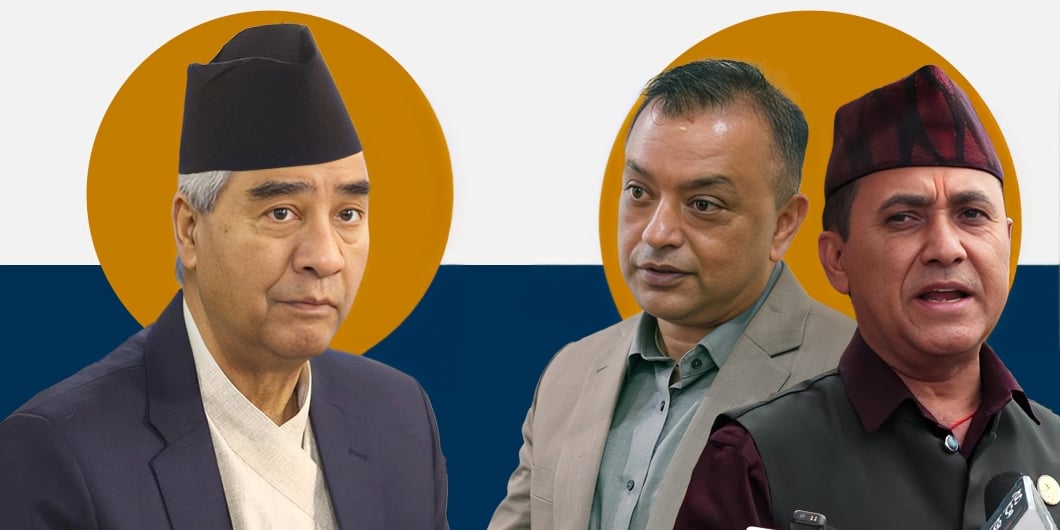
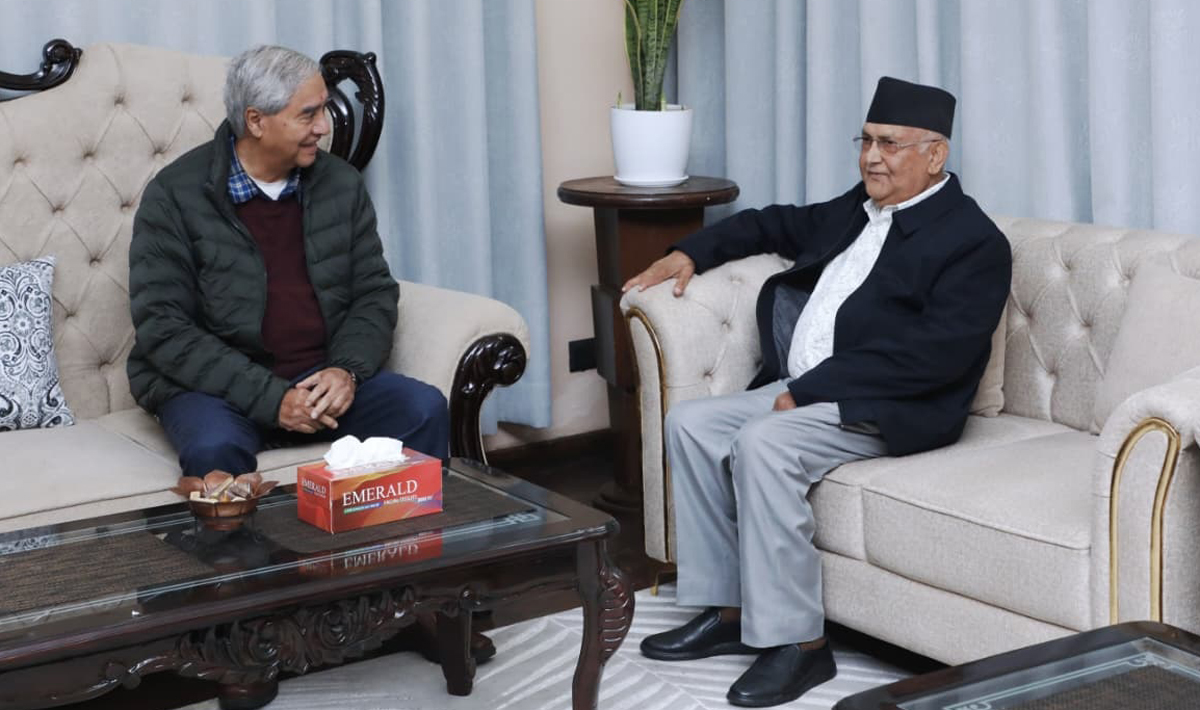
KATHMANDU: CPN-UML Chair and former Prime Minister KP Sharma Oli has claimed that the Nepali Congress has already split, a statement that has drawn sharp rebuttals from leaders across the party, who insist no such division has taken place.
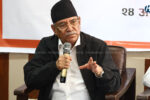
Speaking at a Madan Bhandari Foundation event on Sunday, Oli alleged that the Nepali Congress had been divided as part of a broader effort to weaken democratic forces.
“There has been an attempt to prevent democratic forces from uniting by splitting the Nepali Congress. There may be attempts to split others as well,” Oli said in the presence of former prime ministers Pushpa Kamal Dahal ‘Prachanda’, Madhav Kumar Nepal, Jhalanath Khanal, and former President Bidya Devi Bhandari.
Oli’s remarks came despite the fact that neither Nepali Congress President Gagan Thapa nor senior leaders Purna Bahadur Khadka and Dr. Shekhar Koirala have made any formal announcement suggesting a split in the party.
The comments have sparked political debate, particularly as the Nepali Congress continues internal discussions over preparations for its 15th General Convention.
Dissident camp rejects Oli’s claim
Guru Baral, a central committee member aligned with the dissident faction, dismissed Oli’s statement as lacking any factual basis.
“There has been no official split in the party. I don’t know what basis he used to make such a claim,” Baral said.
He acknowledged that differences remain between the establishment and dissident factions but argued that the party leadership has been reluctant to seriously address concerns raised by the opposing camp.
According to Baral, the dissident faction has already submitted its position on a seven-point proposal but has yet to receive a formal response.
He also expressed concern that recent remarks regarding party membership renewal have discouraged long-time party workers and contributed to growing dissatisfaction within the organization.
Baral further criticized what he described as the party’s silence over several government decisions, including issues related to constitutional governance, federalism, and local government autonomy, saying some members have begun questioning whether the party has become too accommodating toward the ruling coalition.
Establishment says party remains united
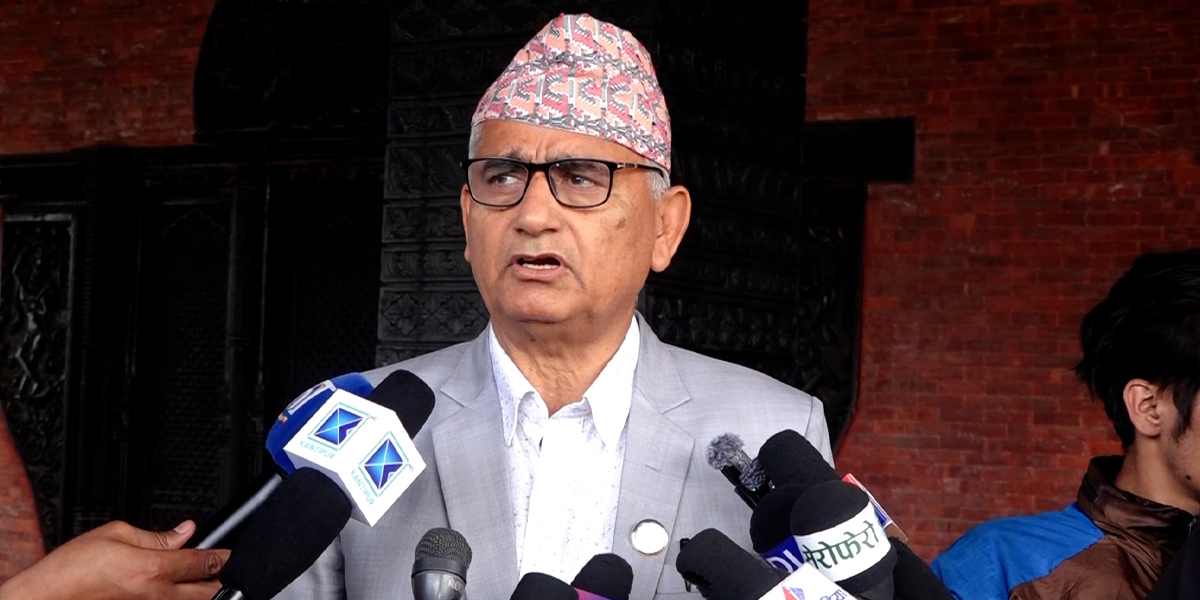
Nepali Congress General Secretary Guru Ghimire strongly rejected Oli’s remarks, insisting the party has neither split nor is heading toward one.
“Neither has the Nepali Congress split, nor will it split,” Ghimire said.
He said continuous discussions are taking place among senior leaders, including Shekhar Koirala, Purna Bahadur Khadka, Krishna Prasad Sitaula, and party president Gagan Thapa, to resolve outstanding differences.
Ghimire said negotiations are focused on addressing concerns raised by the dissident faction, including proposals submitted by both sides, while ensuring broad participation in the party’s upcoming general convention.
“Our priority is to create an environment where everyone can participate in the 15th General Convention,” he said.
He argued that Oli may not fully understand the political culture of the Nepali Congress, noting that the party has endured internal disagreements throughout its 80-year history without breaking apart.
Ghimire also clarified that discussions are continuing on issues such as the integration of central committees formed during the 14th General Convention and the special convention, active membership renewal, and the formation of organizational mechanisms for the next convention.
On the issue of active membership renewal, he said the process is mandated by the party statute and applies equally to all members.
Responding to criticism that the party has remained silent on government decisions, Ghimire said the Nepali Congress has consistently raised concerns both inside Parliament and through public statements by its leadership.
He also criticized the government’s performance during its first 100 days, accusing it of relying on political publicity rather than delivering tangible improvements for citizens.
According to Ghimire, despite commanding a parliamentary majority, the government has failed to produce results that have meaningfully improved people’s daily lives.




Comment