





KATHMANDU: Economic Digest offers a concise yet comprehensive overview of significant business happenings in Nepal, presented in easily digestible summaries.
Nepal’s latest economic signals point to a mixed but cautiously tightening environment, where financial market weakness contrasts with policy-driven liquidity management and infrastructure expansion. The decline in the NEPSE Index alongside falling gold and silver prices suggests subdued investor sentiment and possible short-term demand contraction, even as high market turnover indicates active repositioning rather than withdrawal.
At the same time, Nepal Rastra Bank absorbing excess liquidity and the government’s bi-monthly salary initiative reflect efforts to stabilize interest rates while stimulating consumption. Rising transport fares and calls for MRP reform highlight persistent cost pressures and regulatory frictions in the real economy, whereas strong banking profits and increased imports—particularly in electric vehicles—signal underlying economic resilience and structural shifts.
Meanwhile, large-scale infrastructure investments, including MCC-backed roads and Chinese-funded projects, reinforce long-term growth prospects, though declining air travel, weather disruptions, and agricultural risks underscore ongoing vulnerabilities. Overall, the economy appears to be in a transitional phase, balancing short-term volatility with medium- to long-term development momentum.
NEPSE falls 25.81 points as turnover reaches rs 4.986 billion
The Nepal Stock Exchange (NEPSE) declined by 25.81 points on Wednesday, closing at 2,744.45, a drop of 0.93 percent. The Sensitive Index also decreased by 3.06 points to 464.51, down 0.65 percent. A total of 11.23 million shares were traded across 104,005 transactions involving 351 companies, generating Rs 4.986 billion in turnover. Only 30 companies gained, while 235 declined and four remained unchanged. Out of 13 sectors, just three advanced, while 10 fell, with major losses seen in manufacturing and processing, hotels and tourism, and hydropower.
Gold, silver prices drop in domestic market today
Gold and silver prices in the market declined on Wednesday. According to the Federation of Nepal Gold and Silver Dealers’ Association, the price of gold fell by Rs 3,000 per tola (11.66 grams) compared to Tuesday. Gold, which was traded at Rs 297,500 per tola on Tuesday, dropped to Rs 294,500 per tola on Wednesday. Similarly, silver prices also eased. Silver, which was sold at Rs 4,945 per tola on Tuesday, decreased by Rs 30 to Rs 4,915 per tola on Wednesday.
NRB absorbs Rs 40 billion in excess liquidity from banks
Nepal Rastra Bank (NRB) carried out a Rs 40 billion deposit collection auction on Wednesday to reduce surplus liquidity in the banking system. Total deposits in banks have surpassed Rs 7.8 trillion. Class ‘A’, ‘B’, and ‘C’ financial institutions joined the online bidding, where interest rates were set competitively. The collected amount, along with interest, will be settled on June 17. This step is part of the central bank’s open market operations aimed at keeping interest rates stable amid growing loanable funds.
Govt begins 15-day salary pilot for employees
Finance Minister Swarnim Wagle launched a pilot program to distribute salaries to government employees every 15 days. Using the Computerized Government Accounting System (CGAS), staff at the Ministry of Finance received their first bi-monthly payment. The minister said the initiative is intended to boost consumption and overall economic activity. Initially covering federal civil servants, the program is expected to expand to all government employees. The Financial Comptroller General Office confirmed it is technically prepared to process payments twice monthly, supporting a shift toward a more digital economy.
Transport Department raises inter-province fares by 5 percent
The Department of Transport Management has increased public transport fares by 5 percent, effective Wednesday. The revision applies to both passenger and freight vehicles operating across provinces in hilly and Terai regions. The decision follows recent fuel price hikes and comes shortly after the previous adjustment on April 8. Officials said the automatic fare adjustment system was triggered by rising petroleum costs to ensure transport operators remain sustainable.
Industrialists call for reforms in MRP policies
Business leaders, led by the Kathmandu Chamber of Commerce and Industry, submitted a 20-point recommendation to the government regarding Maximum Retail Price policies. They proposed introducing MRP gradually, starting with essential goods and keeping it optional for luxury and high-tech items. The group also requested permission to label products after import instead of at customs and urged a halt to strict market inspections. They warned that impractical policies could encourage smuggling and emphasized that exchange rates and transport costs should be factored into pricing regulations.
Commercial bank profits reach rs 49.21 billion
By the end of the third quarter of the current fiscal year, 20 commercial banks collectively earned Rs 49.21 billion in net profit, marking a 19.30 percent increase from last year. Nabil Bank recorded the highest profit at Rs 6.76 billion, while Kumari Bank showed the fastest growth at 1361.76 percent. Although 13 banks reported profit growth, seven—including Prabhu Bank and NIC Asia—saw a decline in earnings.
Spare part imports through Birgunj climb to rs 26.13 billion
Imports of vehicles and spare parts through the Birgunj customs point reached Rs 26.13 billion in the first nine months of the fiscal year, a 36.19 percent rise compared to last year’s Rs 19.19 billion. Revenue from these imports increased to Rs 18.22 billion. Electric vehicle imports grew significantly by 102 percent, totaling Rs 2.98 billion for 493 units, indicating a shift toward greener transportation.
Groundbreaking held for Dhanakhola–Lamahi road under $747 Million MCC Nepal Compact
The U.S. Embassy Nepal, along with the Millennium Challenge Account Nepal and the Government of Nepal, has marked the groundbreaking of the Dhanakhola–Lamahi Road Rehabilitation Project, a key component of the MCC Nepal Compact. The broader compact represents a USD 747 million joint investment, including USD 550 million from the Millennium Challenge Corporation and USD 197 million from the Government of Nepal. Speaking at the event, Chargé d’Affaires a.i. Scott Urbom said the project reflects the strength of US-Nepal ties and a shared commitment to delivering tangible outcomes. “This milestone highlights our partnership and the benefits it brings to the people of Nepal and American businesses,” he said. The MCC Compact aims to upgrade road infrastructure, reduce transport costs, improve electricity transmission, and support long term economic growth and cross border energy trade.
Passenger numbers on Pokhara–Jomsom route drop by 40 percent
Air travel on the Pokhara–Jomsom route has declined sharply, with only 7,586 passengers recorded between July 17, 2025, and April 13, 2026. According to the Jomsom Civil Aviation Office, this reflects a 40.31 percent drop compared to the previous fiscal year. Rising fuel costs linked to the Middle East conflict and improvements in the Beni–Jomsom–Korala road have encouraged travelers to choose road transport. Currently, Tara Air and Summit Air operate around 10 daily flights, down from earlier peaks of 25.
Bad weather disrupts domestic and international flights
Adverse weather conditions across the country caused major disruptions to flight operations at Tribhuvan International Airport on Wednesday. General Manager Tek Nath Sitaula reported significant delays in domestic flights to Simara, Pokhara, Biratnagar, and Bhairahawa. Several international flights were also forced to remain in holding patterns due to poor visibility and strong winds. Authorities stated that normal operations would resume once weather conditions improve. The disruption followed multiple weather warnings issued across various provinces.
Land acquisition completed for Rs 2 billion GIS substation
The Cabinet has approved the use of 2034.93 square meters of land owned by Kathmandu Upatyaka Khanepani Limited (KUKL) for the construction of a GIS substation in Balkumari, Lalitpur. The project, funded by a Rs 2 billion loan from the Asian Development Bank (ADB), had been stalled for over four years due to land acquisition issues. As part of the agreement, the Nepal Electricity Authority will provide free electricity to KUKL’s sewage treatment plant in exchange for the land use. The substation will connect underground lines from Thimi to Teku, securing power supply reliability for the next five years.
China grants Rs 11 billion for Ring Road extension phase 2nd
The government of China has signed an agreement to provide a grant of Rs 11 billion for the second phase of the Ring Road Expansion Project. Minister for Physical Infrastructure and Transport Sunil Lamsal and Chinese Ambassador Zhang Maoming formalized the deal on Wednesday. The project focuses on expanding the section from Kalanki to Basundhara, following the successful completion of the Koteshwor-Kalanki stretch. Minister Lamsal emphasized that north-south connectivity remains a top priority, while Ambassador Maoming noted that improved investment environments would attract more Chinese investors to Nepal’s growing infrastructure sector.
Farmers urged to store wheat amid adverse weather alerts
The Department of Agriculture has issued an urgent advisory for farmers to harvest and store wheat immediately due to deteriorating weather conditions. With forecasts of fog and rain across various regions, the risk of damage to crops left in fields is high. Officials estimate this year’s total wheat production at 2.2 million metric tons. Farmers are also advised to use organic leaves like Neem or Titepati for pest protection during storage. Additionally, the Agriculture Information Center warned of increased lumpy skin disease risks in livestock as temperatures rise, urging owners to prioritize mandatory vaccinations for cattle.
Wheat productivity increases by 2.1% in Kanchanpur
Wheat production in Kanchanpur has grown by 2.1 percent this year, reaching a total of 106,114 metric tons. According to the Agriculture Knowledge Center, the productivity rate rose to 3.4 per hectare across 31,210 hectares of land. Improved access to high-quality seeds, timely chemical fertilizer distribution, and expanded irrigation through the Mahakali Irrigation Project contributed to the yield increase. Currently, 11,600 hectares in the district benefit from reliable irrigation, supporting agricultural growth despite the static cultivation area.
New suspension bridge completed over Uttar Ganga river
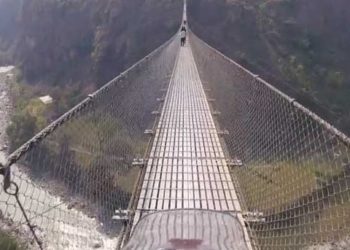
A new suspension bridge has been constructed over the Uttar Ganga River, connecting Chentung and Khaldekhulde with a federal investment of Rs 27.7 million. The 288.4 meters long structure provides essential connectivity for residents of Dogadi, Chhalhalna, Kudum, and Gadikhoula in Dhorpatan Municipality-6. Previously, locals faced dangerous river crossings or lengthy three hours detours to reach the town center. This remote infrastructure project is expected to ease the movement of livestock and improve access to basic services for over a dozen isolated villages in the region.
Joint inspection finds lack of fertilizer records in Jhapa
A joint monitoring team led by the Agriculture Knowledge Center Jhapa discovered that most private firms are failing to maintain official records of chemical fertilizer sales. The inspection conducted on Tuesday covered 11 centers across Bhadrapur, Birtamod, Haldibari, and Bahradashi. While cooperatives maintained systematic reports, private dealers were directed to issue mandatory bills and follow transparency standards. The government continues to provide subsidized Urea, DAP, and Potash through Krishi Samagri Company and Salt Trading Corporation. Authorities warned of legal action against sellers who violate pricing and reporting protocols.
Everest Color Limited opens IPO for migrant workers
Everest Color Limited launched its Initial Public Offering (IPO) today, Wednesday, specifically for Nepalese citizens employed abroad. The company received approval to issue 790,000 shares, representing 26.33 percent of its Rs 300 million capital. In this first phase, 79,000 shares worth Rs 7.9 million are available for those with valid labor permits. Investors can apply for a minimum of 10 shares and a maximum of 7,000 shares until May 5 via the Mero Share platform.
Yambaling Hydropower launches IPO for general public
Yambaling Hydropower opened its IPO for the general public on Wednesday, following earlier allocations for local residents and foreign workers. The company is offering 1,743,000 shares worth Rs 174.3 million in this second phase. This forms part of the total 2.8 million shares approved for public issuance, representing 40 percent of the Rs 700 million capital. Applications for a minimum of 10 shares are open until May 5 through C-ASBA-approved banks and the Mero Share online system.





Comment