




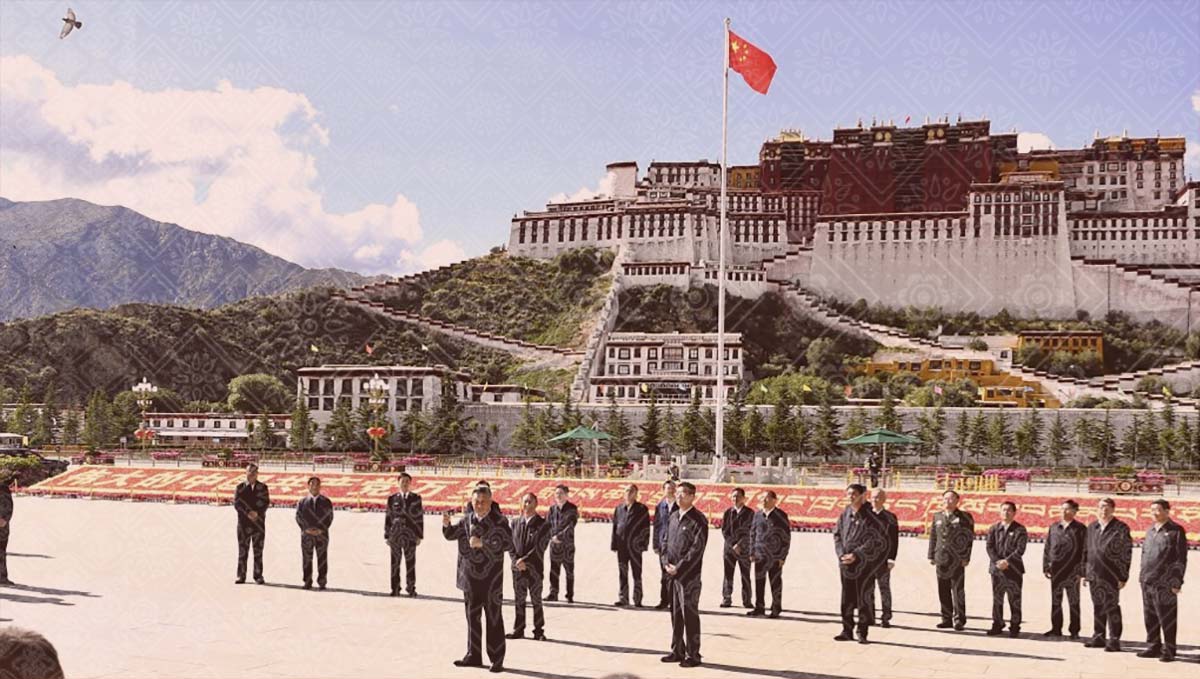
The appointment of Hu Changsheng as Tibet’s new Communist Party secretary on September 22 has come at a politically significant moment. Hu, who previously headed Gansu, replaces Wang Junzheng, who had led Tibet since 2021. The announcement itself was brief, following the familiar language of Chinese personnel changes, but the timing is noteworthy. Tibet is entering a period in which several of Beijing’s key policy priorities, including ethnic policy, religious affairs, border security, economic integration and the succession of the Dalai Lama, are converging with preparations for the 21st Communist Party Congress in 2027.
The change therefore raises a larger question than who will govern Tibet next. Why is Beijing adjusting the leadership structure of the region now, and what priorities will the new leadership face? The answer lies partly in the changing policy environment inside Tibet and partly in the Party’s preparations for the next phase of its national development agenda. The reshuffle suggests less a departure from existing policy than an emphasis on continuity, administrative experience and alignment with Beijing’s policy priorities in Tibet.
The politics behind the reshuffle
Personnel changes are a normal feature of China’s political system, particularly in the period preceding a Party Congress. Provincial and autonomous-region leaders are regularly transferred as the Communist Party renews its leadership teams, rewards officials and positions cadres for future promotion. Research on Tibet’s post-20th Party Congress leadership has similarly shown that large-scale personnel changes generally follow the Party’s five-year political cycle, with provincial and regional appointments forming part of a wider process of political selection.
But Tibet is different from an ordinary provincial posting. The Party has long treated the region as a question of political stability and national security rather than simply provincial administration. Xi Jinping’s Tibet policy has emphasized stability as a prerequisite for development, while border security, ethnic unity and religious affairs are closely linked to the Party’s approach to national sovereignty.
That helps explain the profile of the incoming leadership. Hu Changsheng is not a Tibet specialist in the conventional sense. His career has largely been built outside the region, including senior positions in Qinghai and Gansu before becoming Gansu’s party secretary. His appointment therefore appears less about bringing a distinct Tibet policy to the region than about placing another experienced provincial Party administrator at the top of a politically sensitive territory.
The departure of Wang Junzheng is similarly notable. During his five years in Tibet, Beijing placed considerable emphasis on stability, poverty reduction, infrastructure, border development and strengthening Party-led administration. In 2026 alone, authorities continued deploying more than 22,000 cadres across villages in the Tibet Autonomous Region as part of a long-running system of grassroots political work.
The reshuffle therefore comes after a period in which the Party has strengthened grassroots administration and governance. The incoming leadership inherits that institutional framework rather than starting from scratch.
Tibet’s changing political environment
The more important change is taking place in the policy environment surrounding Tibet. In March 2026, China’s National People’s Congress adopted the Ethnic Unity and Progress Promotion Law, which came into force on July 1. Beijing presents the law as a mechanism for strengthening ethnic unity and developing a shared sense of national identity. The legislation fits closely with Xi’s broader emphasis on building a common national identity and integrating ethnic policy with national development and security.
Critics, however, argue that the law gives legal reinforcement to policies that could affect the way Tibetan language, culture and religious practices are addressed. The International Campaign for Tibet has argued that it will further centralize ethnic governance and accelerate assimilation, while various analyses have highlighted provisions concerning identity, language and the construction of a shared Chinese national identity. These interpretations come from organizations critical of Beijing’s Tibet policy and should be distinguished from the Chinese government’s stated justification of the legislation.
What is important politically is that the law creates a more defined framework within which the new Tibet leadership will operate. Ethnic policy is becoming less a matter of individual local experimentation and more explicitly connected to national legislation and central Party priorities.
That was evident during Politburo Standing Committee member Wang Huning’s four-day Tibet visit in July. He called for greater attention to social stability, ethnic unity, border development and the implementation of the new law. He also called for Tibetan Buddhism to adapt to socialist society and for historical and cultural material to be used to reinforce the narrative of interaction and integration among China’s ethnic groups.
The Dalai Lama succession adds urgency
There is another reason Tibet has acquired greater political sensitivity: the succession of the Dalai Lama. The issue moved closer to the center of Beijing’s policy considerations in 2025, when the Dalai Lama announced that the institution would continue after his death and that responsibility for identifying his reincarnation would rest with the Gaden Phodrang Trust. He also stated that his successor would be born outside China. Beijing rejected this position and reiterated that the reincarnation must comply with Chinese law and established religious procedures recognized by the Chinese state.
China has previously played a direct role in the succession of Tibetan Buddhist religious figures, including in the selection of the 11th Panchen Lama. In 1995, Beijing rejected the Dalai Lama’s recognition of Gedhun Choekyi Nyima as the 11th Panchen Lama and recognized Gyaltsen Norbu instead. The child recognized by the Dalai Lama as the 11th Panchen Lama has not appeared publicly since 1995, and his whereabouts have remained the subject of differing accounts. In June 2025, Xi Jinping met Gyaltsen Norbu in Beijing, where the latter reaffirmed his support for Communist Party leadership and Xi called for the systematic Sinicization of religion.
The Panchen Lama episode provides an earlier example of the complexities surrounding religious succession in Tibet. The differing positions over the recognition of religious figures also illustrate the sensitivity surrounding the issue. The coming Dalai Lama succession is therefore expected to be politically significant.
The issue extends beyond the question of who will succeed the Dalai Lama. It also concerns the future role of the Tibetan religious institution and how its religious and cultural authority will interact with China’s existing political and administrative framework.
Why the 21st Party Congress matters
The 21st Party Congress is expected in autumn 2027 and will be an important event for China’s political and leadership arrangements. The period leading into it is already producing heightened attention to party discipline, cadre selection and social stability. The Politburo has placed party governance and discipline at the centre of the October 2026 Central Committee plenum, while a new Central Committee social-governance group has reportedly been operating as Beijing places greater emphasis on grassroots stability ahead of the congress.
Tibet fits naturally into this broader political environment. The next generation of regional leaders will have to implement the 15th Five-Year Plan, implement the new ethnic-unity legislation, manage religious affairs, oversee border development and prepare for the implications of the Dalai Lama succession. These are areas in which Beijing has been placing greater emphasis on coordinated governance.
The International Campaign’s data suggest that Tibetans occupy only 62 of 240 senior positions across the region’s major Party, government, security and judicial institutions, with non-Tibetans occupying the remaining 178. That is an assessment from an advocacy organization rather than an official Chinese classification, but it points to a longstanding feature of Tibet’s political structure: senior Party positions have generally included officials appointed from outside the Tibetan leadership.
The timing of the personnel changes, the new ethnic-unity legislation, Wang Huning’s high-level inspection, continued village-level cadre deployment and the intensifying debate over the Dalai Lama’s succession all point to a period of continued policy attention in Tibet. The developments indicate an effort to strengthen governance mechanisms in Tibet as questions involving identity, religion, border security and international attention continue to intersect.
Hu Changsheng’s appointment is therefore important not because it signals a new Tibet policy, but because it shows who Beijing has selected to implement its existing policy priorities as the political system moves towards 2027.
A key question is how the strengthened governance approach will affect political stability and development in Tibet. Under recent policies, the Party has placed greater emphasis on infrastructure development, poverty reduction, grassroots administration, and economic integration, while also strengthening state oversight of religious and cultural affairs. From Beijing’s perspective, these measures are intended to support stability and national integration.





Comment