




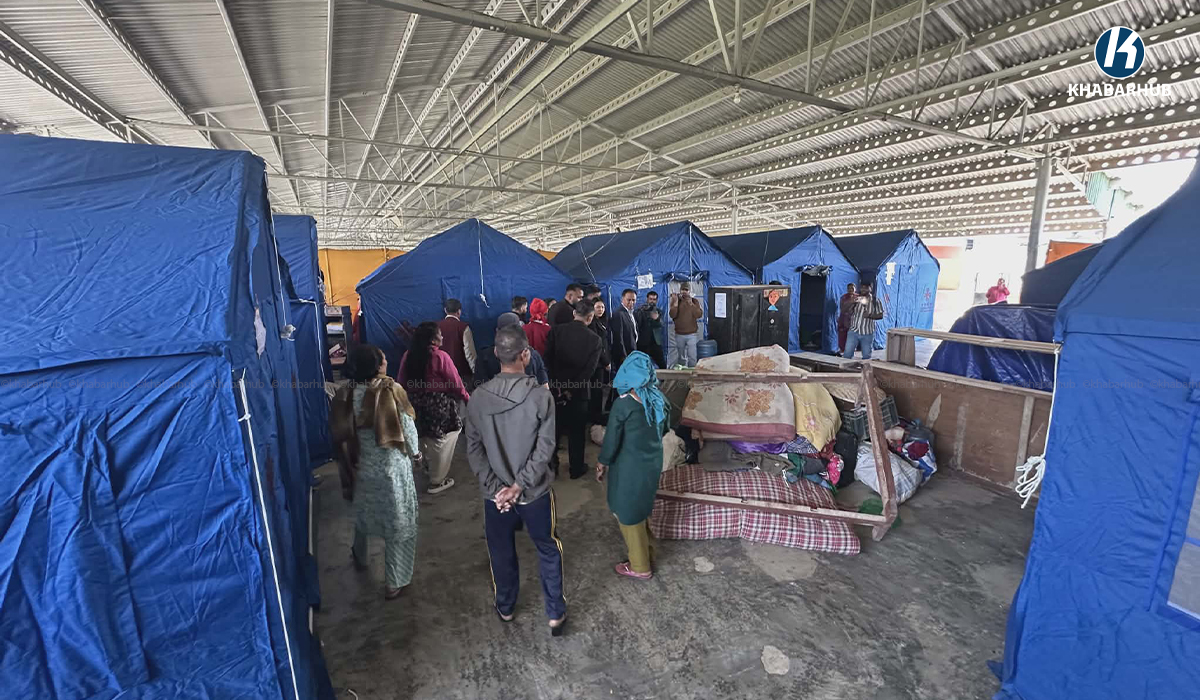
KATHMANDU: Thirty-five days have passed since the government evicted landless squatters from informal settlements after promising to arrange proper rehabilitation within about three weeks. However, there are still no visible signs of concrete resettlement efforts, while displaced families living in holding shelters say they are being treated like prisoners.
The government has also barred media access to the holding shelters, drawing criticism from rights activists who accuse authorities of attempting to hide poor living conditions and administrative failures.
Despite being forced to vacate their settlements under heavy police presence, many displaced families still remain hopeful that the new government will eventually address their problems. Even amid growing hardship, most victims have refrained from openly criticizing the government.
Meanwhile, the government has reportedly formed a new committee to address land-related problems. However, concerns have emerged after preparations were made to place Chief District Officers (CDOs) in leadership roles within the mechanism.
According to Bhagwati Adhikari, director of the Nepal Women Unity Society, such a move could further endanger landless communities.
“The mandate of the district administration office is to reclaim public land occupied by others,” Adhikari said, comparing the decision to “handing the key to a thief.”
Speaking in an interview with Khabarhub, Adhikari alleged that the state had no real preparation for rehabilitation despite carrying out the eviction drive.
“Thirty-five days have already passed since the settlements were cleared. The government claims it works rapidly on everything, but why is it silent on the issue of rehabilitation?” she asked.
She claimed the government never expected squatters to actually seek shelter and therefore failed to make adequate arrangements beforehand.
“The government has nothing except assurances,” she said, warning that frustration among displaced families could eventually spill onto the streets if their demands continue to be ignored.
Adhikari further criticized the newly proposed land problem resolution committee, saying it excludes representatives of squatters and ordinary citizens.
“Everything will now be directed by bureaucrats. There are no representatives of landless communities or even all-party representation in the committee,” she said. “This puts squatters across the country at even greater risk.”
She also warned that not only riverside squatters, but also freed bonded laborers, Haruwa-Charuwa communities, and Kamalari survivors living on public land could face eviction in the future.
Questioning claims that squatters vacated the settlements voluntarily, Adhikari said people were forced to leave under fear and intimidation.
“Police officers stood with fingers on the trigger while the Manohara settlement was being cleared,” she alleged. “Armed police entered homes and ordered residents to remove their belongings. People prioritized saving their lives.”
According to her, many residents avoided resistance out of fear for their children and elderly family members.
“People felt that if even Gen-Z protesters who were shot during demonstrations have not received justice yet, what chance would squatters have?” she said.
Adhikari also described the conditions inside the holding shelters as “inhumane.”
“Providing two meals a day and a place on the floor to sleep cannot be called proper management,” she said.
She claimed postpartum mothers were sleeping on cold floors inside tents shared with extended family members, while nutritious food and baby formula were lacking.
According to her, several children staying in the Kirtipur shelter have recently shown symptoms of measles and chickenpox.
“If they had been allowed to stay in their homes, they would not have been exposed to such diseases,” she said, calling the situation a “humanitarian crisis created by the state.”
Although the government has repeatedly said that rehabilitation efforts are underway, Adhikari expressed skepticism.
“It would be foolish to simply wait and hope the government will manage everything,” she said.
She added that displaced families have continued cooperating with authorities by registering wherever instructed, submitting documents, and providing thumbprints while waiting for rehabilitation plans to materialize.
Adhikari also criticized the government’s decision to restrict journalists from entering the shelters.
“If the management was truly proper, there would be no reason to stop the media,” she said.
She urged the government to immediately coordinate with local authorities, organizations, and community groups to provide humane resettlement options rather than keeping displaced families in deteriorating temporary shelters.






Comment