




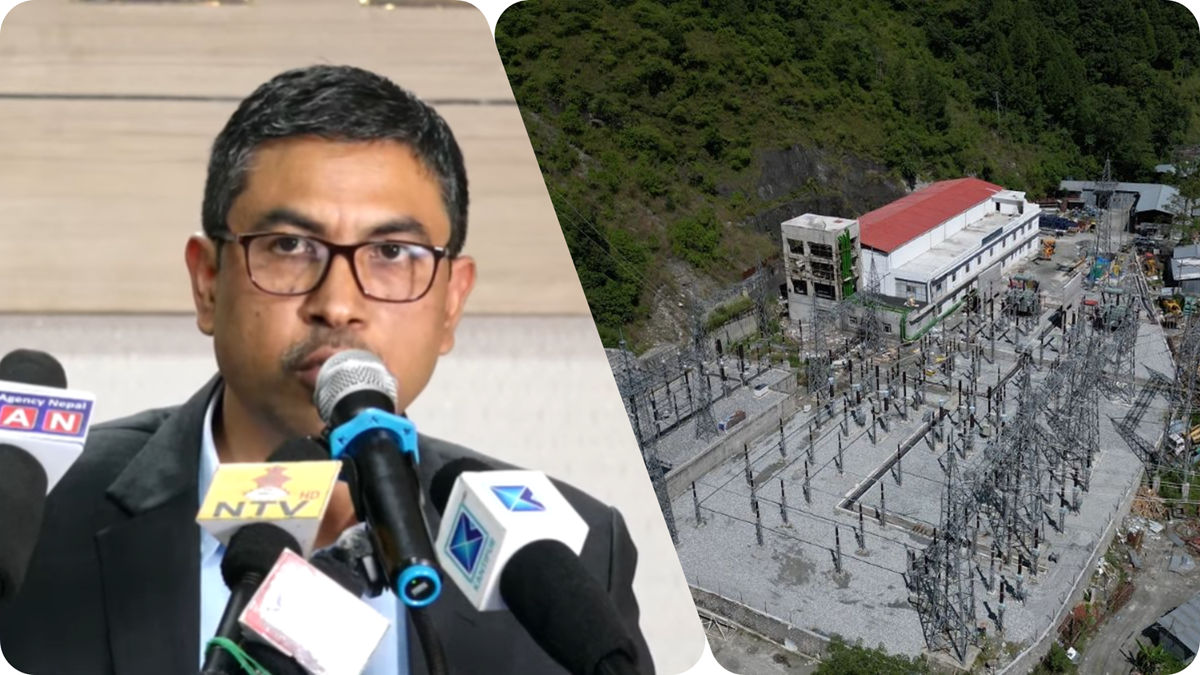
KATHMANDU: The Nepal Electricity Authority (NEA) has said damage to electricity infrastructure caused by continuous rainfall since September 25 has disrupted regular power transmission.
At a press conference in Kathmandu on Monday, the NEA said some generation plants that were shut down temporarily due to flooding have resumed operation, while plants affected by damage to transmission towers will take some time to return to service.
NEA Executive Director Dirghayu Kumar Shrestha said the tailrace gate and duct of the Raghughat Hydropower Project were damaged by flooding, while water entered the turbine floor. He said it would take around 10 days to clean the facility and resume operation.
He said damage to the Kushma-Dana transmission line had disrupted generation at seven hydropower plants with a combined capacity of 190 megawatts. Of the projects connected to the Raghughat substation, all except the 40 MW Raghughat project are in a position to resume operation, accounting for 127 MW of generation capacity.
Shrestha said preliminary details showed that towers numbered 21 and 22 on the Dana-Kushma section of the 220 kV Kaligandaki Corridor transmission line in Myagdi had also been damaged.
He said continuous rainfall caused distribution infrastructure and transmission towers to collapse, while more than 1,000 MW of generation capacity went offline, creating difficult conditions throughout Sunday.
Shrestha also said the Bhadra 10 floods damaged the Upper Trishuli 3-B 220 kV hub and several other facilities, taking 430 MW of electricity generation capacity offline. The preliminary estimate of the damage is around Rs 14 billion.
According to Shrestha, Nepal’s current installed generation capacity stands at 3,739.40 MW. An additional 320 MW is expected to come online during the dry season, taking total installed capacity to around 4,060 MW by Mangsir.
The NEA said domestic generation during the dry season is expected to be only around 1,218 MW. To meet demand, around 1,154 MW of electricity will be imported.
The authority said the peak national electricity demand during last year’s dry season was 2,292 MW.






Comment