




Prime Minister Balendra Shah returned to Kathmandu after completing his visit to Mustang last week. There is very limited information about why Shah traveled to Mustang and what he did there after visiting Muktinath.
Shah’s visit to Mustang, under tight security provided by the Nepal Army, has attracted considerable public attention. In an age of rapid technological dissemination, whatever a public figure does can quickly become a subject of discussion. This raises an important question: how does the cycle of algorithms amplify such issues?
From Kathmandu to the Terai, protests were held over the rape and murder of three-year-old Garima Chaudhary, with demonstrators demanding justice. At the same time, Shah traveled to Mustang with his wife and daughter. He also has a private life, and some argue that such a visit falls within his personal freedom. Others believe that, as the guardian of the state and all its citizens, he should have been engaged in addressing such a sensitive issue.
Debate between these two perspectives is natural. However, the way technology frames such issues and the reactions that follow increasingly carry the risk of pushing society toward conflict and division.
Algorithm and Digital War
According to computer scientist Donald E. Knuth, an algorithm involves a clear and finite process, including inputs and outputs. In the context of social media, an algorithm can be understood more simply as a decision-making process that uses rules and calculations based on data provided by users to determine what content should be displayed, prioritized or suppressed.
The words, symbols and search terms recognized by algorithms can be manipulated and changed. In the virtual world, search engine optimization (SEO) can be used to promote specific keywords and narratives, something those with technical expertise can accomplish relatively easily.
Algorithms identify patterns in users’ behavior, interests and searches and continuously serve them similar content. In this way, technology can influence people’s perceptions and behavior.
A social media post by Gyan Bahadur Shahi, leader of the parliamentary party of the Rastriya Prajatantra Party, provides one example. In the post, he suggested that Prime Minister Shah had traveled to Mustang to visit Khampa Gumba.
There is, of course, no reason why Shah should not be allowed to visit a monastery. However, such visits can carry political and geopolitical interpretations, particularly in a sensitive region such as Mustang. I will return to this aspect later.
The Race to Go Viral and the Speed of Algorithms
Three-year-old Garima Chaudhary of Jitpur Simara Sub-Metropolitan City-1 in Bara was raped and murdered. Opposition groups widely circulated photographs and videos of the girl, while protests were held in Bara, Kathmandu and other parts of the country demanding justice. Some of these protests may also have had political motivations, which is not unusual.
The government, meanwhile, appears to have attempted to turn the situation into an opportunity. Garima’s parents were brought from Bara to the Ministry of Home Affairs, where discussions were held. The Home Minister’s decision to sit on the floor during the meeting was widely discussed as a sign of simplicity. At the same time, a video of Garima’s parents thanking the government was recorded at the ministry and subsequently made public, apparently as an attempt to counter the criticism and protests taking place on the streets.
Such incidents quickly become products of the virtual world. Bipin Acharya, a member of parliament and general secretary of the Rastriya Swatantra Party, objected to this trend. Questioning what kind of society we are creating, he said that a society in which a video of the deceased’s parents thanking someone is recorded inside a ministry, while statements made by an accused during a medical examination are also publicly released, must be stopped.
His statement reflects a larger problem: trapped in the cycle of algorithms, we are increasingly prepared to turn even sensitive issues into publicity material and shape narratives to favor our own side.
In this case, a statement by the boy accused of the crime was also recorded and made public. From a legal and ethical perspective, such a practice raises serious concerns. Yet the mathematical cycle of algorithms moving rapidly through society appears to be crossing traditional boundaries. Even the state, which should regulate such practices, sometimes appears to be participating in them.
Monasteries, Perception, Reality and Politics
Buddhist monasteries are an important part of Nepal’s Himalayan cultural and religious heritage. Many are centuries old and hold deep significance for Buddhist communities. However, because of Nepal’s geopolitical position, monasteries in the Himalayan region are sometimes viewed through a political and strategic lens. Monasteries in Mustang are particularly vulnerable to such interpretations.
Activities by various foreign actors connected to Tibetan issues, including efforts involving the Dalai Lama and Tibetan exile institutions in India, can sometimes run contrary to Nepal’s diplomatic principles and policies. At the same time, powerful foreign actors engage in activities such as donations, reconstruction and other forms of support in pursuit of their own interests.
Shahi appears to be attempting to derive political benefit from this geopolitical sensitivity. He has been a strong critic of the US-funded Millennium Challenge Corporation (MCC) compact. In his attempts to link the government formed after the Gen Z movement with TOB, algorithms and the United States, his political narrative appears to follow a similar pattern.
When Shah visited Mustang shortly after an American diplomat had completed a visit to the region, Shahi framed the timing as a matter of political significance. His reference to a monastery using language associated with the Khampa rebellion further strengthened that narrative. The issue then became another product of the algorithmic cycle.
When viral figures such as Shahi use Shah’s name alongside references to Khampa Gumba, algorithms can amplify the connection and create a particular message for audiences. Ordinary users, in turn, become caught in the same algorithmic loop and engage in heated exchanges in comment sections. The language of support, opposition and criticism itself demonstrates how deeply we have become entangled in the digital ecosystem.
The Earning Trap and Algorithms
Foreign embassies and other organizations conduct content-creation workshops in Nepal and promote opportunities to earn through digital content. Viral personalities are brought together and encouraged to pursue content creation, often creating the impression that significant earnings are readily available.
However, the difficulties involved in achieving sustainable success are rarely emphasized. Social media platforms have also entered almost every aspect of users’ lives through monetization programs, gifts and other incentives.
The desire to earn has encouraged many people to spend increasing amounts of time scrolling through screens. Digital content is no longer merely a hobby for many; it has become a potential source of income. This has intensified competition for attention, with algorithms playing a central role in determining which content becomes visible and profitable.
We need to understand the interests and incentives behind this system and learn to examine and use technology according to our own needs. Otherwise, digital dependence can gradually become an unhealthy habit, making it increasingly difficult to escape its influence.
Ideas, innovation and creativity have become commodities that can be marketed and sold. But should the marketing of these commodities be determined entirely by mathematical calculations embedded in algorithms, or should it be guided by human judgment and self-awareness? This is a question society increasingly needs to confront.
Technology is now an integral part of human life. It should be used for human welfare, environmental protection and the broader interests of society. Rather than simply following whatever algorithms place in front of us, we should identify our own needs and make conscious choices. Digital platforms can certainly provide opportunities to earn, but economic benefits should go hand in hand with social responsibility, human sensitivity and public welfare.
Algorithms, Power and Social Psychology
Algorithms played a significant role in shaping the current government. Even young children had become familiar with the name “Balen” during the election campaign. Social media was filled with slogans such as “Balen government this time,” while phrases such as “Jhikai Maya Tamlai” became widely known.
Those capable of influencing public opinion should use that influence to address genuine public concerns and aspirations. Algorithms should ultimately serve democratic values, transparency and informed public debate.
Much of this reach was made possible by the digital ecosystem created by algorithms. Yet power can appear far less comfortable when algorithms work against those in power. Reports of journalists being asked to delete photographs and videos taken during Shah’s Mustang visit can be viewed in this context. Such an approach also risks reflecting an intoxication with power.
The words, symbols and search terms recognized by algorithms can be manipulated and changed. In the virtual world, search engine optimization (SEO) can be used to promote specific keywords and narratives, something those with technical expertise can accomplish relatively easily.
Therefore, those in power have a responsibility to ensure that technology and digital platforms are used to channel positive energy toward public welfare rather than suppressing information or controlling narratives.
Those capable of influencing public opinion should use that influence to address genuine public concerns and aspirations. Algorithms should ultimately serve democratic values, transparency and informed public debate.
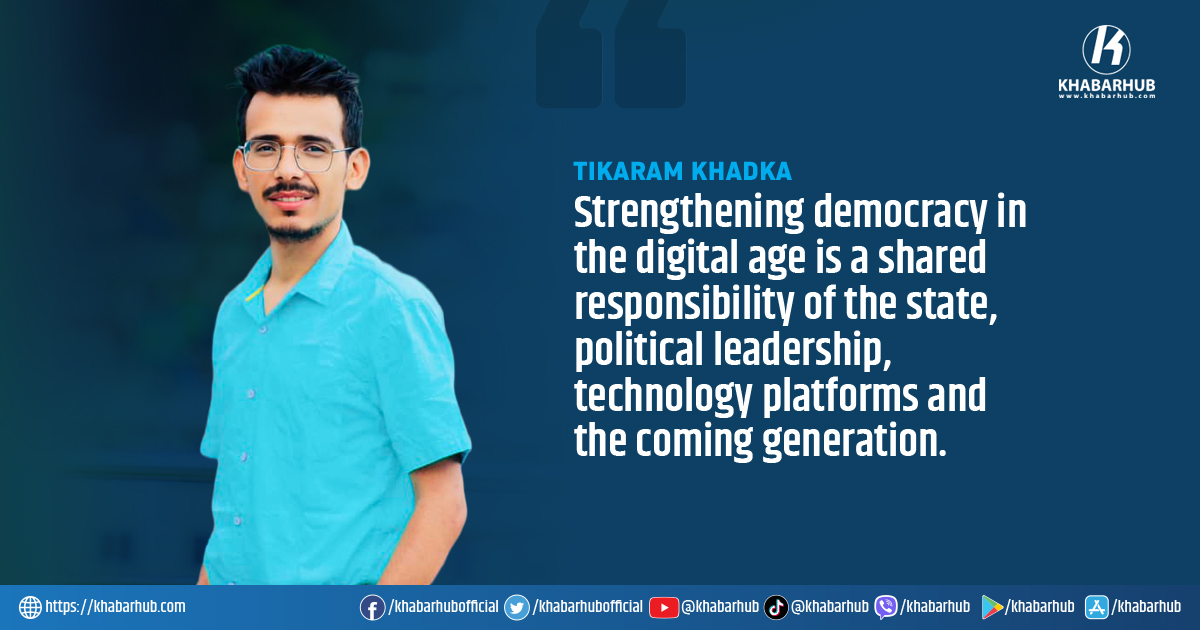
Strengthening democracy in the digital age is a shared responsibility of the state, political leadership, technology platforms and the coming generation. But no cycle of power can continue indefinitely without scrutiny. Ultimately, those in power will have to face questions from the public—and no algorithm can permanently prevent that reckoning.






Comment