




On September 8, 2025, as many as 19 young protesters were shot dead by police on the streets of Kathmandu. But how did a peaceful Gen Z protest turn into a tragedy? And who gave the order to open fire?
A video released by the BBC just a few days before the election has brought about a debate surrounding “Shot Like Enemies: Inside Nepal’s Gen Z Uprising” – BBC World Service Documentaries, which cannot be separated from a larger strategic question:
How does international media framing shape political transitions in fragile democracies?
In the 21st century, power rarely announces itself through invasion. It moves through narrative.
The controversy surrounding the BBC documentary on Nepal’s Gen Z uprising highlights a larger strategic reality: information framing has become an instrument of geopolitical influence. In fragile or transitional democracies—especially small states positioned between major powers—narrative timing can alter political atmospheres more effectively than overt intervention.
This is not a claim of secret orchestration. It is an observation about structural power.
Historically, major international broadcasters have played consequential roles during moments of geopolitical tension. During the era of Franklin D. Roosevelt, wartime information campaigns helped shape public opinion in the United States prior to and during World War II. In later decades, global media narratives surrounding upheavals in Iran (1979) and Chile (1973) influenced how domestic crises were interpreted internationally.
The lesson is not that media “cause” regime change. Rather, media ecosystems shape the moral framing within which political outcomes unfold.
Additional examples reinforce this structural pattern.
During the 2003 Iraq crisis, international media narratives surrounding weapons of mass destruction played a decisive role in shaping Western public opinion ahead of the invasion of Iraq. The framing of intelligence assessments—later heavily disputed—demonstrated how information ecosystems can legitimize policy trajectories before facts are fully verified.
Similarly, during the 2011 Arab uprisings in Libya and Syria, global broadcasting amplified particular narratives of popular revolt and humanitarian urgency. These framings influenced diplomatic alignments, sanctions regimes, and intervention debates within United Nations and NATO structures. The media did not create the uprisings—but narrative emphasis shaped the speed and character of international responses.
In Eastern Europe, coverage surrounding the 2004 and 2014 Ukrainian political crises—particularly during the Orange Revolution and later unrest—demonstrated how competing global narratives reflected broader strategic competition between Russia and Western powers. Information domains became extensions of geopolitical rivalry.
In Asia, reporting on the 1989 unrest in Tiananmen Square significantly shaped global perceptions of China for decades, affecting sanctions, diplomatic engagement, and normative positioning in international institutions.
Across these cases, the structural constant is clear: perception precedes policy.
The Mechanics of Narrative Leverage
Modern influence operates through five reinforcing vectors:
First is Emotional Framing – simplifying complex crises into moral binaries (youth vs. state, people vs. regime).
Second is Selective Evidence Amplification – highlighting compelling visuals or documents while compressing context.
Third is Timing Sensitivity – releasing high-impact narratives near electoral or transitional moments.
Fourth is Digital Echo Amplification – algorithms and diaspora networks multiplying reach exponentially.
Fifth is Normative Signaling – human rights discourse shaping diplomatic and donor postures.
In small democracies, these vectors can shift political energy without a single foreign official issuing instructions.
Narrative influence is not conspiracy. It is ecology.
The Small-State Vulnerability
Nepal’s structural vulnerability lies in three realities: One, it is a young democracy recovering from monarchy, insurgency, and coalition instability. Two, it sits between India and China, amid intensifying global competition. And three, its youth population is digitally native but economically frustrated.
In such an environment, a documentary that foregrounds state violence while minimizing mob escalation, institutional arson, prison breaks, and geopolitical context does more than tell a story—it alters the emotional climate preceding elections.
When external storytelling coincides with domestic volatility, it can function as a force multiplier—not by directing outcomes, but by shaping perceptions of legitimacy.
Elections in fragile democracies are often decided less by policy debate and more by moral momentum.
The “Campaign Manager” Misconception
It is analytically unsound to claim that an international broadcaster directly “manages” elections. However, it is equally naïve to ignore that narrative production influences political trajectories.
In the Cold War era, influence often required covert coordination, funding, or military backing. Today, influence may require a compelling visual frame, a global distribution infrastructure, and moral clarity that outpaces contextual nuance.
The cumulative effect may resemble political steering without overt orchestration.
The Iraq example illustrates how narrative consensus can precede policy action. The Ukraine crises illustrate how narrative domains become arenas of great-power rivalry. The Arab Spring cases show how moral urgency shapes intervention calculus.
Thus, the issue is not whether foreign media replace elections. The issue is whether they shape the emotional terrain upon which elections are fought.
In highly polarized environments, the perception of injustice mobilizes more powerfully than institutional nuance.
Narrative Sovereignty as Strategic Doctrine
For small states, the solution is not censorship. Nor is it defensive paranoia.
The solution is narrative sovereignty.
Narrative sovereignty rests on four pillars:
First, ‘Transparent Domestic Investigations’ – credible accountability reduces the persuasive power of external framing.
Second, ‘Professional Strategic Communication’ – rapid, evidence-based responses prevent informational vacuums.
Third, ‘Institutional Resilience’ – courts, election commissions, and oversight bodies must demonstrate independence.
Fourth, ‘Media Literacy at Scale’ – citizens must understand how global narratives are constructed and amplified.
Where these pillars exist, external storytelling becomes commentary—not leverage.
The Geopolitical Layer
As strategic competition between the United States and China intensifies, information domains become contested spaces. Influence is no longer only economic or military; it is reputational.
A democracy portrayed internationally as unstable, repressive, or on the brink invites recalibration by donors, investors, and diplomatic actors. Risk premiums rise. Aid conditions tighten. Strategic engagement shifts.
Thus, narrative framing indirectly affects strategic space.
For small states, the battlefield is not territorial—it is perceptual.
Youth Mobilization and Political Maturity
Gen Z activism reflects legitimate grievances—corruption, unemployment, elite patronage. These require reform. But digital mobilization without geopolitical awareness can be unintentionally amplified by larger strategic narratives.
When protests escalate into institutional arson, prison breaks, or economic sabotage, simplified storytelling often preserves the “pure youth vs. oppressive state” binary because it resonates globally. Yet national stability requires a fuller mosaic.
The challenge for Nepal—and similar states—is integrating youth energy into constitutional reform without allowing volatile episodes to define national identity internationally.
Strategic Conclusion
Narrative warfare in the modern era is subtle. It requires framing, timing, and amplification—not command and control.
From Iraq to Ukraine, from Libya to Tiananmen, global narratives have shaped diplomatic posture and policy tempo. The pattern is not uniform—but the structural logic is consistent: perception shapes legitimacy; legitimacy shapes leverage.
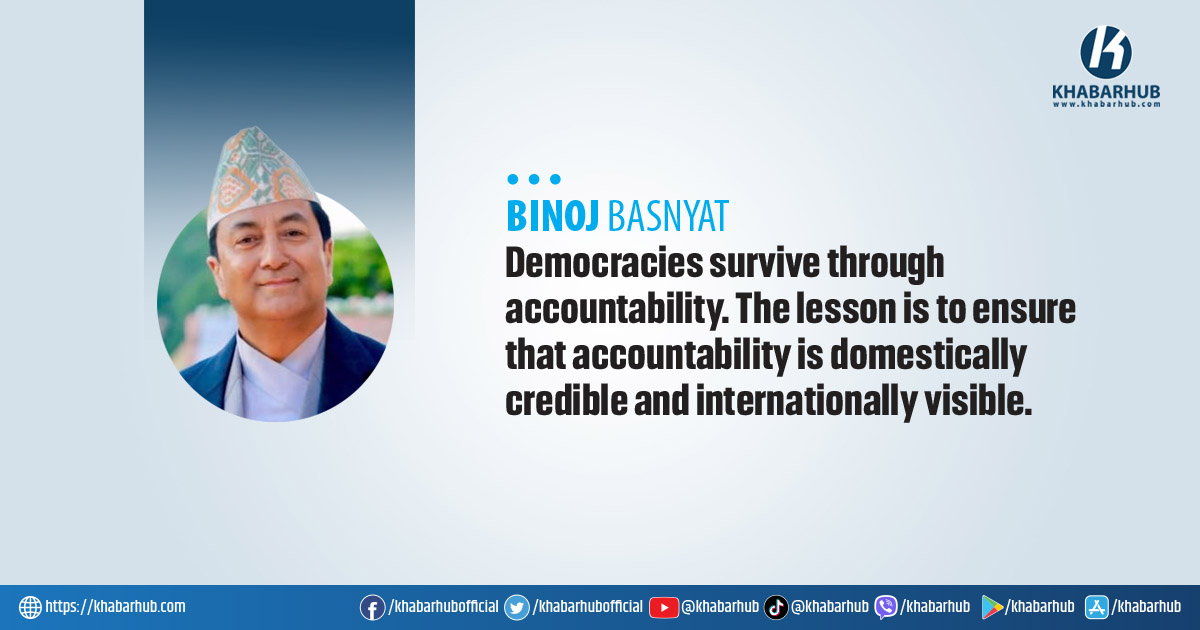
The lesson for Nepal is not to reject scrutiny. Democracies survive through accountability. The lesson is to ensure that accountability is domestically credible and internationally visible.
Foreign documentaries may zoom in on tragedy. Domestic institutions must zoom out toward continuity.
Small states cannot control global storytelling. But they can control institutional integrity.
And in the end, integrity—not narrative—determines whether a democracy bends or breaks.
(Basnyat is a Maj. Gen. (retd) from the Nepali Army, a strategic affairs analyst, and is associated with Rangsit University, Thailand.)






Comment