




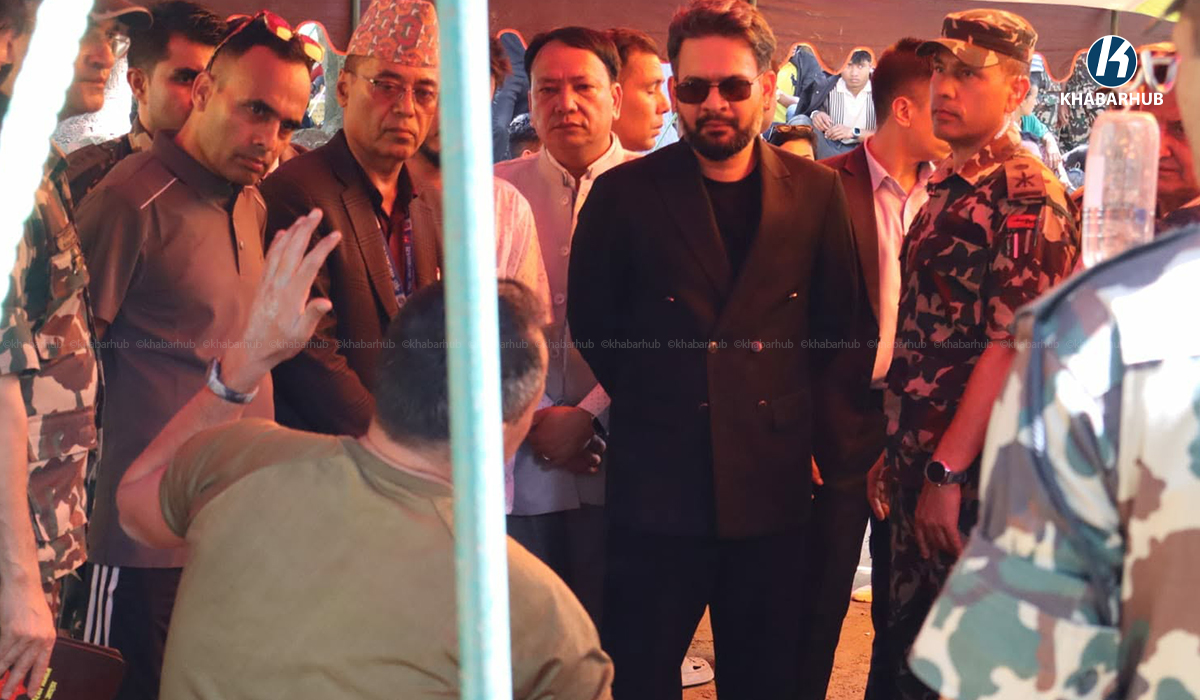
KATHMANDU: Prime Minister Balendra Shah (Balen) has said that all state mechanisms have been mobilised to their full capacity for rescue, relief and rehabilitation following the devastating floods and landslides.
After conducting an on-site inspection of flood- and landslide-affected areas in Nuwakot and returning to Kathmandu, Prime Minister Shah made public a 20-point update on the government’s ongoing response.
Shah said he received first-hand information from affected residents, local representatives, security personnel, health workers and those involved in rescue and relief operations. He said the situation in the affected areas remains challenging and that the government’s immediate priority is to save lives, search for missing people, treat the injured and provide immediate relief to affected families.
A total of 13,295 security personnel from the Nepal Police, Nepali Army and Armed Police Force have been mobilised for search and rescue operations. The deployment includes 7,250 Nepal Police personnel, 4,200 Nepali Army personnel and 1,845 Armed Police Force personnel.
Rescue operations are continuing through both air and ground routes. Shah said 351 people were rescued through 69 aerial sorties on Thursday alone. Additional helicopters have been kept on standby, while private helicopters have also been mobilised through the government’s coordination mechanism for rescue and relief operations.
Priority in aerial rescue has been given to patients, pregnant and postpartum women, children, senior citizens and persons with disabilities.
The government is continuing efforts to evacuate stranded residents and security personnel from Rasuwa, Nuwakot, Dhading and other affected areas. Temporary accommodation has been arranged in schools and public and community buildings for around 3,500 people.
For immediate relief, Rs 10 million each has been allocated to Rasuwa and Nuwakot and Rs 5 million to Dhading. Ten truckloads of relief supplies, including noodles, biscuits, sleeping bags, mattresses and blankets, have been sent to the affected areas, while additional food and non-food supplies are being delivered by helicopter.
Temporary relief camps have been established in affected areas with arrangements for food, drinking water and other basic services. The Nepal Red Cross, Nepal Scouts, Lions Club and other volunteer organisations are also involved in rescue and relief operations. The Red Cross has sent relief materials sufficient for around 30,000 people.
The Health Emergency Operations Centre has been activated, while Bir Hospital, Trauma Centre, Teaching Hospital, Civil Hospital, Patan Hospital and Police Hospital have been placed on standby. According to Shah, 100 emergency beds each have been prepared at Bir Hospital and Trauma Centre, while 60 emergency beds have been prepared at Patan Hospital.
Free treatment has been ensured for affected and injured people, with medical teams, medicines and necessary equipment being deployed from various hospitals.
To facilitate the delivery of relief and rescue materials, the National Emergency Warehouse at Tribhuvan International Airport, the Nepali Army’s Maithili Barracks in Battar, Nuwakot, and the Baireni Barracks in Dhading have been designated as collection and distribution centres.
Generators, portable mobile towers, batteries, medical supplies, tents and machinery for cutting iron and stone are also being sent to affected areas. A field hospital set has also been dispatched towards Trishuli.
Restoration of telecommunications services has been placed among the government’s emergency priorities. Shah said at least 70 towers and sites—38 belonging to Nepal Telecom and 32 belonging to Ncell—are currently out of service. Technical teams, generators and batteries are being transported to affected areas by helicopter to restore services.
Free communication facilities have also been provided to affected residents. According to Shah, Nepal Telecom is providing 2GB of data, 50 SMS messages and free voice calls daily, while Ncell has also made voice, data and SMS services available free of charge.
The concerned ministries, departments and agencies have been directed to mobilise the necessary manpower, equipment and resources to restore essential infrastructure, including roads, bridges, drinking water, electricity and telecommunications, as quickly as possible.
Authorities have also been urged to maintain heightened vigilance in riverbank areas in view of the possibility of further risks. Shah said the flow of the Bhote Koshi and Trishuli rivers, potential landslides and other hazards are being continuously monitored. Residents in vulnerable riverbank areas of Rasuwa, Nuwakot, Dhading, Gorkha and Chitwan have been urged to move to safer locations.
Drone surveys and field assessments are being carried out to collect information on the actual situation and extent of damage. The findings will help authorities identify stranded people, blocked roads and access routes and better target rescue and relief operations.
Shah said financial assistance would be provided to the families of those killed in accordance with prevailing laws, while identification and management of the recovered bodies are being carried out in an organised manner.
He also said national and international assistance is being mobilised for relief and rehabilitation. Relief materials have been received from India, while coordination is underway with the United States, European Union, World Health Organization, International Federation of Red Cross and Red Crescent Societies and other international partners for additional support.
Prime Minister Shah said the government’s full attention is now focused on saving lives, searching for and rescuing missing people, treating the injured, providing immediate relief and safe accommodation to affected families, and restoring damaged essential infrastructure at the earliest.
He said the government stands with affected citizens during the crisis and that all state mechanisms will remain deployed on the ground until rescue and relief operations are completed.




Comment