




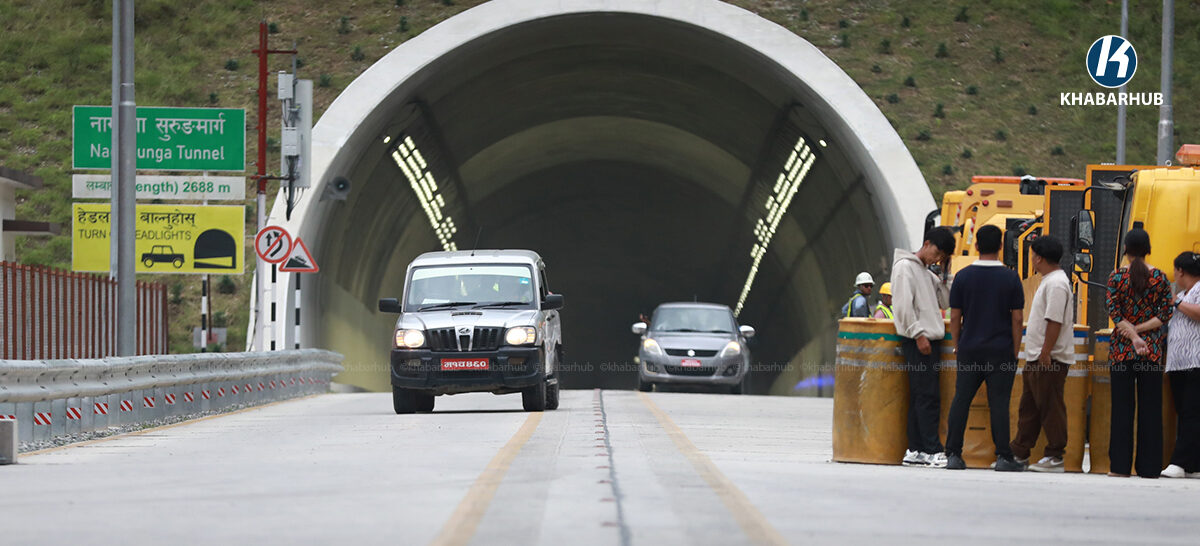
KATHMANDU: Nepal’s first road tunnel, the 2.688-kilometre Nagdhunga–Sisnekhola Tunnel, was officially inaugurated on Sunday, marking a major milestone in the country’s transport infrastructure and Nepal–Japan development cooperation.
The tunnel was jointly inaugurated by Minister for Physical Infrastructure and Transport Sunil Lamsal, Japanese Ambassador to Nepal Toru Maeda, and Japan International Cooperation Agency (JICA) President Akihiko Tanaka.
Speaking at the ceremony, Tanaka described the project as a landmark achievement that goes beyond infrastructure, calling it a symbol of the long-standing partnership between Nepal and Japan. He said the tunnel ushers in a new phase of bilateral cooperation, with both countries launching a technical assistance programme to strengthen Nepal’s capacity in tunnel planning, construction, operation and maintenance.
Tanaka also noted that the inauguration comes as Nepal and Japan celebrate the 70th anniversary of diplomatic relations, describing the tunnel as a lasting testament to the friendship and cooperation between the two nations.
Ambassador Maeda said the project was completed with financial support from the Japanese government’s Official Development Assistance (ODA) programme and the dedicated efforts of Nepali engineers and workers. He expressed confidence that the expertise and technology transferred through the project would support Nepal’s future tunnel and infrastructure development while enhancing the country’s ability to independently operate and maintain such facilities.
Ministry Secretary Gopal Prasad Sigdel said the Nagdhunga section has long been one of the busiest and most congested gateways into the Kathmandu Valley. He said the tunnel is expected to significantly reduce travel time, ease chronic traffic congestion and improve road safety.
Sigdel credited the successful completion of the project to the close collaboration between Nepali and Japanese engineers despite difficult terrain and technical challenges.
The tunnel project, for which the construction contract was signed on November 14, 2019, was originally scheduled for completion by April 26, 2023. However, the project was delayed by the COVID-19 pandemic, contractor-related issues and local disruptions, with the construction deadline ultimately extended to October 25, 2025.
The government has already approved toll charges for vehicles using the tunnel. Passenger cars, vans and other light vehicles will pay Rs 65 when entering Kathmandu and Rs 60 when exiting. Minibuses and mini-trucks will be charged Rs 125 and Rs 80, respectively, while buses and single rear-axle trucks will pay Rs 260 and Rs 200. Heavy multi-axle trucks and construction equipment will be charged Rs 600 for entering the Valley and Rs 250 for exiting.
The Nagdhunga–Sisnekhola Tunnel is expected to improve traffic flow along the Kathmandu–Naubise corridor and provide a safer, faster and more reliable route for commuters and freight transport.






Comment