




The international system is undergoing one of the most profound transformations since the end of the Cold War. The assumptions that shaped global politics for more than three decades are being challenged by intensifying geopolitical competition, technological disruption, economic fragmentation, and shifting centers of power.
Today, nations compete not only for military superiority or territorial influence but also for investment, supply chains, critical minerals, digital infrastructure, technological innovation, talent, and strategic partnerships.
Asia has emerged as the principal theater where much of this transformation is unfolding, making the region simultaneously the engine of global growth and the center of geopolitical competition.
These developments are redefining diplomacy itself, requiring countries of every size to think more strategically about their place in the world. This broad assessment frames a central argument: Nepal must respond to a changing international environment with greater strategic clarity and purpose.
For Nepal, this changing environment should not be viewed primarily as a source of uncertainty. Rather, it presents a rare strategic opportunity. The important question is no longer whether the world is changing—the evidence is unmistakable. The more important question is whether Nepal is prepared to navigate this transformation with confidence, consistency, and strategic vision.
Strategy, however, has little value unless it shapes practice. Strategic frameworks matter only when they guide statesmanship and statecraft.
The answer will depend less on external events than on our own ability to strengthen national institutions, develop coherent policies, and translate diplomacy into measurable national value.
Three simultaneous realities define the strategic environment confronting Nepal today.
The first is a global strategic transition marked by renewed great-power competition, the resurgence of hard power, and the gradual erosion of the post-Cold War international order.
The second is a regional geopolitical realignment in which the Asia-Pacific and the wider Asian region have become the world’s principal center of economic growth, political influence, and strategic competition.
The third is a national strategic opportunity. Nepal has an opportunity to reposition itself through strategic rebranding, economic statecraft, institutional reform, and proactive diplomacy. These three realities are interconnected. Global transformation creates new possibilities, but only countries that prepare themselves internally are able to benefit from external change.
Nepal does not enter this changing world without strategic foundations. Long before concepts such as strategic autonomy, multi-alignment, or economic statecraft entered the vocabulary of international relations, Nepal’s own political heritage had already grappled with the challenges of navigating complex geopolitical realities.
King Prithvi Narayan Shah’s enduring description of Nepal as “a yam between two boulders” continues to capture the country’s unique geopolitical position between two major powers and empires. Similarly, Kautilya’s Rajamandala reminds us that while geography shapes strategic realities, wise leadership determines how geography is managed. These historical insights remain remarkably relevant because they encourage Nepal to approach diplomacy not with fear but with strategic confidence.
Building on these foundations, Nepal’s foreign policy can be understood through a modern four-layer strategic framework that reflects both geography and opportunity.
The first layer remains Nepal’s immediate neighborhood. Stable, predictable, and mutually beneficial relations with India and China will always remain fundamental to national stability, security, and economic development. Geography ensures that no foreign policy can succeed without sustained engagement with our two neighbors.
The second layer extends across the wider Asian region. As Asia continues to drive global economic growth and regional integration, Nepal must deepen its engagement through trade, connectivity, investment, energy cooperation, and broader regional partnerships.
The third layer encompasses Nepal’s engagement with the United States, Europe, Japan, South Korea, Australia, the Gulf states, Russia, and other middle powers whose partnerships contribute significantly to Nepal’s development, technology transfer, education, governance, and economic modernization.
The fourth layer consists of international organizations and multilateral institutions where Nepal can advance its national interests while contributing to peacekeeping, climate action, sustainable development, international cooperation, and the collective voice of small states.
At the same time, Nepal should continue to champion the principle that sovereignty and the right to self-determination derive not from a country’s size or economic strength but from its equal standing under international law.
This strategic framework rests upon a single overarching foundation: national confidence.
No foreign policy can be stronger than the nation it represents. National confidence is built through political stability, good governance, economic resilience, institutional credibility, implementation capacity, and a shared sense of national purpose.
It provides both the confidence and the capability to pursue an independent and consistent foreign policy. Without confidence at home, strategic autonomy abroad becomes increasingly difficult to sustain.
Upon this foundation stand four mutually reinforcing pillars.
The first is an Active Non-Alignment Policy as Nepal’s grand strategy, safeguarding strategic autonomy while constructively engaging all major powers without becoming aligned with competing geopolitical blocs.
The second is the Smart Neighborhood Policy, designed to strengthen stable, mutually beneficial, and forward-looking relations with India and China through mutual respect, economic interdependence, and sensitivity to each other’s legitimate security concerns.
The third is Strategic Regional Engagement, aimed at expanding Nepal’s economic integration, connectivity, and constructive cooperation across South Asia, the Asia-Pacific, and beyond.
The fourth is Smart Diplomacy, the practical instrument that translates national priorities into effective international engagement by mobilizing partnerships, expanding influence, and advancing Nepal’s long-term national interests. Together, these pillars transform strategic thinking into practical statecraft.
Nepal appears to be entering such a period. As reforms gather momentum, international perceptions begin to change. Investors pay closer attention. Universities seek academic collaboration. Businesses identify new opportunities.
Strategy, however, has little value unless it shapes practice. Strategic frameworks matter only when they guide statesmanship and statecraft.
Recent diplomatic engagement by Foreign Minister Shishir Khanal with both China and India illustrates what this philosophy looks like in practice and how strategic principles can be translated into practical diplomacy. Diplomacy was shaped by economic statecraft, informed by resource governance, and guided by development partnerships.
Rather than viewing diplomacy as a choice between competing partners, Nepal should engage constructively with all countries while remaining firmly anchored in the protection and promotion of its own national interests. Economic statecraft, development partnerships, and responsible resource governance should increasingly become the centerpieces of diplomatic engagement.
This philosophy can be summarized in three simple but powerful diplomatic principles: Engage with All; Align Selectively; Decide Independently.
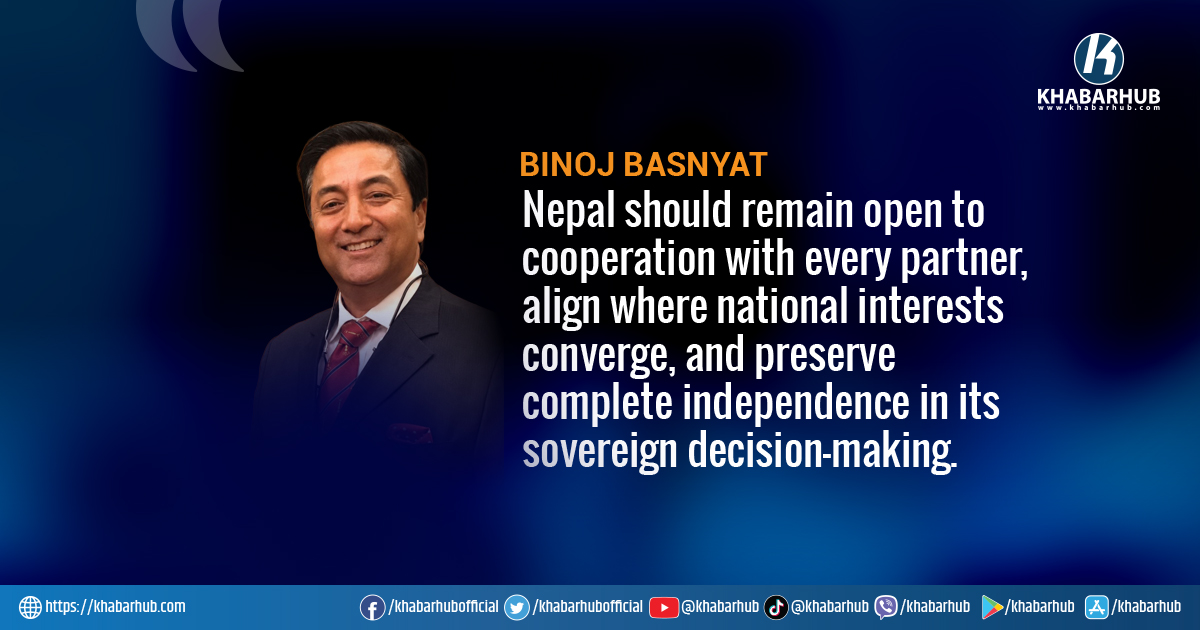
These three ideas capture the essence of strategic autonomy in a complex world. Nepal should remain open to cooperation with every partner, align where national interests converge, and preserve complete independence in its sovereign decision-making. Such an approach avoids the false choice between competing powers while maximizing opportunities from every relationship.
Effective diplomacy also requires engagement at every level of government. Influence is rarely built through summit meetings alone. Countries that consistently engage senior leaders, ministers, senior officials, technical experts, and working-level counterparts are better positioned to shape decisions early, build strategic trust, and advance their interests over the long term. Diplomatic success, therefore, depends upon sustained engagement rather than occasional high-level visits.
Perhaps the most important opportunity before Nepal today lies in what many scholars describe as a reform window. International transformation alone does not create opportunity. Opportunity emerges when domestic reform and international engagement reinforce one another.
Reform windows occur when political leadership possesses both the mandate and the willingness to implement change, institutions become more receptive to innovation, governments strengthen implementation capacity, and society becomes increasingly prepared to embrace new ideas. These moments are uncommon, but when they emerge, they can fundamentally reshape a country’s development trajectory.
History occasionally presents nations with rare moments when domestic reform and international transformation occur simultaneously.
Nepal appears to be entering such a period. As reforms gather momentum, international perceptions begin to change. Investors pay closer attention. Universities seek academic collaboration. Businesses identify new opportunities.
Development partners become more willing to engage. Governments gain greater confidence in building long-term partnerships. Reform, therefore, creates diplomatic opportunities just as diplomacy can reinforce reform.
This is why diplomacy should no longer be understood simply as representing Nepal abroad. Modern diplomacy must become an instrument for converting reform into partnerships, partnerships into investment, investment into opportunity, and opportunity into national prosperity. Dynamic diplomacy during a reform window is not merely a foreign policy activity; it becomes one of the nation’s most valuable strategic assets.
Nepal already possesses an important foundation for such an approach through its extensive diplomatic network. Its embassies, permanent missions, consulates, honorary consuls, and resident diplomatic missions collectively represent far more than administrative institutions.
Properly utilized, they serve as gateways to investment, innovation, knowledge, technology, tourism, and development cooperation. The challenge is no longer simply expanding diplomatic presence; it is ensuring that this network works coherently toward common national objectives.
The central task of modern diplomacy is, therefore, the coordination of interests.
Diplomats must continuously identify where Nepal’s priorities intersect with those of international partners. Modern diplomacy is no longer measured solely by the number of official visits, agreements signed, or ceremonial engagements. Its success should instead be evaluated by the mutual value it creates through effective coordination of interests.
It will remember the credibility the country earned, the institutions it strengthened, the partnerships it forged, the solutions it helped create, and, above all, what Nepal contributed to its own people, its neighborhood, its region, and the wider world.
When interests converge, partnerships become stronger. Stronger partnerships generate new opportunities. Those opportunities ultimately translate into economic growth, institutional development, technological advancement, and national prosperity. In this sense, diplomacy becomes an engine of strategic stability and sustainable growth rather than simply an instrument of foreign policy.
History occasionally presents nations with rare moments when domestic reform and international transformation occur simultaneously. Nepal may be living through one of those moments. The world is changing, Nepal’s strategic thinking is evolving, and its diplomatic doctrine is becoming increasingly coherent. These developments create an opportunity that should not be taken for granted.
The responsibility before policymakers, diplomats, businesses, academia, civil society, and citizens is therefore not merely to participate in international affairs but to shape Nepal’s place within them.
Ultimately, the purpose of diplomacy extends far beyond maintaining cordial relations with other countries. Its highest purpose is to strengthen sovereignty, expand economic opportunity, build knowledge, mobilize partnerships, and improve the lives of future generations. History will not remember how many international meetings Nepal attended or how many diplomatic statements it issued.
It will remember the credibility the country earned, the institutions it strengthened, the partnerships it forged, the solutions it helped create, and, above all, what Nepal contributed to its own people, its neighborhood, its region, and the wider world. That contribution should become the defining measure of Nepal’s diplomacy—and the foundation of Nepal’s contributing identity.
(Adapted from the keynote address from Mr. Basnyat’s delivery at the Honorary Consular Corps–Nepal (HCC-N) Program on 23rd July 2026, held in the presence of Minister for Foreign Affairs Mr. Shishir Khanal, members of the diplomatic corps, honorary consuls, ambassadors, and distinguished guests)
(Basnyat is a Maj. Gen. (Retd.) of the Nepali Army)






Comment