




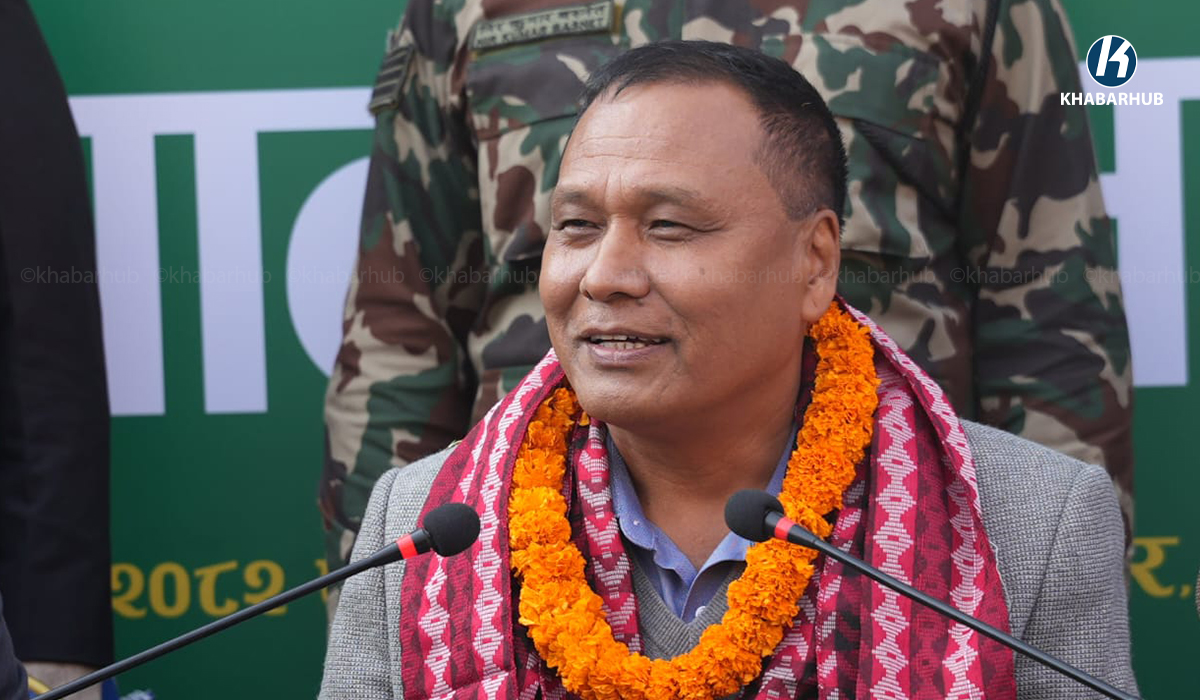
KATHMANDU: Hopes of a united alternative force faded quickly for Kulman Ghising, who now faces a tough, three-cornered contest in Kathmandu Constituency-3 after a brief Gen-Z-inspired alliance fell apart.
The Gen-Z protests held on September 8 and 9, 2025 had sent a strong message calling for unity among new political forces to challenge traditional parties. Capitalizing on that sentiment, Ujyalo Nepal and the Rastriya Swatantra Party (RSP) announced a sudden unification on December 29.
However, disagreements over power sharing and organizational responsibilities led to the breakup of the alliance within just 12 days, leaving Ghising politically isolated.
The fallout proved particularly damaging for Ujyalo Nepal. The party had already withdrawn its proportional representation list, submitted after paying a Rs 50,000 fee, in order to join the alliance. When the unity collapsed after the proportional deadline, Ujyalo Nepal lost hundreds of leaders and cadres.
On Sunday alone, 15 central committee members resigned, while earlier departures, including Dakendra Thegim from Ilam, had already weakened the party’s organizational strength. The hurried unification, brokered under the initiative of Gen-Z activist Sudan Gurung, collapsed due to what Ghising has described as a failure to honor the agreement reached between the two parties.
Party leader Mahendra Lawati blamed the split on the political immaturity of RSP leaders, noting that warnings about the fragility of such a rushed alliance were ignored. Ghising, however, continued to push for unity until the final moment.
After the breakup, Ghising publicly criticized RSP Chair Rabi Lamichhane for not allowing the alliance to move forward, while RSP vice chair DP Aryal countered that Ujyalo Nepal frequently changed its stance. Despite the sharp exchange of accusations, leaders from both sides have said that cooperation in the future has not been completely ruled out.
Following the split, Ghising moved ahead by fielding candidates across the country under the ‘flute’ election symbol in the proportional race. However, internal assessments within the party suggest that, apart from Ghising himself and a few candidates, the chances of electoral success remain limited.
Even so, Ujyalo Nepal insists it is not panicking. Party leaders say they are moving forward independently under a low-profile strategy, focusing on long-term political grounding rather than immediate gains. According to leaders close to Ghising, the party has learned from the turbulence of the past weeks and is now concentrating on steady organizational rebuilding.
Ghising’s secretariat maintains confidence about Kathmandu-3. Although his home district is Ramechhap, he has lived for years in Boudha, within the constituency, where he is believed to enjoy strong backing from indigenous communities.
His supporters argue that his engagement with local residents during his tenure as Energy Minister and as Executive Director of the Nepal Electricity Authority has built lasting goodwill. They also point to voter dissatisfaction with past representatives from major parties and Ghising’s national profile as factors working in his favor.
Despite the collapse of the Gen-Z-inspired unity and the loss of key allies, Ghising is pressing ahead with his campaign in Kathmandu-3, presenting the election as a decisive test of independent and alternative politics in the capital.
Key grounds
Kulman Ghising resides in the Bouddha and Mahakal areas of Kathmandu-3, where he is believed to enjoy strong support among indigenous communities. Local leaders say Newar, Tamang, Magar and other indigenous groups in the constituency largely view Ghising as their preferred candidate.
During his tenure as Minister of Energy and as Executive Director of the Nepal Electricity Authority, Ghising maintained regular engagement with residents of the area. Supporters say he worked closely with local communities, including informal settlers, helping to build long-term relationships.
Similarly, voters in the constituency have expressed dissatisfaction with past representatives. Development activities failed to gain momentum after the UML won the seat for the first time in the 2017 election, with complaints that then-MP Krishna Rai did not adequately address local issues.
Similar criticism has been directed at Nepali Congress MP Santosh Chalise, who won in 2022, with locals saying their concerns remained largely unaddressed. As a result, some voters are inclined toward a nationally recognized figure rather than a traditional party candidate.
The Rastriya Swatantra Party has fielded former Kathmandu Metropolitan City Police Chief Raju Pandey from this constituency. However, Ghising’s supporters argue that his public profile and popularity surpass those of Pandey as well as candidates from the UML and the Nepali Congress.
Although Ghising was initially preparing to contest from his home district of Ramechhap, he ultimately chose Kathmandu–3 after sustained requests from residents of Bouddha and Gokarneshwor municipalities, particularly from indigenous communities urging him to represent the constituency.
Past arithmetic of Kathmandu–3
Kathmandu Constituency-3 has traditionally leaned toward the Nepali Congress, with only one major interruption in recent elections. In the 2022 House of Representatives election, Nepali Congress candidate Santosh Chalise won with 15,158 votes, defeating CPN-UML’s Krishna Bahadur Rai, who secured 11,196 votes, a margin of about 4,000 votes. Congress also swept both provincial assembly seats (A and B) from this constituency in the same election, reinforcing its organizational strength.
In the 2017 election, however, the pattern briefly shifted. The Left Alliance candidate Krishna Rai (CPN-UML) won the parliamentary seat, while Nepali Congress candidate Ambika Basnet received 14,884 votes. An alternative force, the Bibeksheel Sajha Party, polled only a few hundred votes, indicating limited impact at the time. That election recorded 39,003 votes cast out of 53,824 registered voters.
Looking further back, in the first Constituent Assembly election, Chakra Bahadur Thakuri of the Nepali Congress won from Kathmandu-3. Overall, the constituency’s “past arithmetic” shows a Nepali Congress-dominant seat, briefly captured by the CPN-UML during the Left Alliance wave of 2017, and reclaimed by Nepali Congress in 2022.
This history explains why even a three- or four-way contest on March 5 is expected to be decided by how much the Congress vote holds and how effectively new or independent candidates split the anti-Congress base.



Comment