




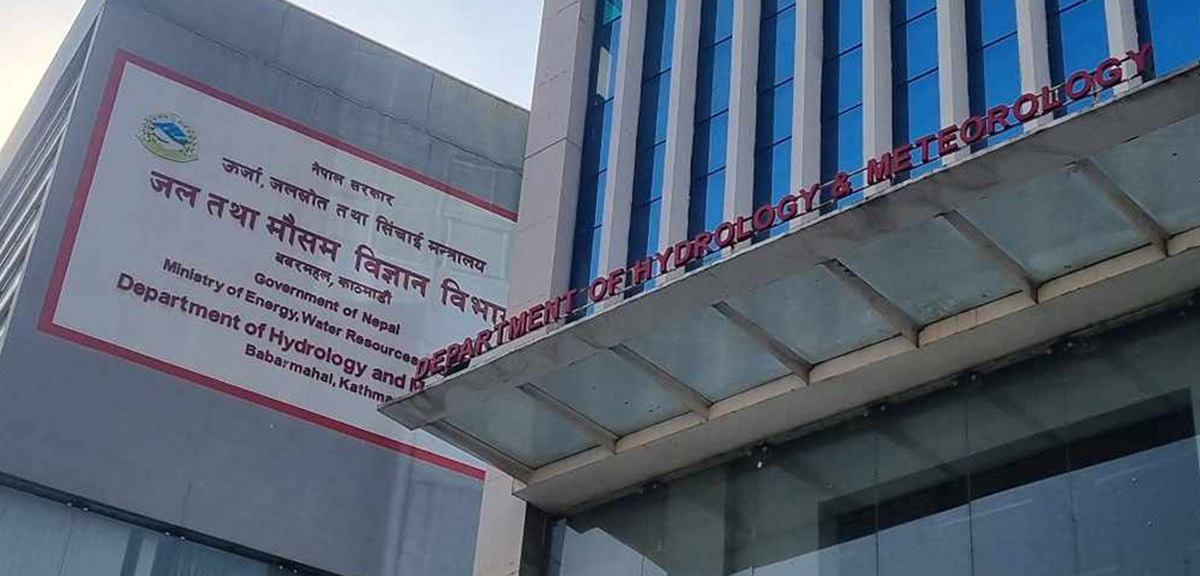
KATHMANDU: The government has released two white papers aimed at strengthening the water resources and meteorological sectors.
The Center of Hydrology and Water Resources Research under the Ministry of Energy, Water Resources and Irrigation and the Department of Hydrology and Meteorology separately released the white papers on Sunday.
The documents provide guidelines for the sustainable use of Nepal’s water resources, the construction of climate-resilient infrastructure, aviation safety and disaster risk reduction.
They also emphasize protecting the lives and property of citizens through the use of modern technology, open data systems and scientific research.
Special programmes for six river basins and four high-risk glacial lakes
The government has introduced plans to expand early warning systems in six major river basins and lower the water levels of four high-risk glacial lakes to strengthen disaster risk reduction and flood early warning systems.
As climate change raises temperatures in the Himalayan region, increasing the risks of glacier melting, avalanches and glacial lake outburst floods, the government has unveiled a new strategy incorporating modern technology through the Hydrology and Water Resources Research Center’s five-year strategic plan and the Department of Hydrology and Meteorology’s white paper.
Water levels of four glacial lakes to be lowered
The GLOBE Sanjeevani Project has been introduced to lower the water levels of four highly vulnerable glacial lakes: Thulagi in Manang, Lower Arun in Sankhuwasabha, and Lumding Cho and Hongu-2 in Solukhumbu.
The project, which will run from 2026 to 2033, has a total budget of approximately USD 49.9 million.
Building on the experience of successfully lowering the water levels of the Tsho Rolpa glacial lake in Dolakha’s Rolwaling Valley and the Imja glacial lake in Solukhumbu, the government will implement similar risk reduction measures at the four lakes.
Flood early warning and 24-hour monitoring in six river basins
The Center of Hydrology and Water Resources Research is installing flood early warning systems in six river basins under the Priority River Basin Flood Risk Management Project (2022–2028), at a cost of USD 7.54 million.
In addition, the center will operate a 24-hour flood forecasting and early warning service from Jestha 1 to mid-Asoj.
In the current fiscal year, the center plans to develop new flood early warning models for the Karnali and Narayani river basins. It also plans to establish a community-based flood early warning system under the Bagmati Improvement Project, with an allocated budget of Rs. 26.1 million.
AI and modern technology in weather forecasting
According to the draft white paper of the Department of Hydrology and Meteorology, the use of artificial intelligence (AI), machine learning (ML) and high-performance computing (HPC) will be prioritized to improve the accuracy and reliability of weather forecasts.
In addition, 503 manual weather stations across the country will be gradually upgraded to automatic weather stations (AWS).
The Department has also proposed maintaining weather radars in Surkhet, Palpa and Udaypur and installing an X-band radar in the Kathmandu Valley.
Radiosonde stations will be established in six additional provinces to study upper-atmosphere conditions. Early warnings will be delivered to communities in low-lying and coastal areas through the 1155 toll-free service, mobile apps, social media and audiovisual briefings.
Weather early warnings at the local level
The Department of Hydrology and Meteorology has prioritized not only preparing forecasts but also delivering them to vulnerable communities in a timely manner.
The planned multi-hazard early warning system will integrate weather observations, identification of vulnerable areas, impact-based forecasting, warning maps and information dissemination. The aim is to deliver information at the community level in coordination with relevant government agencies and local governments.
The white paper states that although these plans are expected to contribute significantly to disaster management and the reduction of human casualties in the long term, their implementation will face several challenges, including sustained budgetary support, a shortage of skilled technical personnel, regular maintenance of modern equipment and coordination among agencies.






Comment