




KATHMANDU: Prime Minister Balendra Shah’s address to the 81st United Nations General Assembly was, above all, an attempt to turn Nepal’s recent disaster into a global political argument. Rather than presenting the Bhotekoshi-Trishuli floods simply as a national tragedy requiring international assistance, Shah framed them as evidence of a much larger crisis: the failure of the international community to translate warnings about climate change into adequate action.
The central message of the speech was straightforward: Nepal contributes very little to global greenhouse-gas emissions but faces disproportionately severe consequences from a changing climate. The floods, in Shah’s framing, were therefore not merely a disaster to be managed but a warning that the international community should hear and act upon.
This framing gave the speech a clear diplomatic purpose. Nepal was presented not as a passive recipient of international assistance but as a vulnerable country with a legitimate claim to greater climate justice, stronger international cooperation and more accessible financing.
From national tragedy to global warning
The most effective rhetorical device in Shah’s speech was his transformation of the Bhotekoshi-Trishuli disaster into a symbol. His question—“have we really heard that warning?”—gave the speech a recurring moral theme.
The line, “When the house is burning, we do not ask the family to complete fifty forms. We act,” captures the speech’s broader approach: humanitarian urgency should take precedence over bureaucratic procedure.
The reference to UN Secretary-General António Guterres’s earlier warnings from the Himalayas strengthened this argument. Shah effectively suggested that the world had already been warned about the consequences of climate change and that the latest disaster demonstrated the cost of failing to act.
This approach allowed Nepal to speak from the position of a country experiencing the consequences of climate change rather than merely discussing them as an abstract policy issue.
The speech also connected climate vulnerability with development. Roads, bridges, schools, homes, farms and energy infrastructure are not simply physical assets; they represent years of development investment. When disasters destroy them, countries such as Nepal are forced to spend scarce resources rebuilding what they have already built.
This is why Shah described climate catastrophe as a “development emergency.” That formulation is significant because it moves the climate debate beyond environmental protection and into questions of poverty, development, infrastructure and fiscal sustainability.
Climate change as a cross-border security issue
Another important feature of the speech was its emphasis on geography.
The floods crossed national boundaries, while the Himalayas themselves span several countries. Shah used this reality to argue that climate change cannot be managed exclusively through national policies.
His statement that “Glaciers and floods do not travel with a visa stamped on passports” was rhetorically memorable because it translated a complex geopolitical problem into an accessible image. More importantly, it supported his proposal for a Himalayan Climate Resilience Mechanism involving Nepal, India and China.
The proposal is potentially significant because it focuses on functional cooperation rather than ideological alignment. Satellite data, glacial-lake monitoring, early-warning systems and disaster response are areas where neighboring countries can cooperate even when broader political relations remain complicated.
For Nepal, this is an important diplomatic idea. The country is situated between two major powers whose strategic competition frequently shapes discussions about Himalayan connectivity and security. Climate resilience offers Kathmandu a different diplomatic space—one based on shared vulnerability and practical cooperation.
Whether such a mechanism can become operational would depend on the willingness of Nepal, India and China to share data, technology and institutional responsibilities. But as a diplomatic proposal, it gives Nepal an opportunity to frame the Himalayas as a region requiring cooperation rather than simply competition.
From climate finance to climate justice
The strongest political argument in the speech concerned climate finance.
Shah argued that vulnerable developing countries should not be forced to borrow heavily to recover from climate-related disasters they contributed little to creating. His distinction between grants and loans goes to the heart of the climate-justice debate.
The speech’s six-word formulation—“Relief. Rehabilitation. Reconstruction. Responsibility. Reparation. Resilience.”—was designed to give this argument a memorable structure.
The first three terms describe what happens after disaster. The second three describe what Shah believes should happen to prevent vulnerable countries from being trapped in a permanent cycle of disaster and reconstruction.
His criticism of existing climate-finance mechanisms was also direct. He argued that vulnerable countries face complicated procedures for accessing funds and that existing resources remain inadequate.
One of the more consequential policy messages was Shah’s call to move from an “ad-hoc” response model toward a culture of preparedness.
The line, “When the house is burning, we do not ask the family to complete fifty forms. We act,” captures the speech’s broader approach: humanitarian urgency should take precedence over bureaucratic procedure.
The challenge, however, is translating this moral argument into an internationally agreed financing framework. Developed countries, multilateral institutions and vulnerable states have different positions regarding the scale, sources and forms of climate finance. Nepal’s argument therefore enters a much larger negotiation in which moral claims must ultimately be converted into institutional arrangements.
Linking climate justice with the global economic order
The speech then moved beyond climate policy into a broader critique of the international system.
Shah questioned an international order in which military equipment can move across borders with extraordinary efficiency while fertilizer, fuel and other essential goods can become difficult for poorer countries to obtain.
His formulation—“flawless logistics for war and broken logistics for food”—was perhaps the most striking political line in the speech.
It is not simply a climate argument. It is an argument about priorities in the international economic system.
By contrasting the movement of weapons with the difficulties faced by farmers, Shah sought to connect climate vulnerability, poverty, supply chains, food security and international security. This widened the speech’s scope considerably.
The reference to other South Asian countries also placed Nepal’s experience within a broader regional narrative. Bangladesh, Bhutan, India, the Maldives, Pakistan and Sri Lanka were invoked as countries facing various combinations of climate vulnerability and geopolitical pressures.
This regional framing could help Nepal position itself as a voice for vulnerable developing countries rather than speaking only on behalf of itself.
The language of a new political generation
The second major theme of the speech was Nepal’s domestic political transformation.
Shah presented the new government as representing a generational shift toward integrity, accountability and effective public service. He linked this domestic political message to the broader international themes of his address.
This was strategically useful because it allowed him to present Nepal’s external message as part of a larger transformation at home.
Yet this part of the speech also carries a higher burden of proof. Claims about democratic renewal, political integrity and the significance of a new political generation ultimately have to be demonstrated through governance rather than speeches.
The international audience will judge such claims not only by the language used at the General Assembly but also by whether Nepal’s government can deliver jobs, infrastructure, social protection, institutional reform and effective disaster preparedness.
The proposed Himalayan Climate Resilience Mechanism could become meaningful if Nepal develops the technical and diplomatic capacity necessary to turn the concept into an operational framework.
In that sense, the speech creates expectations for the government as much as it makes demands of the international community.
From disaster response to preparedness
One of the more consequential policy messages was Shah’s call to move from an “ad-hoc” response model toward a culture of preparedness.
This is particularly relevant for Nepal because the country’s geography exposes it to multiple hazards, including floods, landslides, earthquakes, glacial-lake outburst floods and other climate-related risks.
Preparedness requires more than emergency rescue capacity. It involves early-warning systems, resilient infrastructure, insurance, hydrological monitoring, land-use planning, communications, local government capacity and institutional coordination.
Shah’s emphasis on these areas therefore represents a potentially practical dimension of the speech.
The real measure of the government’s climate agenda will be whether these ideas translate into functioning systems. A warning mechanism is useful only if warnings reach communities in time. Satellite data are useful only if institutions can interpret and act on them. Infrastructure resilience matters only if construction standards, maintenance and planning are strengthened.
The speech therefore establishes a policy agenda whose credibility will ultimately depend on implementation.
Nepal’s strategic opportunity
Perhaps the most important underlying idea in the speech is that Nepal can convert vulnerability into diplomatic relevance.
For decades, Nepal’s geopolitical importance has largely been discussed through its position between India and China. Shah’s speech offered another possibility: Nepal as a Himalayan country capable of convening conversations about climate, disaster resilience and regional cooperation.
That would represent a shift from viewing geography primarily as a constraint to viewing it as a source of diplomatic capital.
Nepal’s potential role in this area is strengthened by its experience with mountain ecosystems, hydropower, biodiversity, disaster vulnerability and climate adaptation. But diplomatic leadership also requires institutional capacity, reliable data, technical expertise and sustained engagement.
Balen Shah’s UN address was fundamentally an attempt to reposition Nepal’s climate vulnerability as a matter of international responsibility.
The proposed Himalayan Climate Resilience Mechanism could become meaningful if Nepal develops the technical and diplomatic capacity necessary to turn the concept into an operational framework.
The rhetoric of the speech
The speech was deliberately constructed around contrasts: war and food, weapons and fertilizers, borders and glaciers, disaster and development, vulnerability and resilience.
This rhetorical structure made a technically complex subject accessible to a general international audience.
The use of short phrases such as “Climate change does not recognize borders” and “We act” also gave the address a campaigning quality. The speech was less a conventional diplomatic report than an argument designed to generate urgency.
Its conclusion reinforced that approach. Shah moved from international policy to preparedness and finally to a spiritual message invoking Pashupatinath and Buddha.
That ending brought Nepal’s cultural identity into an otherwise strongly internationalist speech. It also softened the confrontational elements of the earlier sections by ending with a universal message of well-being and peace.
The central challenge
The most important question arising from the speech is not whether its arguments are compelling rhetorically, but whether Nepal can convert them into policy.
The speech asks the international community for greater climate finance, stronger cooperation, improved disaster preparedness and a fairer international system. Those demands are understandable within Nepal’s climate vulnerability.
But Nepal must also demonstrate domestic capacity to use international support effectively. That means strengthening institutions, improving project implementation, maintaining infrastructure, developing credible climate data and ensuring that resources reach vulnerable communities.
The test now is implementation: whether the warning delivered from the “rooftop of the world” can be translated into institutions, financing, cooperation and preparedness before the next disaster arrives.
The speech therefore creates a two-sided responsibility. The international community must improve its response to vulnerable countries, while Nepal must strengthen its own capacity to convert assistance and diplomatic opportunities into durable resilience.
Conclusion
Balen Shah’s UN address was fundamentally an attempt to reposition Nepal’s climate vulnerability as a matter of international responsibility.
Its central argument was that the Bhotekoshi-Trishuli disaster should not be understood as an isolated Himalayan tragedy. It should be treated as a warning about a wider future in which climate change threatens development, infrastructure, food security and human security.
The proposal for a Himalayan Climate Resilience Mechanism gives the speech a concrete regional dimension. The call for grant-based climate finance gives it an economic dimension. The discussion of global supply chains gives it a broader political dimension. And the emphasis on a new generation of Nepali politics gives it a domestic dimension.
The speech’s ultimate significance will depend on what follows.
If Nepal can turn the proposed resilience mechanism into practical regional cooperation, strengthen its domestic preparedness systems, mobilize international climate finance and demonstrate effective reconstruction, the speech could become more than a statement of grievance. It could form part of a broader effort to establish Nepal as a constructive voice on Himalayan climate governance.
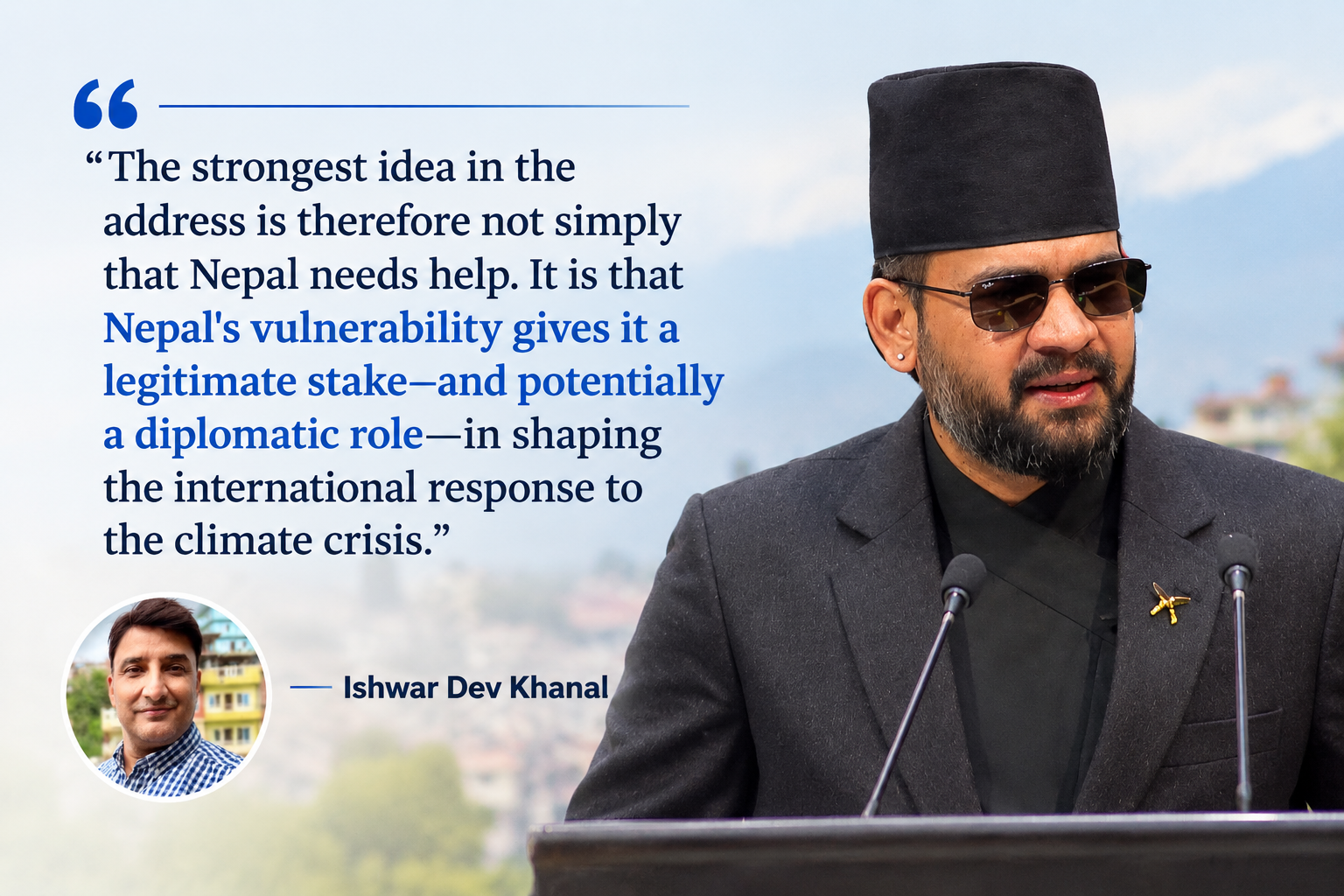
The strongest idea in the address is therefore not simply that Nepal needs help. It is that Nepal’s vulnerability gives it a legitimate stake—and potentially a diplomatic role—in shaping the international response to the climate crisis.
The test now is implementation: whether the warning delivered from the “rooftop of the world” can be translated into institutions, financing, cooperation and preparedness before the next disaster arrives.





Comment