




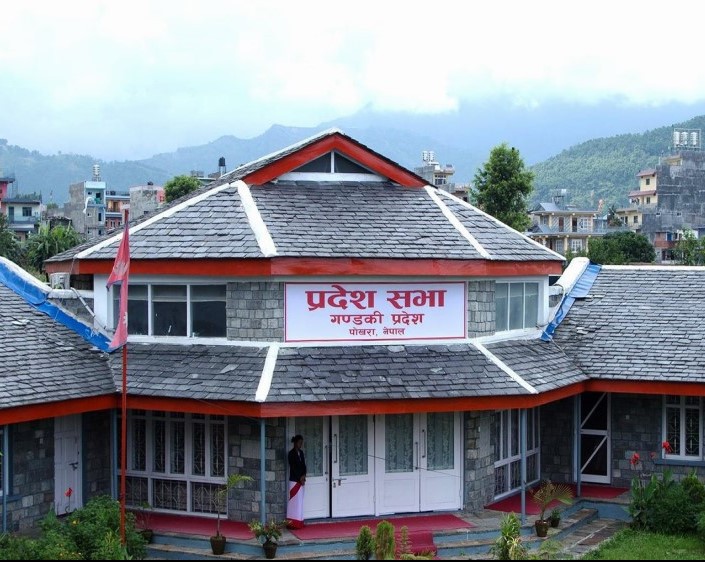
POKHARA: The CPN-UML has decided to withdraw from the Gandaki provincial government and recall its ministers, effectively ending the power-sharing arrangement between the UML and Nepali Congress in the province.
The decision was taken at the UML parliamentary party meeting held on Tuesday morning, according to UML lawmaker Sudhir Poudel.
With the UML’s decision, the agreement reached between the Nepali Congress and UML on July 1, 2024, has also come to an end in Gandaki.
The decision follows an agreement between the UML and the Nepali Communist Party (NCP) to cooperate in provincial governments. Following the agreement, the current leadership of the Nepali Congress decided against continuing its cooperation with the UML.
The agreement reached between UML Chairman KP Sharma Oli and NCP Chairman Pushpa Kamal Dahal, states that the leadership and participation of the government in Madhes and Gandaki provinces would be determined in consultation with other parties represented in the provincial assemblies.
The inability of the UML and NCP to secure a majority in the Gandaki Provincial Assembly even if they joined hands was a key factor behind the decision.
The Gandaki Provincial Assembly has 22 UML lawmakers and seven NCP lawmakers, including the Speaker.
Rajiv Gurung, popularly known as Deepak Manange, who was elected as an independent lawmaker from Manang, has been suspended. As a result, the provincial assembly currently has 59 lawmakers.
The Nepali Congress has 27 lawmakers, while the Rastriya Prajatantra Party (RPP) has two and the Nepal Samajwadi Party (Naya Shakti) has one lawmaker, Phanindra Devkota. A total of 30 lawmakers are required for a majority.
As the Speaker is expected to remain neutral, the UML-NCP alliance would need the support of the two RPP lawmakers to secure a majority.
The RPP has decided not to join the provincial government at present, although it continues to support the government led by Chief Minister Surendra Raj Pandey. Devkota has also been supporting the Chief Minister.
As the UML failed to secure a majority, its Gandaki leadership had been seeking to continue the existing alliance. Chief Minister Pandey, however, did not agree to the proposal.
Pandey has maintained that he has a clear majority in the Assembly and, as the leader of the largest party, has the constitutional basis to form the government. He had also reminded UML ministers that they could resign voluntarily or face dismissal.
Following the UML’s decision to withdraw its four ministers, Chief Minister Pandey is almost certain to appoint Phanindra Devkota of the Nepal Samajwadi Party as a minister, according to sources. Devkota has reportedly sought the Ministry of Physical Infrastructure.
As the RPP is not joining the government, the remaining three ministerial positions are also expected to go to the Nepali Congress. Sources said the party is considering giving ministerial opportunities to some lawmakers who have been dissatisfied with the existing arrangements.


Comment