




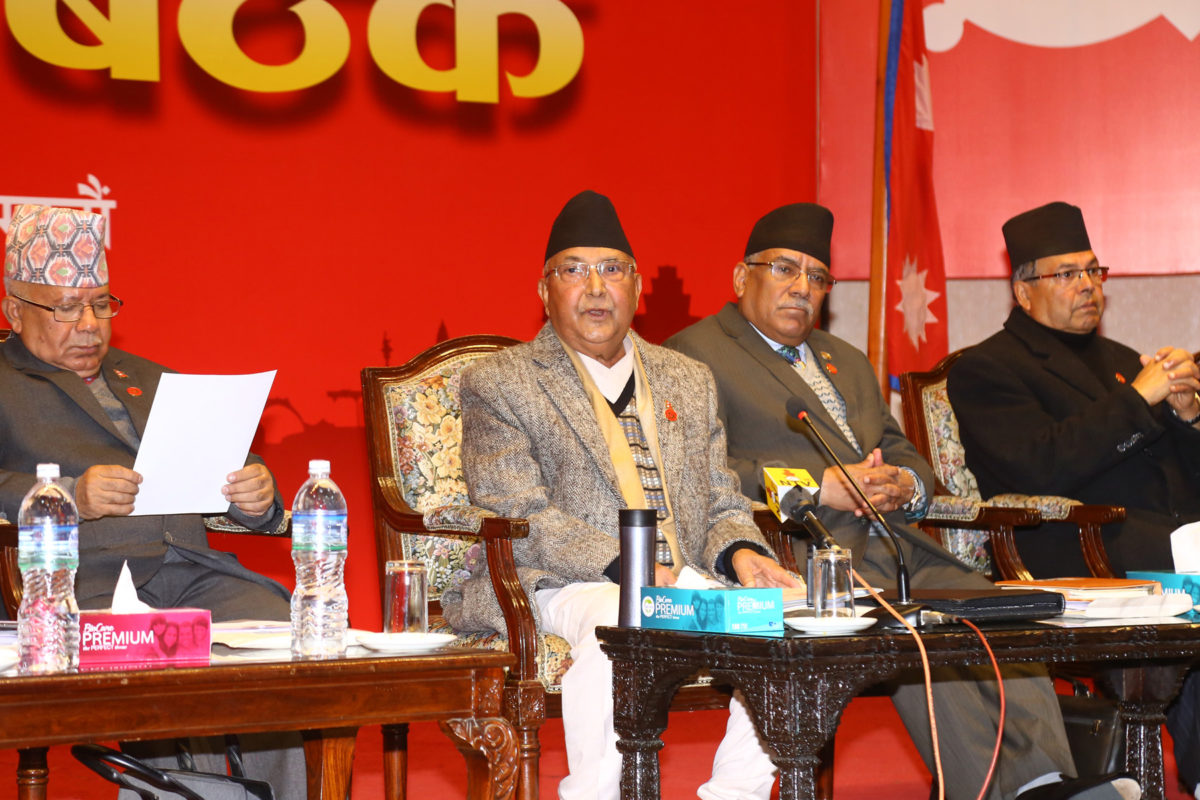
KATHMANDU: Nepal’s fractured communist movement appears to be edging toward a political reset, with the CPN-UML and Nepali Communist Party (NCP) intensifying discussions on provincial power-sharing following recent electoral setbacks.
Leaders from both sides have begun publicly arguing that closer cooperation among left forces has become necessary amid what they describe as growing political challenges facing the country. While immediate party unification remains off the table, both camps say forming joint provincial governments has emerged as the top priority.
According to UML Secretary Mahesh Basnet, UML Chairman KP Sharma Oli, NCP Coordinator Pushpa Kamal Dahal ‘Prachanda’ and Co-coordinator Madhav Kumar Nepal are all positive about provincial-level cooperation.
The renewed momentum comes after Nepali Congress President Gagan Kumar Thapa reportedly ruled out the possibility of a three-party alliance involving the Nepali Congress, UML and NCP in the provinces, prompting left leaders to accelerate internal discussions.
Cooperation before unification
Speaking at a programme marking the 48th Pushpalal Memorial Day on Friday, Prachanda stressed that communist forces should work together to safeguard democracy, the Constitution and the republican system.
He said party unity was not immediately feasible and warned against rushing the process without reviewing past political experiences.
“There is no situation to merge the parties right away. If we unite today, disputes will begin immediately. We need to review the past before talking about party unity,” Prachanda said.
Oli has also repeatedly argued that the current political situation demands cooperation not only among communist parties but also among broader democratic forces to protect the existing constitutional order.
According to sources close to Prachanda, Oli’s recent willingness to maintain dialogue has significantly improved the prospects for left cooperation.
Provincial governments in focus
Leaders involved in the negotiations say discussions are now centred on the framework for provincial governments, including leadership-sharing arrangements and power distribution.
Koshi Province parliamentary party leader Indra Bahadur Angbo, after meeting Prachanda in Kathmandu, said verbal understanding has already been reached between the top leaders, although formal agreements are still being prepared.
“There is already a verbal understanding between Oli and Prachanda to move forward with left cooperation. This is not driven by power-sharing alone but by the need to protect democracy and the Constitution,” Angbo told Khabarhub.
He expressed confidence that the process of forming left-led governments in most provinces could begin within a week.
NC rules out three-party alliance
Meanwhile, Bagmati Province Chief Minister Indra Baniya said the NC has received no formal communication from the centre regarding any new left alliance but maintained that his party would peacefully hand over power if a new majority emerges.
“The Nepali Congress is not desperate to remain in power. If they form a government, we are ready to transfer responsibility,” Baniya said, adding that the party does not support a three-party coalition with UML and NCP.
NC Vice President Bishwa Prakash Sharma and senior leader Pushpa Bhusal have also dismissed the possibility of a provincial alliance involving the Congress, UML and NCP.
Bhusal said the Nepali Congress has already made its position clear and is not inclined to join a government led by the UML.
Leaders discuss power-sharing formula
Negotiations between the UML and NCP have now shifted toward provincial leadership arrangements.
According to party sources, UML Vice Chairman Ram Bahadur Thapa ‘Badal’, General Secretary Shankar Pokharel and Secretary Mahesh Basnet are leading talks from the UML side, while Barshaman Pun, Pravesh Hamal and Prakash Jwala are representing the NCP.
Sources said the NCP has sought leadership of three provinces, with Sudurpashchim emerging as its strongest claim. Discussions are also underway on including leaders from the former CPN (Unified Socialist) faction in the provincial government there.
The parties remain divided over Koshi Province, where the UML currently backs Chief Minister Hikmat Kumar Karki, while the NCP is reportedly insisting on Indra Bahadur Angbo as chief minister.
The UML is said to be seeking leadership in Koshi, Lumbini, Gandaki and Karnali, while the NCP has expressed interest in leading Sudurpashchim, Karnali, Bagmati and Koshi.
Talks are also continuing on government formation in Madhesh Province, where smaller regional parties are expected to play a decisive role.
Smaller parties likely to be included
Leaders involved in the negotiations said discussions are also underway to bring smaller parties into the proposed provincial alliance, particularly in Madhesh, Karnali and Sudurpashchim.
Sources said informal consultations are being planned with leaders including Upendra Yadav, CK Raut and Mahanta Thakur, while dialogue with second-rung Madhesh-based leaders is also expected.
NCP leader Prakash Jwala said the two parties have reached “almost complete understanding” on cooperation, with only technical issues remaining.
“Continuous dialogue is taking place. The current situation requires us to work together to protect democracy, the communist movement and the achievements of past people’s movements,” Jwala said.
The renewed left engagement also comes as relations between the UML and the Rastriya Swatantra Party (RSP) continue to deteriorate, with both Oli and Prachanda adopting a more critical stance toward the ruling party in recent weeks.



Comment