




The Sustainable Development Report 2026 offers Nepal an important moment of reflection. The report tells a story that is both encouraging and cautionary. On one hand, Nepal has made remarkable progress in reducing poverty, expanding access to education, healthcare, clean water, sanitation, and electricity.
On the other hand, it exposes a reality that many young Nepalis experience every day: despite progress, opportunity remains scarce.
Nepal’s SDG score has improved significantly since 2015, and the country now ranks 90th among 169 nations. This achievement deserves recognition. It reflects the hard work of citizens, development partners, local communities, and public institutions. Yet statistics alone do not define a nation’s future.
As a representative of Nepal’s Gen Z generation, I believe the most important finding of this report is not where Nepal has succeeded, but where it continues to struggle. The report highlights weaknesses in employment, innovation, industrialization, and governance. These are not isolated policy failures; they are symptoms of a deeper institutional challenge.
The Sustainable Development Report 2026 makes one message clear: Nepal has made significant progress in addressing yesterday’s challenges. The challenge now is preparing for tomorrow.
Today, Nepal is producing more educated young people than ever before. Schools and universities graduate thousands of students every year, yet too many remain unemployed or underemployed. Many see migration as the only path toward economic security. This should concern all of us.
A country cannot build sustainable prosperity by exporting its most productive workforce. Remittances have sustained Nepal’s economy, but no nation has achieved long-term prosperity by depending primarily on the labor of its citizens abroad. The future belongs to countries that innovate, manufacture, compete, and create opportunities at home.
The report’s findings on innovation and research should serve as a wake-up call. Nepal invests very little in research and development, while innovation ecosystems remain weak. We often discuss entrepreneurship, artificial intelligence, and the digital economy, but these ambitions cannot flourish without institutions capable of supporting them.
This is precisely where the Gen Z Movement’s agenda becomes relevant.
For us, the future of Nepal is not merely about changing governments; it is about transforming institutions.
If Nepal is serious about achieving the Sustainable Development Goals by 2030 and becoming a prosperous nation beyond 2030, the country must undertake a bold program of institutional restructuring and reform.
The judiciary must become faster, more independent, and more accessible. Justice delayed is opportunity denied. A modern economy cannot thrive where legal uncertainty discourages investment and innovation.
The bureaucracy must shift from a culture of process to a culture of performance. Young citizens and entrepreneurs should not have to navigate layers of inefficiency to pursue opportunities. Public institutions must become digitally driven, transparent, accountable, and service-oriented.
The security sector must evolve beyond traditional functions and become a professional institution capable of responding to emerging challenges, including cyber threats, disaster management, and national resilience in a rapidly changing world.
Nepal’s diplomatic institutions must also be reimagined. Diplomacy should not be limited to protocol and political appointments. In the twenty-first century, diplomacy must attract investment, open markets, promote technology transfer, strengthen educational partnerships, and connect Nepal to global opportunities.
Perhaps no institution requires greater reform than the university system. Universities should be engines of innovation, research, and leadership development. Yet many remain trapped in outdated structures that prepare students for yesterday’s world rather than tomorrow’s economy. The future of Nepal will depend on whether our universities produce job seekers or job creators, followers or innovators.
The Sustainable Development Report identifies governance as one of Nepal’s weakest areas. This should not surprise us. Development is ultimately a function of institutions. Strong institutions create opportunities; weak institutions create frustration. Strong institutions retain talent; weak institutions export talent.
For my generation, governance is not an abstract concept. It determines whether merit is rewarded, whether public services function effectively, and whether young people believe they have a future in Nepal.
The defining task of our generation is not simply to develop Nepal. It is to modernize the institutions that will determine whether Nepal succeeds or falls behind in the decades ahead.
The next phase of Nepal’s development therefore requires more than incremental improvements. It demands institutional transformation.
We need an economy that creates jobs, a state that rewards competence, a judiciary that delivers justice, universities that drive innovation, diplomatic institutions that expand opportunities, and public agencies that serve citizens rather than themselves.
The Sustainable Development Report 2026 makes one message clear: Nepal has made significant progress in addressing yesterday’s challenges. The challenge now is preparing for tomorrow.
My generation does not seek sympathy. We seek opportunity.
We do not want to inherit a nation constrained by outdated institutions and limited possibilities. We want to build a Nepal that is innovative, competitive, meritocratic, and globally connected.
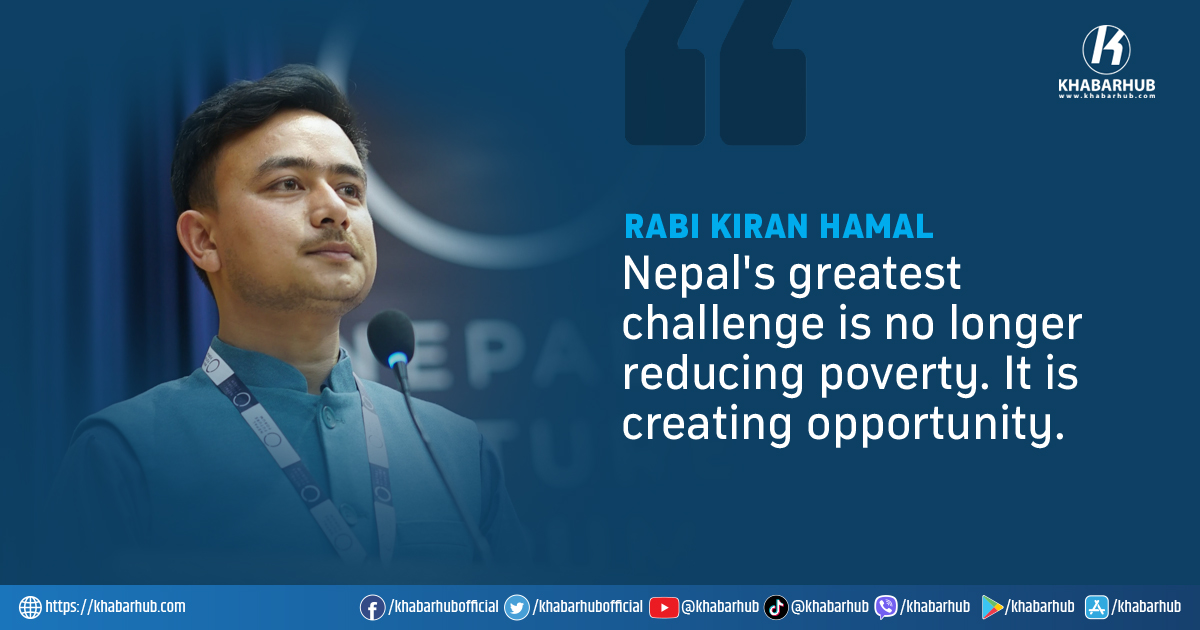
Nepal’s greatest challenge is no longer reducing poverty. It is creating opportunity. And creating opportunity requires something deeper than economic growth; it requires the courage to reform the institutions that shape our future.
The defining task of our generation is not simply to develop Nepal. It is to modernize the institutions that will determine whether Nepal succeeds or falls behind in the decades ahead.





Comment