




The relationship between Nepal and India is unique and historically significant. It is deeply rooted in centuries-old people-to-people connections, cultural affinity, and mutual interdependence.
Both nations share strong interests in maintaining close ties and mutual trust. In international politics, Nepal and India often hold similar views on many regional and global issues, although differences occasionally emerge.
Nepal has long faced challenges related to limited resources, poverty, slow economic growth, and unemployment. In contrast, India is emerging as a major regional power with one of the world’s fastest-growing economies.
Since gaining independence from Britain in 1947, India’s foreign policy has evolved from a non-aligned approach during the Cold War to a more multi-aligned strategy today. This transformation reflects India’s pursuit of security and influence amid increasingly complex regional geopolitics.
Nepal, while proud of its independence and sovereignty, has traditionally favored a non-aligned foreign policy. Nevertheless, pragmatic dialogue remains essential to preserving the deep-rooted relationship between Nepal and India.
Recent political developments, including Nepal’s changing domestic political landscape and electoral outcomes in India, have introduced new dimensions to regional diplomacy. From an academic perspective, adopting constructive and balanced policies can help sustain harmony in Nepal–India relations.
Without a systematic understanding of both historical and contemporary bilateral relations, it is difficult to identify the core areas of conflict and cooperation. Developing effective policy measures to strengthen bilateral trust and cooperation is therefore an urgent necessity.
Understanding Nepal–India relations requires careful attention to contested areas such as Lipulekh, Kalapani, and Limpiyadhura, where both countries claim sovereignty. India’s continued presence in these territories despite Nepal’s objections has intensified diplomatic tensions.
These disputes cannot be resolved through unilateral approaches; rather, they require historical treaty interpretation, diplomatic negotiation, and democratic dialogue grounded in international norms and mutual respect.
When diplomatic tensions escalate, analysis must move beyond rhetoric and simplistic prescriptions. In recent years, the region has also witnessed illicit arms trafficking, human trafficking, counterfeit currency circulation, customs evasion, terrorism-related activities, and other forms of cross-border crime.
Addressing these challenges requires coordinated political action, institutional cooperation, and comprehensive policy coordination. A strong national identity and mutual trust are essential for social cohesion and regional stability. In the context of the growing influence of both China and India, Nepal may face increasing challenges related to territorial sovereignty and foreign policy autonomy.
It has often been observed that Nepal’s foreign policy has remained reactive rather than strategically progressive. Relations with India have occasionally become strained due to the inability of both sides to effectively prevent, manage, and resolve long-standing border disputes.
Many experts argue that Nepal suspects Indian interference in its domestic affairs, while India sometimes views Nepal as vulnerable to external strategic influences. Nepal also perceives delays in Indian-assisted development projects, which have contributed to frustration and mistrust. Frequent political changes in Nepal have further hindered the development of a consistent and coherent policy toward India. Both countries therefore need sustained dialogue and confidence-building measures to rebuild trust.
Historically, many Nepali students pursued higher education primarily in India because opportunities in Western countries were limited. At that time, India generally did not question the academic or political orientation of Nepali graduates educated there.
Today, however, a growing number of Nepalis receive education in countries beyond India, reflecting Nepal’s expanding global engagement. This shift has, in some circles, generated concerns about changing intellectual and political influences in Nepal.
Similarly, employment patterns have changed significantly. While many Nepalis once relied on India for employment opportunities, today Nepali youth increasingly work across the global labor market. These changing educational and economic dynamics may also influence the evolving nature of Nepal–India relations.
Economically, Nepal continues to face a persistent trade deficit with India. Although some Nepali products receive duty-free access to Indian markets, they often struggle to remain competitive. India’s trade policies have not substantially expanded opportunities for Nepali exports.
This situation calls for frank discussions regarding the special economic facilities Nepal should receive as a smaller neighboring country. At the same time, social and religious ties between the two countries remain strong, reinforced by shared cultural traditions, faith, and cross-border marriages. However, these connections have not always been effectively nurtured, and their neglect has indirectly affected long-term economic cooperation.
A longstanding challenge in Nepal’s foreign policy has been the absence of a clearly defined strategic vision. Although Nepal maintains multifaceted relations with both India and China, its diplomacy has often appeared reactive rather than guided by a coherent long-term national strategy.
Nepal’s ties with both neighbors extend beyond state relations and are deeply rooted in linguistic, cultural, religious, ethnic, and commercial exchanges. Communities associated with Tibeto-Burman cultural and linguistic traditions, for example, maintain historical and social linkages with China, highlighting the importance of governance that recognizes these longstanding cross-border interactions.
At the same time, India has expressed concerns regarding Nepal’s growing engagement with China, particularly in areas such as infrastructure development, connectivity, and economic cooperation. Such developments are often viewed in New Delhi as affecting India’s traditional strategic influence in Nepal.
From Nepal’s perspective, however, cooperation with China is not intended to undermine Indian interests but rather reflects Nepal’s sovereign right to maintain balanced and constructive relations with both neighbors on the basis of equality and national interest.
Nepal therefore needs to pursue a balanced diplomatic strategy that reassures India while simultaneously deepening mutually beneficial ties with China. This requires transparent communication, confidence-building measures, and sustained political dialogue with both countries.
A balanced foreign policy grounded in national interest rather than external pressure would strengthen Nepal’s regional role and create greater opportunities for trade, connectivity, and long-term development.
For centuries, Nepali policymakers have believed that the Gurkha legacy, particularly after the Treaty of Sugauli in 1816, earned considerable respect within the military structures of British India and later independent India.
However, changing regional security dynamics and evolving military policies appear to be reshaping this historical arrangement. Meaningful progress in bilateral relations can only emerge through substantive dialogue, political understanding, and a shared vision for the future.
Excessive nationalist rhetoric and aggressive regional competition should be avoided, as they risk undermining peace and stability. Building mutual trust through sustained engagement and pragmatic solutions remains beneficial for both countries.
Many informed Nepali observers argue that as India positions itself among emerging global powers, its “Neighborhood First” policy must be guided by respect, empathy, and genuine understanding toward Nepal. Cooperation and mutual understanding are essential for strengthening bilateral ties and ensuring long-term regional stability.
Although Nepal and India share convergence on many political, strategic, social, and economic concerns, the frameworks through which they address these issues often differ.
Ultimately, policymakers must maintain peaceful and cooperative relations with neighboring countries while safeguarding Nepal’s sovereignty, dignity, and long-term national interests.
Without a systematic understanding of both historical and contemporary bilateral relations, it is difficult to identify the core areas of conflict and cooperation. Developing effective policy measures to strengthen bilateral trust and cooperation is therefore an urgent necessity.
Written agreements alone are insufficient to capture the complexity of Nepal–India relations. The diplomacy of both countries has long been shaped by deep social and cultural ties dating back centuries. Nepal’s contribution to India’s freedom movement remains historically significant.
During that era, many Indian diplomats understood Nepal’s sensitivities and aspirations. Today, however, there appears to be a shortage of such empathetic understanding. Nepal has always been an independent and self-respecting nation and has never sought to act against India’s interests. Therefore, both countries must address bilateral concerns honestly and work collectively to deepen cooperation.
The relationship between domestic politics and foreign policy is well established. In democratic systems, foreign policy is often shaped by political leadership, ideology, and broader national priorities. Although changes in government may influence diplomatic approaches, such shifts are frequently procedural rather than fundamentally transformative.
Nepal has increasingly emerged as an important actor in regional affairs. Engagement with emerging markets has contributed to raising Nepal’s international profile while promoting trade openness and economic growth.
Although some analysts describe Nepal as a “buffer state” between India and China, Nepal is not a pawn of any external power. As a sovereign nation, it pursues its own national interests and foreign policy priorities.
Recent decades have witnessed the spread of liberal norms in governance, including institutional reforms and greater emphasis on international cooperation. Within this changing context, Nepal seeks to adapt to evolving regional and global realities while preserving its sovereignty and autonomy.
The Nepal–India relationship is characterized by historical closeness and extensive bilateral cooperation. At the same time, Nepal seeks to maintain a balanced and independent foreign policy. Its demographic, geographic, and geopolitical realities require a careful and pragmatic diplomatic approach that addresses both domestic priorities and external relations.
These developments present both opportunities and challenges for Nepal and India while also creating possibilities for economic growth, technological advancement, and regional cooperation beneficial to both nations.
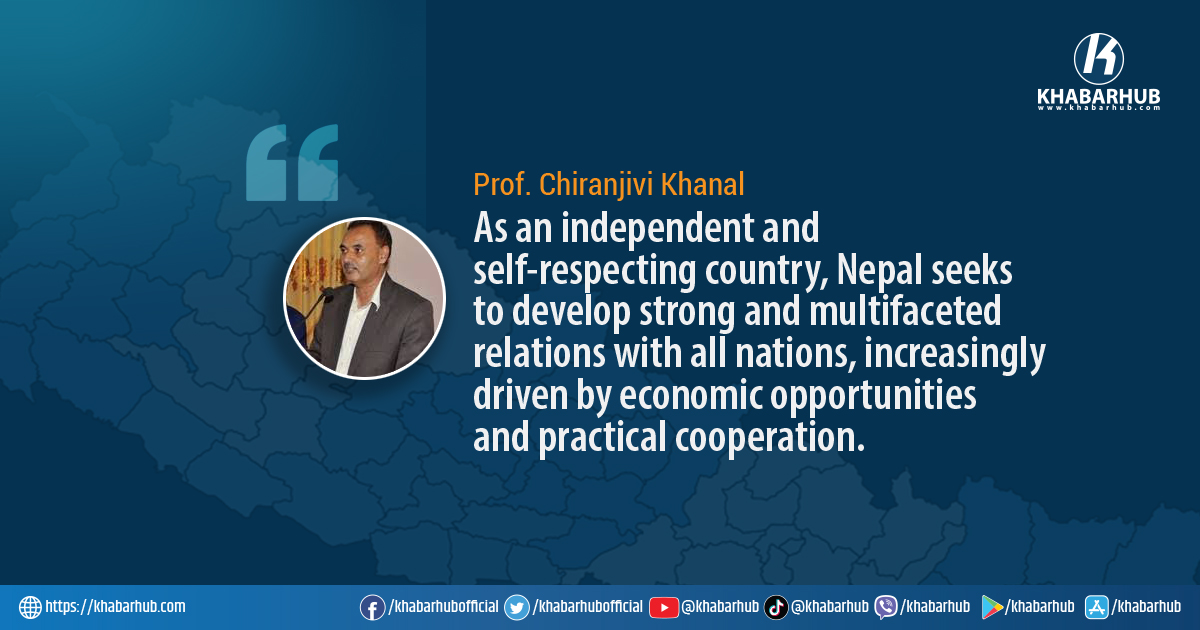
As an independent and self-respecting country, Nepal seeks to develop strong and multifaceted relations with all nations, increasingly driven by economic opportunities and practical cooperation. In an era of expanding regional connectivity and infrastructure development, Nepal must adopt a pluralistic foreign policy approach that reflects both national interests and constructive international engagement.
Ultimately, policymakers must maintain peaceful and cooperative relations with neighboring countries while safeguarding Nepal’s sovereignty, dignity, and long-term national interests.
Nepal and India share a deep relationship rooted in history, culture, and complex geopolitical realities. While traditional dimensions of the relationship have evolved over time, new opportunities and challenges are emerging at the center of bilateral engagement.
These transformations affect both state and non-state actors and contribute to changing political dynamics in the region. Although treaties and mutual interests continue to bind the two countries, issues such as border disputes, trade imbalances, and differing foreign policy priorities occasionally strain their otherwise close people-to-people ties. Media relations also play an important role in shaping public perceptions and bilateral understanding.
If both countries commit themselves to dialogue, mutual respect for sovereignty, and a shared vision of regional peace and prosperity, Nepal and India can establish a model partnership in South Asia. India’s leadership in regional organizations such as SAARC and its participation in Indo-Pacific initiatives such as the Quadrilateral framework reflect its growing regional and global ambitions.
These developments present both opportunities and challenges for Nepal and India while also creating possibilities for economic growth, technological advancement, and regional cooperation beneficial to both nations.
(The opinions expressed herein are the author’s own and do not necessarily represent the editorial position of Khabarhub)





Comment