




KATHMANDU: The past week in Nepal was not merely a routine cycle of political developments. Beneath the headlines of judicial appointments, parliamentary obstruction, party infighting and controversial court decisions lies a deeper story about the state of Nepal’s democracy itself.
The events of the week collectively exposed growing tensions between constitutional institutions, executive power, political legitimacy and public trust. From the swift appointment of Manoj Kumar Sharma as Chief Justice to Prime Minister Balen Shah’s refusal to immediately appear in Parliament, from internal rebellion within the UML to the withdrawal of serious criminal charges against Rabi Lamichhane, the developments reflected a democracy functioning procedurally but increasingly struggling politically.
At the same time, the week also showed signs of resilience, whether through civil society activism, administrative reforms or Nepal’s continuing achievements in sports and mountaineering. Yet the broader political mood remained defined by uncertainty, institutional friction and growing questions about accountability.
A Chief Justice appointed in record time
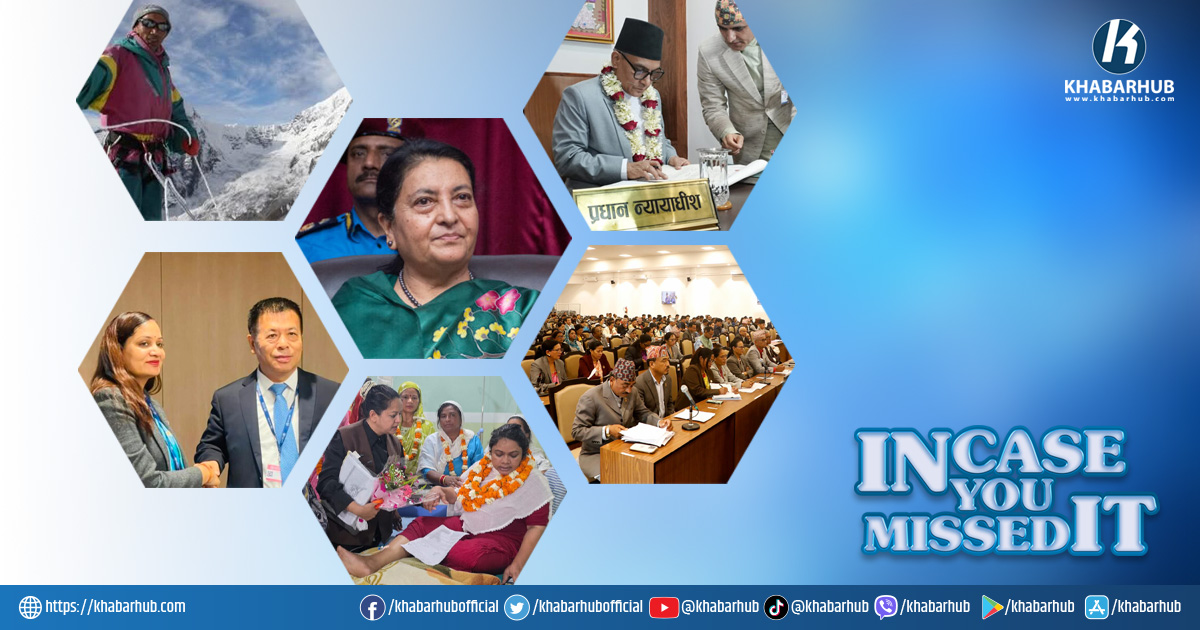
The appointment of Manoj Kumar Sharma as Chief Justice became one of the most symbolic developments of the week.
In an unusually rapid sequence of events completed within a single day, Sharma passed through parliamentary hearing, endorsement, presidential appointment, oath-taking and formal assumption of office. Constitutionally, the process followed all required procedures. Politically, however, it reopened a familiar debate regarding judicial independence and institutional legitimacy.
The opening of a liaison office by dissident Nepali Congress leaders in Anamnagar highlighted continuing factionalism inside Nepal’s oldest democratic party as well.
The controversy was not centered on Sharma’s qualifications but on the decision to bypass seniority. Acting Chief Justice Sapana Pradhan Malla, who had been serving in the role since March following the retirement of former Chief Justice Prakash Man Singh Raut, was overlooked despite being the senior-most justice in the Supreme Court.
Although Nepal’s constitution does not legally require that the senior-most justice become Chief Justice, seniority has historically functioned as an important informal norm designed to reduce perceptions of political interference in the judiciary. Whenever that convention is broken, questions naturally arise about political motivations behind judicial appointments.
Malla’s immediate decision to take a 20-day leave and her absence from Sharma’s oath-taking ceremony carried strong symbolic significance. It reflected dissatisfaction not only at an individual level but also broader discomfort within sections of the judiciary regarding how constitutional appointments are increasingly handled.
The speed of the appointment process itself also attracted attention. Supreme Court officials updated Sharma’s name and photograph on the court’s official website even before he formally arrived at the premises after taking the oath. The incident symbolized how Nepali institutions often emphasize procedural completion while deeper concerns regarding legitimacy remain unresolved.
Parliament Vs the Prime Minister
If the judiciary reflected institutional discomfort, Parliament reflected outright confrontation.
Prime Minister Balen Shah’s continued refusal to immediately appear before Parliament despite repeated requests from Speaker Dol Prasad Aryal became one of the defining political disputes of the week.
In parliamentary democracies, appearances before the legislature are not optional political gestures; they are central to democratic accountability. A Prime Minister derives authority not only from electoral success but also from regular accountability to Parliament.
However, Shah reportedly informed the Speaker that he would appear in Parliament only at an “appropriate time” after further consideration. The response intensified frustration among opposition lawmakers who have increasingly accused the Prime Minister of bypassing parliamentary norms.
The protests inside the House were notable not only because of the obstruction itself — something Nepal’s Parliament is familiar with — but because of the methods being used. Opposition lawmakers staged demonstrations with pamphlets and placards inside the federal parliament, something described as unprecedented in Nepal’s parliamentary history.
Initially driven mainly by the Shram Sanskriti Party led by Hark Raj Rai (Harka Sampang), the protests gradually drew support from larger opposition forces including the CPN-UML. This widening coalition of critics suggests that dissatisfaction with Shah is no longer limited to fringe political actors.
The Speaker’s unsuccessful attempt to personally persuade the Prime Minister to attend Parliament further highlighted growing tensions between the executive and legislature. The image of the Speaker returning “disappointed” after meeting the Prime Minister symbolized a deeper institutional imbalance emerging within Nepal’s parliamentary system.
The Rise of Executive-Style Politics
The confrontation between Parliament and Prime Minister Shah also reflects a larger transformation in Nepali politics.
Balen Shah rose to power as an outsider figure challenging traditional political culture. His leadership style has consistently emphasized executive independence, direct public appeal and skepticism toward established parliamentary practices.
Supporters see this approach as necessary disruption against an inefficient and discredited political class. Critics, however, argue that such politics risks weakening democratic institutions by concentrating legitimacy around personality-driven leadership rather than constitutional accountability.
This tension is increasingly becoming one of the defining political questions in Nepal: can anti-establishment leaders effectively govern within parliamentary systems without undermining the very institutions they claim to reform?
The answer remains uncertain. But the events of the week demonstrated that Nepal’s constitutional framework is facing growing pressure from leadership styles that prioritize executive autonomy over parliamentary engagement.
Rabi Lamichhane and Questions of Selective Justice
The Kaski District Court’s decision to allow the withdrawal of organized crime and money laundering charges against Rastriya Swatantra Party chairman Rabi Lamichhane added another controversial dimension to the week.
The decision means Lamichhane and other defendants in the Surya Darshan Cooperative case will now face only cooperative fraud charges.
Legally, the withdrawal followed a request from government prosecutors after revisions by the Office of the Attorney General. Politically, however, the decision immediately fueled suspicions regarding selective prosecution and negotiated justice.
High-profile political cases in Nepal often generate controversy not simply because of legal outcomes but because of widespread public distrust regarding institutional neutrality. Even when decisions may have legal justification, the perception of political convenience can significantly damage public confidence.
Lamichhane’s political identity as an anti-establishment figure makes the controversy even more complicated. His rise was built largely on public frustration toward traditional parties accused of corruption and misuse of state power. When anti-establishment leaders themselves become entangled in allegations and legal negotiations, voters increasingly begin questioning whether Nepal’s political culture changes systems or merely rotates personalities.
UML’s Internal Power Struggle Intensifies
While the government faced pressure from opposition forces, Nepal’s largest communist party appeared increasingly divided internally.
Reports that senior UML leaders Bishnu Prasad Paudel and Prithvi Subba Gurung openly challenged KP Sharma Oli’s leadership during an internal meeting were politically significant.
Both leaders had previously been considered close allies of Oli. Their criticism therefore reflects more than ordinary internal disagreement; it signals growing anxiety within the UML about the party’s future direction.
The debate appears closely linked to broader concerns regarding leadership centralization, generational transition and the party’s declining ability to adapt to changing political realities.
The re-emergence of former President Bidya Devi Bhandari has further complicated UML politics.
The party’s decision to restore her membership after previously blocking it marks a major shift. Bhandari’s gradual return to active politics suggests that alternative power centers are beginning to emerge inside the UML at a time when Oli’s leadership is facing increasing internal scrutiny.
Digitization may improve efficiency, but it cannot by itself resolve deeper issues of political trust, institutional culture or democratic accountability.
Bhandari carries symbolic political weight far beyond ordinary party competition. As Nepal’s former President and widow of Madan Bhandari, she represents continuity with one of UML’s most influential ideological legacies. Her return therefore has implications not only for internal factionalism but also for the party’s future succession politics.
Fragmentation Across the Political Spectrum
Political fragmentation was not limited to UML alone.
The opening of a liaison office by dissident Nepali Congress leaders in Anamnagar highlighted continuing factionalism inside Nepal’s oldest democratic party as well. Although the group publicly framed the initiative as an effort to promote party unity ahead of the 15th General Convention, the move clearly reflected internal dissatisfaction and preparations for future leadership battles.
Across Nepal’s major political parties, similar patterns are emerging: aging leadership structures, unresolved succession debates and increasing factional competition.
This fragmentation reflects a broader uncertainty within Nepal’s post-constitution political order. Traditional parties continue to dominate institutional politics but increasingly struggle to maintain ideological clarity, organizational discipline and public enthusiasm.
Governance Reforms Amid Political Turbulence
Despite political instability, the government continued introducing administrative reforms.
The Department of Immigration launched a “Digital Time Card” system aimed at improving transparency, tracking applications in real time and enhancing accountability in public service delivery.
Similarly, mountaineers Kami Rita Sherpa and Lhakpa Sherpa once again brought global attention to Nepal through historic Everest achievements.
Similarly, the Department of Transport Management suspended registration of new public transport vehicles nationwide, citing growing traffic management challenges.
These developments reflect Nepal’s continuing push toward digital governance and administrative modernization. However, they also highlight a recurring contradiction within the Nepali state: technical reforms often move forward even while broader political institutions remain deeply contested.
Digitization may improve efficiency, but it cannot by itself resolve deeper issues of political trust, institutional culture or democratic accountability.
Civil Society Still Matters
One of the most important non-party political developments of the week came through the 23-day hunger strike by rights activist Ruby Khan.
Khan ended her protest only after reaching a five-point agreement with the government regarding investigations into the alleged abduction and murder case of Nirmala Kurmi.
The episode highlighted both the weaknesses and strengths of Nepal’s democratic system. On one hand, the fact that prolonged hunger strikes remain necessary to secure state attention reflects continuing failures in the justice system. On the other hand, the government’s eventual engagement also demonstrates that civil society pressure still carries influence in Nepal’s political environment.
At a time when public distrust toward formal institutions is growing, grassroots activism increasingly functions as an alternative mechanism for accountability.
National Pride Beyond Politics
Amid political turbulence, Nepal also witnessed moments of national achievement.
The national cricket team concluded its ICC World Cup League-2 home series with a dominant victory over the United States, strengthening public optimism about Nepal’s growing international cricket profile.
The coming months will likely determine whether political leaders choose to strengthen institutional norms or continue exploiting institutional weaknesses for short-term advantage.
Similarly, mountaineers Kami Rita Sherpa and Lhakpa Sherpa once again brought global attention to Nepal through historic Everest achievements. Kami Rita climbed Everest for a record 32nd time, while Lhakpa Sherpa became the female climber with the highest number of Everest ascents with her 11th summit.
These moments offered rare examples of collective national pride during an otherwise politically tense week.
Yet even these achievements carry deeper meaning. Nepal’s global image is increasingly shaped by individual excellence — whether in mountaineering, sports or activism — rather than by institutional accomplishment. The contrast between individual resilience and institutional fragility remains one of the defining features of contemporary Nepal.
A Democracy Under Strain, But Still Functioning
Taken together, last week’s events revealed a democracy under visible strain but not yet in collapse.
Nepal’s institutions continue functioning procedurally. Courts make appointments. Parliament convenes. Political parties hold meetings. Ministries introduce reforms. Civil society remains active. Public debate remains vibrant.
Yet beneath this procedural continuity lies growing tension regarding legitimacy, accountability and institutional trust.
The deeper challenge facing Nepal today is not merely instability. Nepal has experienced political instability for decades. The more serious concern is the gradual weakening of confidence that institutions themselves operate impartially, transparently and predictably.
When senior judges feel bypassed, when prime ministers avoid Parliament, when legal charges appear politically negotiable and when party leadership struggles intensify, democratic fatigue inevitably deepens.
At the same time, Nepal’s democratic system has repeatedly shown resilience. Political conflicts remain largely constitutional rather than violent. Power struggles continue to unfold within institutional frameworks rather than outside them.
That resilience remains Nepal’s greatest democratic strength.
The coming months will likely determine whether political leaders choose to strengthen institutional norms or continue exploiting institutional weaknesses for short-term advantage. Last week’s developments were not isolated incidents. Together, they formed a revealing snapshot of a country struggling to move from procedural democracy toward deeper democratic accountability.




Comment