




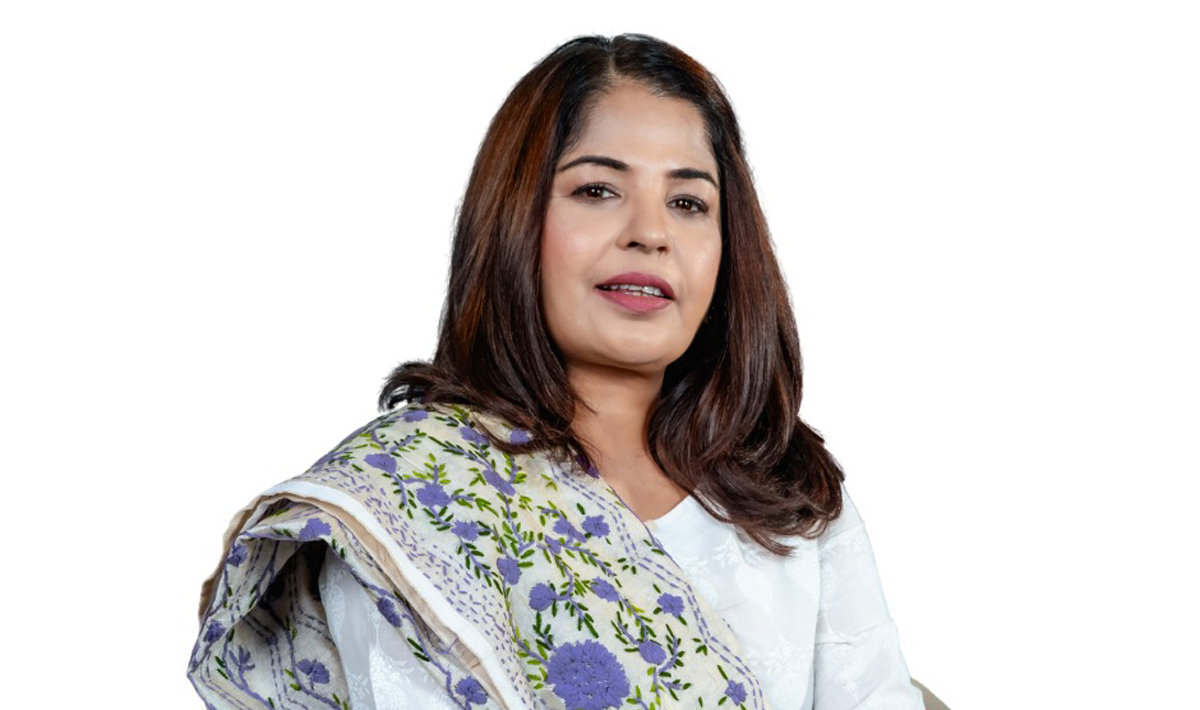
Lima Adhikari, the daughter of the late communist leader Bharat Mohan Adhikari, represents a new generation of politicians seeking to redefine Nepal’s political landscape. Once associated with the CPN-UML, a party her father helped shape, she chose to break away, arguing that it had drifted from its founding ideals of multiparty democracy. Today, she serves as treasurer of the Rastriya Swatantra Party (RSP), a rising force that has positioned itself as an alternative to Nepal’s established political order.
Adhikari attributes her political shift to what she describes as the resolve and pragmatism of RSP’s president, Rabi Lamichhane, and the willingness of the party’s leadership to challenge entrenched norms. In a recent interview, she outlined the party’s ambitions following its electoral success, including its plans to form a government led by Balendra Shah for a full five-year term. She also spoke of the party’s emphasis on women’s representation, its internal decision-making process, and its pledge to govern strictly in line with promises made to voters.
Framing the party’s approach as one rooted in accountability rather than retaliation, Adhikari said the RSP intends to distinguish itself through delivery. “We will not engage in revenge politics,” she said. “Our focus is on the welfare of the Nepali people and the country’s progress.”
Speaking to Khabarhub, Adhikari discusses the party’s governing strategy, cabinet formation, and what it sees as a decisive moment for Nepal’s experiment with alternative politics.
Excerpts:
RSP is forming a single-party government. How far along is the preparation?
We consider the election results a historic achievement in Nepal’s history. In 1959, the Nepali Congress secured 37.2% of the popular vote, winning 74 out of 109 seats. That led to a majority government. Although many elections have been held since, no party has achieved such a level of popular support or seat count.
This time, RSP secured 48% of the vote and 182 seats combining direct and proportional representation. This carries enormous responsibility. We will implement our pre-election pledges, citizen agreements, and past political commitments accordingly. The government, led by senior leader Balendra Shah, will work based on these commitments and agreements with the people.
We have clearly outlined in various documents why our political agenda and direction differ from others. The citizens have entrusted us with high expectations for the next five years. From economic prosperity to improving daily living standards, we are focused on tangible change. Youth employment is a priority. We are committed to breaking dependence on foreign countries for fuel.
Our aim is to move toward a self-reliant, productive economy. Challenges in energy, food, and other sectors must be addressed. For this, capable individuals are needed in ministries to deliver on our pledges and agreements. Citizens should feel relief and difference from this government, and we are deploying skilled and knowledgeable leaders to ministries accordingly. I can firmly say that the government will operate strictly in line with our pledges, citizen agreements, and reports.
Women’s participation in past cabinets has been inadequate. What will change now?
You are right. The constitution specifies 33% representation, and we plan to adhere to that in our cabinet appointments. Our party, as an alternative political force, will go beyond this minimum. We have capable female leaders ready to deliver, and citizens will notice the difference. Our president and top leaders are fully aware of this and will ensure it is implemented effectively.
Have senior leaders consulted female leaders on their roles?
We are just beginning that process. On March 26, newly elected MPs will take their oaths. Discussions between the president and senior leaders regarding female representation and potential appointees are ongoing. The secretariat and central committee will ultimately make decisions. Leaders are positive about appointing women based on expertise and capability.
Have discussions about potential cabinet members gone beyond four senior leaders?
No, we are still in the preliminary stage. Leaders are reviewing and consulting internally. Once the initial framework is ready, it will be shared with other leaders as well.
What other criteria guide cabinet appointments?
The deputy chairs, senior leaders, and president have assessed our MPs’ roles and competencies. We decide who goes to the government, who joins parliamentary committees, and who focuses on party-building. We also consider strengthening the party ahead of next year’s local elections. Our goal is to ensure cabinet members’ preparedness does not affect government performance. Leaders are evaluating all 182 MPs’ past and present performance to guarantee timely results.
Will Balendra Shah serve as Prime Minister for the full five-year term?
There is no question about that. Senior leader Balendra Shah is the party’s choice for Prime Minister. We will proceed according to our commitments to the people. We will not waver in our decisions because we have made pledges to citizens.
There has been no discussion of a second phase involving Rabi Lamichhane. Shah is the sole choice for now. Our leadership has agreed that the party will be managed by President Lamichhane, while the government will be led by Shah, with no interference or disputes.
In the past, intra-party power struggles occurred after coming to government. Why will RSP avoid that?
That will never happen. We are in a positive, work-focused mindset. We are not moving ahead with speculation or political drama. Nepalese citizens have given us enormous support and energy. We will work with citizens at the center, with no distractions over power.
Our first party convention will take place as scheduled. Government leaders run the government; party leaders strengthen the organization. We are building local-level committees, preparing for upcoming elections, and ensuring that government delivery translates into electoral success. Citizens will feel the difference within 100 days, and I can say that with confidence.
How will RSP proceed on provincial structure reforms?
Our pledges state that within 100 days, we will seek national consensus for provincial reforms. We will initiate discussions and reviews on constitutional amendments and proposals. We will prioritize directly elected executives, fully proportional representation, non-partisan local governments, and a reformed provincial structure as part of our primary agenda.





Comment