




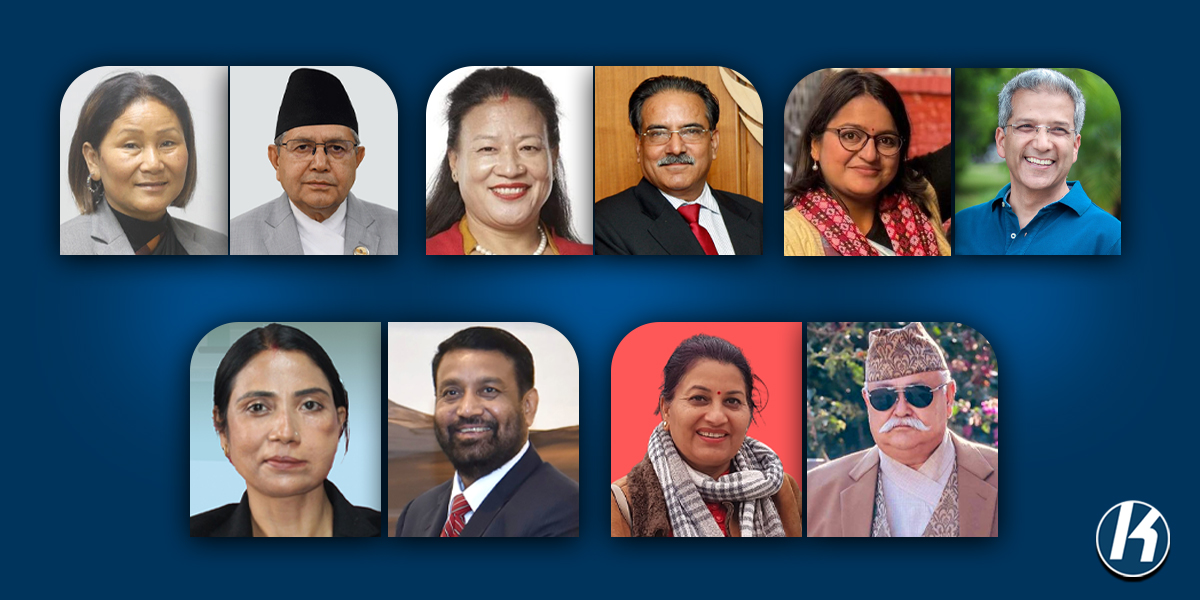
KATHMANDU: Despite constitutional guarantees of inclusion, women remain significantly underrepresented in direct electoral contests. Out of more than 3,400 candidates vying for House of Representatives (HoR) seats this election, only 388 are women.
Yet in several key constituencies, female candidates are stepping into high-stakes races, directly challenging powerful and long-established political figures.
The Constitution guarantees at least one-third (33 percent) representation for women in Parliament. However, as in previous elections, this constitutional provision has not been implemented in practice.
Statistics show that political parties, both large and small, remain reluctant to field women as direct candidates. As a result, criticism continues to mount that parties confine women to proportional representation lists rather than encouraging them to compete directly.
Nevertheless, a few determined women have stepped into direct electoral contests. The presence of women who have established strong leadership credentials and are challenging long-standing male power centers sends a powerful message: meaningful participation of women in Nepali politics is still possible.
Former Speaker–former Deputy Speaker face off (Jhapa-2)
Devraj Ghimire, who joined the communist movement during the 2027–30 BS Jhapa rebellion and later became Speaker of the House of Representatives (HoR), is being challenged in Jhapa-2 by social worker and former Deputy Speaker Indira Rana Magar.
Ghimire, a leader of the CPN-UML, won this constituency in 2022 with 28,697 votes. This time, he faces Rana, a leader of the Rastriya Swatantra Party (RSP), who entered Parliament through proportional representation in the previous election.
The contest has drawn particular attention as Ghimire and Rana previously worked together for three years as Speaker and Deputy Speaker. Rana has said she chose Jhapa-2 out of enthusiasm for direct competition. Although this is her first time contesting a direct election, her decision to challenge a strong incumbent in a difficult constituency has made Jhapa-2 a focal point of national interest.
Rana also faces competition from RPP candidate Bhadra Prasad (Swagat) Nepal, who secured second place in the last election with 26,455 votes.
If Rana succeeds in this constituency, her victory could inspire leaders, especially women, who have so far relied on proportional representation to raise their voices through direct electoral competition. Jhapa-2 has a total of 147,522 voters, including 13,431 new voters.
Kusum challenges Prachanda in Rukum East
Rukum East is the only district with a single House of Representatives constituency. Pushpa Kamal Dahal ‘Prachanda’, coordinator of the Nepali Communist Party (NCP), has entered this Maoist stronghold in search of what is widely considered a “safe seat.” Dahal has served as Prime Minister three times since emerging from the 10-year People’s War.
Challenging him is Kusum Thapa Magar of the Nepali Communist Party. Thapa, who was elected to Parliament through proportional representation from the Indigenous Nationalities cluster in the last election, now faces Prachanda in a direct contest.
In the 2022 House of Representatives election, Purna Bahadur Gharti Magar of the Maoist Centre won Rukum East with 12,262 votes under an alliance with the Nepali Congress and the CPN-UML. His closest rival, Kailash Kumar Malla of the CPN-UML, received 5,211 votes, while independent candidate Chandraraj Jhakri came third with 896 votes. This time, no alliance is in place. Rukum East has 34,112 registered voters, including 594 new voters.
Ranju–Rabindra in a test of strength (Kathmandu-1)
Another closely watched constituency is Kathmandu-1, where an intriguing contest has emerged between former leaders of the Bibeksheel Sajha Party. In this constituency, former Bibeksheel Sajha leader Ranju Darshana is competing against the party’s former President, Rabindra Mishra.
Ranju, who entered Parliament through proportional representation in the past, has stepped into direct electoral competition this time from Kathmandu-1 as a candidate of the Rastriya Swatantra Party (RSP). Mishra, contesting from the same constituency for the third time, is running as a candidate of the Rastriya Prajatantra Party (RPP). However, voters in this constituency have rejected Mishra in the last two elections.
Kathmandu-1 has long been considered the stronghold of Prakash Man Singh, son of late Nepali Congress leader Ganesh Man Singh. However, Nepali Congress President Gagan Thapa has not awarded a ticket to Prakashman this time. Instead, the party has fielded Prabal Thapa as its candidate.
Ranju’s entry into what has traditionally been a Congress-influenced constituency is expected to complicate Mishra’s prospects, particularly as he seeks to revive the narrative of alternative politics. Mishra previously contested from Bibeksheel Sajha in 2074 BS and from RPP in 2079 BS (2022).
A well-known media personality, Mishra entered politics with a strong public image. In the 2074 BS election, he received 10,118 votes, narrowly losing to Prakash Man Singh, who secured 10,936 votes. Similarly, in the 2079 BS election, Mishra was defeated by a slim margin of 125 votes, receiving 7,018 votes against Singh’s 7,143.
On March 5, Ranju will directly challenge her former colleague Mishra, who narrowly missed victory in the previous election. Nepali Congress candidate Prabal Thapa is also under pressure to uphold the party’s legacy in the constituency. UML’s Mohanraj Regmi, CPN’s Menuka Bhandari, and candidates from several new parties are also contesting in Kathmandu-1.
Will Juli defeat Bimalendra? (Dhanusha-3)
Juli Mahato of the CPN-UML has entered the electoral race in Dhanusha-3, where her principal rival is Nepali Congress (NC) leader Bimalendra Nidhi. Nidhi, the son of senior Nepali Congress leader Mahendra Narayan Nidhi, has served as Vice President of the Nepali Congress and Deputy Prime Minister.
Mahato is a central committee member of the UML and a former Minister for Women, Children, and Senior Citizens. Both candidates are seasoned politicians with significant electoral experience. Mahato, who entered Parliament through proportional representation in 2064 BS, won the 2079 BS election by defeating RJP candidate Anil Jha with 33,388 votes.
However, in the same constituency in 2079 BS, Mahato was directly defeated by Nidhi. Nidhi, who has deep roots in the constituency, has once again received the Congress ticket despite internal party opposition. Along with Nidhi, Mahato faces competition from more than 45 candidates, including Parmeshwar Sah Sudi of the Janata Samajwadi Party and Manish Jha of the Rastriya Swatantra Party.
Dina–Deepak: Who will win? (Makawanpur-1)
Mahalaxmi Upadhyaya ‘Dina’ of the Nepali Congress is contesting from Makawanpur-1. Active in electoral politics since 2048 BS, Dina is a senior leader and former central committee member of the Congress. Despite losing in previous direct elections, she has once again entered the race with hopes of securing victory.
Her main rival is former RPP Member of Parliament Dipak Bahadur Singh. Singh won the last election from Makawanpur-1 with 27,816 votes and enjoys strong local influence. Following the 2079 BS election, he served as Minister of State for Water Resources and Chairman of the Infrastructure Development Committee.
In the previous election, Singh defeated coalition candidate Dina by a margin of 2,382 votes. To win this time, Dina must overcome Singh as well as veteran UML leader Rameshwar Rana. Rana had received a UML ticket in 2079 BS but was unable to contest after party chairman KP Sharma Oli replaced him at the last moment with RPP Nepal leader Kamal Thapa, who eventually finished third.
Makawanpur-1 had been a UML stronghold prior to 2079 BS. In this election, Dina faces stiff competition from Rana, Singh, Prakash Gautam of the Rastriya Swatantra Party, and Tej Prasad Upreti of the Pragatisheel Loktantrik Party.


Comment